




When Will We See DME-Powered Trucks?
Although interest in alternative fuels has cooled down a bit as diesel prices have dropped, supporters of dimethyl ether, or DME, still believe the alternative fuel has a bright future.

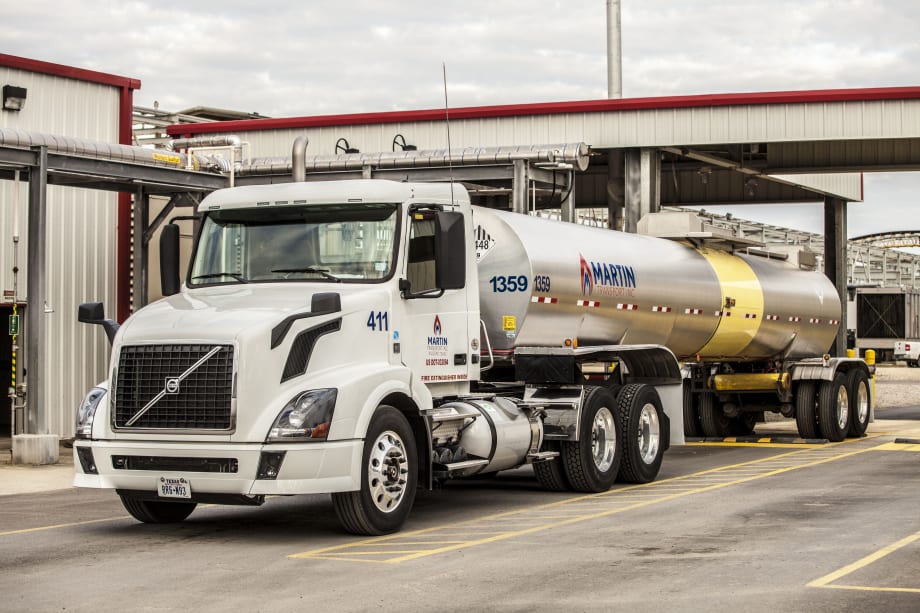
Martin Energy truck powered by DME in pilot program.
Martin Energy truck powered by DME in pilot program.
Although interest in alternative fuels has cooled down a bit as diesel prices have dropped, supporters of dimethyl ether, or DME, still believe the alternative fuel has a bright future.
DME is a methane-based fuel that burns clean and can be derived from a variety of sources, from natural gas to agricultural waste products. It functions similarly to propane for engine conversion and storage purposes, but delivers a similar power performance to diesel.
Volvo Trucks North America so far has been the biggest supporter of the fuel in the U.S., developing DME for commercial use with Oberon Fuels and working to build infrastructure and engines to take advantage of the fuel.
However, last fall it announced it would no longer project a date for commercial availability, citing a slowdown in the pace of the North American alternative fuel market.
Volvo said it would continue to field-test its DME powered vehicles, but the company decided not to set a date for commercialization "as it monitors market and stakeholder interest in the fuel."
Volvo has been conducting a pilot program with Martin Energy Services and Oberon Fuels to bring the fuel to the commercial vehicle industry.
Ironing out the bugs
At the Mid-America Trucking Show, a DME-powered truck was lacking from the Volvo booth. When asked about it by reporters at a press conference, Frank Bio, Volvo Trucks director of sales development, specialty vehicles and alternative fuels, said the DME project was "still alive. We're still actively working with the State of California and also internally still developing DME," he explained.
"The reason we took the introduction date off the table was that we recognized we still had some challenges with distribution and some technical things, that can be solved very easily."
In an interview with Truckinginfo last fall, we asked Elliot Hicks, co-founder of Oberon Fuels, about the pilot program. "Volvo had done all of their development work on DME in Sweden. When they brought over trucks to work with Martin, it was the first time they converted to a North American duty cycle and set up of the truck.
"Naturally with any switchover there are issues to iron out, so it’s been very valuable in that it was the first effort to get the trucks over to North America and get them converted," he continued.
"Overall, it’s been very successful in that we’ve been getting good mileage out of the trucks and the drivers have been very happy with the performance of the trucks. The fuel that we’ve been producing has worked well with the vehicles.
"We have a couple of years before commercialization is finalized, but at this stage we’re quite happy with the performance of the tests," he added.
Long-term play
In an interview at MATS with Truckinginfo, Oberon president Rebecca Boudreaux called DME "a long-term play."
The advantage of DME, she explained, is its simplicity. It's one simple molecule and it can be made from a variety of sources. Unlike natural gas, it does not need to be put under very high pressure or cryogenic storage for use on a vehicle. And, she said, it's "true compression ignition," not needing spark plugs or piloting with diesel fuel as some natural gas engines require. That means less costly vehicles and fueling infrastructure.
She echoed Volvo's Bio, noting that "from an infrastructure standpoint, we want more companies doing it," saying, "we are continuing to make steady progress as well as on technical issues."
"In the last six months we have seen a surge in OEM interest," Boudreaux said. Achates Power, which is developing an opposed-piston engine, is testing it with DME. Oberon hopes to have another announcement soon on a deal with another OEM.
"We need multiple players on the engine side and multiple players on the infrastructure side," she said.
Approvals
Meanwhile, Boudreaux said recent approvals of DME as a vehicle fuel from the Environmental Protection Agency and California officials "are a key step in increasing confidence among distributors, engine manufacturers and fleet owners that DME is ready for commercial markets."
Late last summer, the EPA approved Oberon Fuel’s biogas-based dimethyl ether as meeting the agency’s Renewable Fuel Standard, helping clear the way for it to be an alternative fuel for trucking.
The agency determined that biogas-based DME produced from the Oberon process resulted in an approximate 68% reduction in greenhouse gases when compared to baseline diesel fuel, according to the company.
In February, California officially approved DME for use as a vehicle fuel.
Boudreaux predicts we will see DME trucks in significant volume within the next three years. California's more stringent emissions standards and low-carbon fuel requirements may help pave the way. "Gov. Brown has been very vocal about reducing dependence on petroleum," she said.
Despite the lack of a Volvo DME truck on display at the show, Volvo Group chief Olof Persson, in remarks to a supplier audience at MATS, said that although Volvo sees natural gas fuel as “continuing to play a role in some segments of this market – particularly in certain vocational applications and shorter, regional haul … when it comes to other segments, particularly longer hauls, we continue to believe DME shows tremendous promise.”
That’s because the conversion of natural gas into DME can “address many of the distribution, storage, and fueling challenges otherwise presented by natural gas – particularly liquefied natural gas – as a heavy truck fuel. If the industry were able to get the critical mass of production volume we need, DME could really be a game-changer.”
More Fuel Smarts

How Volvo Updated Its D13 for EPA 2027 [Watch]
Volvo’s updated D13 promises lower emissions without sacrificing performance or fuel economy. Take a closer look at what changed inside the engine in this HDT Spotlight video.
Read More →
Diesel Price Spike Shortens Payback for Natural Gas Trucks, Report Says
Energy Vision estimates fleets could recover the higher purchase price of an RNG-fueled Class 8 tractor in 1.3 to 2.8 years under current fuel-price scenarios.
Read More →
Calstart Becomes Catalyst Mobility, Reflecting Broader Focus
Calstart is now Catalyst Mobility, reflecting the nonprofit’s growing national role in clean transportation, including zero-emission trucks, infrastructure and incentive programs.
Read More →

Record Diesel Prices Squeeze Trucking Fleets
Average U.S. diesel prices have climbed to nearly $6 a gallon, surpassing the 2022 record as tight refinery capacity and Middle East disruptions keep fuel costs elevated.
Read More →
How Fuel Delivery Shapes Engine Performance
Fuel delivery depends on more than what happens at the injector. For fleet, maintenance and technical professionals, looking at the full path from pump to injector can provide useful context for understanding engine performance.
Read More →
East Coast Port Launches $45M Electric Truck Push
The Port Authority of New York and New Jersey announced millions in incentives for zero-emission drayage trucks, yard tractors, and new charging hubs near the port.
Read More →
California Bill Could Shed Light on Electric Truck Prices
Why do battery-electric Class 8 trucks remain so expensive? A California bill headed to Gov. Gavin Newsom would give fleets and state agencies more visibility into what manufacturers charge.
Read More →
Detroit Opens Orders for EPA 2027 Engines
Detroit isn’t starting from scratch to meet EPA 2027 diesel emissions standards. Its Gen 6 DD13 and DD15 engines keep much of today’s platform while updating the fuel and aftertreatment systems.
Read More →
Zero-Emission Truck Corridor Planned for West Coast
California, Oregon, Washington, British Columbia and Baja California are coordinating plans for truck charging and hydrogen fueling from Canada to Mexico.
Read More →
A Closer Look at Kenworth’s Electric T880E Vocational Truck [Video]
Learn more about Kenworth's T880E battery-electric vocational truck at the Paccar Technical Center, including its range, applications, upfitting considerations, and PTO options, in this HDT Spotlight video.
Read More →