




What You Need to Know About Wide-base Singles & Offset Axles
Everything you need to know about switching from dual wheels to wide-base singles you can learn at a playground. Picture a teeter-totter with a big kid on one end and a little kid on the other. The big kid is on the ground, while the little guy's legs are dangling in the air. The load is unevenly distributed. If you moved the fulcrum closer to the big kid, the beam would eventually balance.

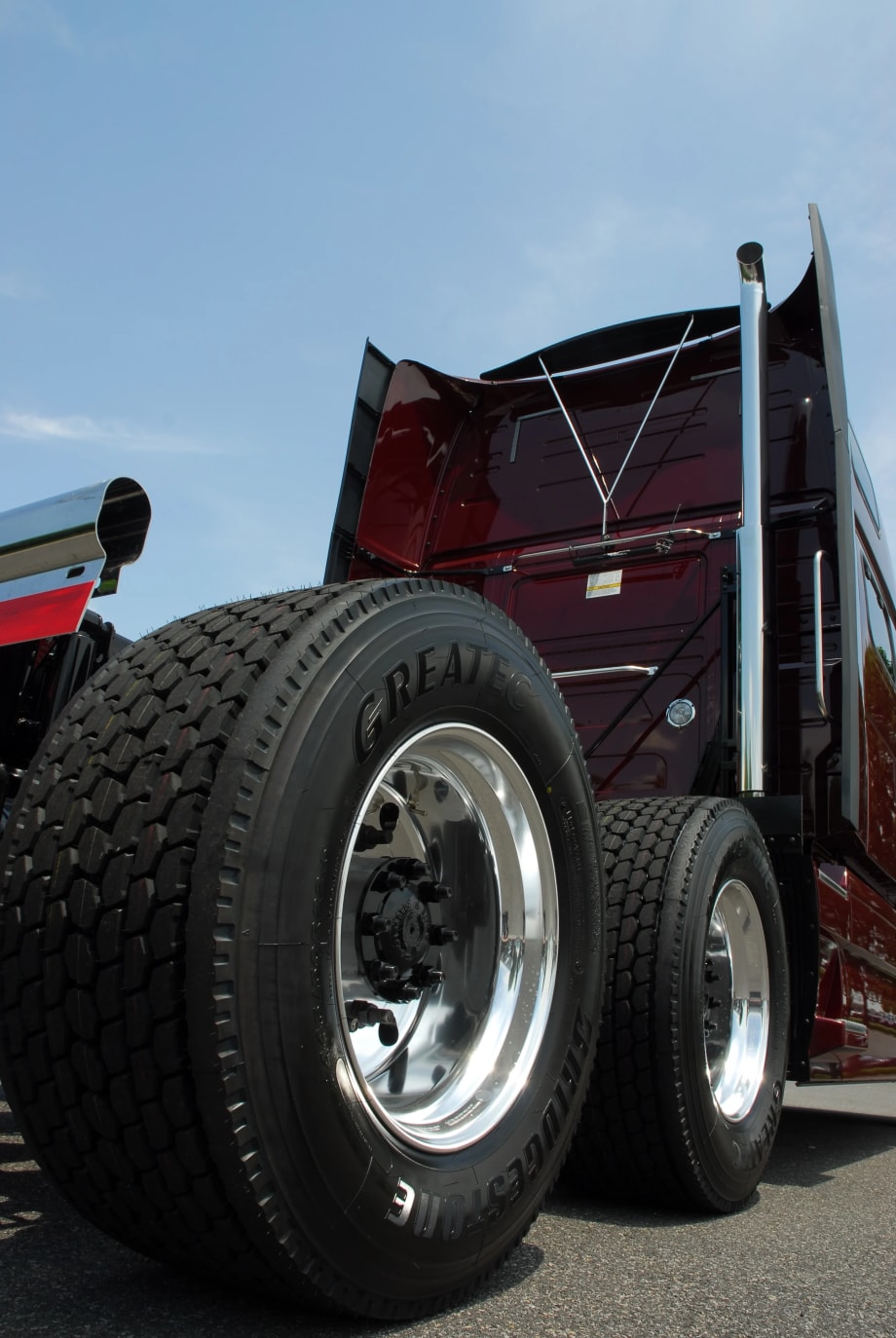
Wide-base single tires are popular for weight and fuel saving, but not everybody likes them. Spec'ing to revert back to dual tires at resale needs special consideration.
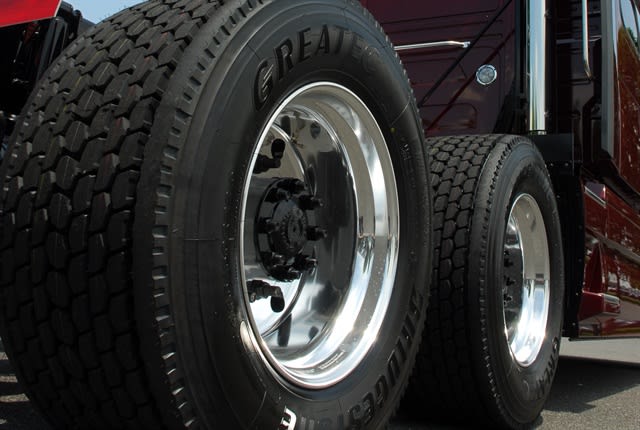
Wide-base single tires are popular for weight and fuel saving, but not everybody likes them. Spec'ing to revert back to dual tires at resale needs special consideration.
Everything you need to know about switching from dual wheels to wide-base singles you can learn at a playground.
Picture a teeter-totter with a big kid on one end and a little kid on the other. The big kid is on the ground, while the little guy's legs are dangling in the air. The load is unevenly distributed. If you moved the fulcrum closer to the big kid, the beam would eventually balance.
With the tapered “R” spindle axles used on tractors, there are two bearings on the axle spindle; the inner bearing is larger than the outer bearing. By installing a wheel with a 2-inch outset — a common practice when switching from dual tires to wide-singles to maintain a suitable track width — you shift a larger portion of the load to the smaller outer bearing. That's why we hear of wheel-end and bearing failures resulting from the use of offset wheels when switching from dual tires to wide-base single tires.
It's important to note that those failures are not universal. Nor are the tires, the wheels or the hubs singularly to blame. More often, it's a combination of factors, including a lack of understanding of the impact of the switch, incorrect components, lack of engineering oversight and poor maintenance practices.
One fleet's experience
In fact, some fleets have seen remarkable success using wide-single tires with 2-inch offset wheels. Con-way Truckload is one of them.
Con-way Truckload's former vice president of maintenance and asset management, Bruce Stockton, now an independent maintenance consultant operating as Stockton Solutions, heeded the warnings about wheel bearing problems and managed to get 10 years or more out of trailer axles using the 2-inch offset wheels.
“Back then we were retrofitting 10-year-old trailers with half a million miles on them, and they are still running today with the 2-inch off-set wheels,” Stockton says. “It's not a problem when it's done right.”
One key to Con-way's success was that Stockton was retrofitting trailers, not drive axles.
Trailers usually use parallel or “P” spindles, which use the same size bearing at the inner and outer position. The larger outer bearing on a “P” spindle is more robust and better able to manage the increased load caused by shifting the load line outward through the use of the 2-inch offset wheel.
In other words, there may be more factors at play in certain situations than meets the eye.
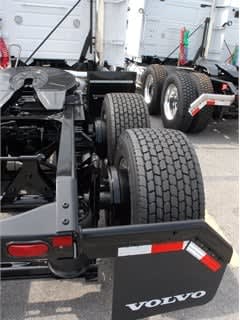
Standard-track axles with 2-inch offset wheels leave much of the brake drum exposed.
Concerns about outsetting
In January 2010, Meritor went on record saying the company would no longer approve applications with wide-base single tires and 2-inch outset wheels on tapered-spindle drive axles with standard-width housings. Nor will Meritor approve aftermarket vehicle modifications to install wide-base single tires and 2-inch outset wheels.
“In in-service fleet analysis and computer modeling, we found the service life of the outer bearing on tapered spindles could be compromised by the additional loads imposed on the outer bearings by the 2-inch outset wheels,” says Charlie Allen, Meritor's general manager for North American technical service.
In 2011, Meritor published a white paper, “Understanding the Impact of Wide-Base Single Tires on Axle and Wheel-end Systems,” which outlined the engineering concerns involved with 2-inch outset wheels and the tapered “R” spindle.
In the paper, Meritor explains that the load line position on the bearings, particularly the outer bearing, depends on several factors, all of which vary: the cup-to-hub-flange dimension, the offset of the wheel, the thickness of the wheel (steel vs. aluminum) and the thickness of the brake drum flange. Combined, these can push the load line outboard beyond acceptable limits.
Dana, on the other hand, says in an axle and driveline service bulletin, ABIB-0511R2, that 2-inch outset wheels are approved on its DS404, DST40, DSP40, & D40-145 (Pro40) axles, provided the tire track width, as measured from center to center of the tires, does not exceed 73.3 inches.
Not a universal problem
“There are a lot of wheel-end variables to consider,” says Steve Slesin-ski, director of global product planning at Dana Holding Corp. Commercial Vehicle Products. “It's not a case of'here's the axle, here's the problem.’ Industry people tell me there are issues with poor quality wheel bearings, maybe some poor maintenance practices and concerns about various other components at the wheel end. And oh, by the way, some of those trucks also happen to run wide-base tires.”
Slesinski says many of his customers continue to report positive results with the 2-inch outset wheels.
“There are so many variables here that I can't point to a single issue that is a consistent source of problems,” he notes.
Maintenance has to be seen as a key factor in getting the most out of a system using standard-width axles and 2-inch outset wheels, but it's worth noting that even well-run maintenance shops like those of Ryder System have seen early bearing failures with such setups.
“We have experienced early bearing failure in some applications using the wide-base tires with standard axles,” says Scott Perry, Ryder's vice president of supply management. “We also have seen accelerated wear of wide-base products, especially when the tractor-trailer is used in a heavy outbound/ light or empty return duty cycle.”
Perry says it's standard practice at Ryder when ordering new vehicles with wide-base tires to use wide-track axles, but they have done some conversions.
“In some instances we have allowed for the conversion of an in-use tractor to wide-base tires using a standard axle under very specific conditions,” he notes.
Meritor's Allen stresses that you can't just slap a set of wide-single tires on a truck like you did with the mag wheels you bought at Pep Boys for your ‘72 Camaro. There's more here to worry about than the bolt pattern.
“When you increase the offset, you extend the load line outward, and that applies excessive load to the outer bearing,” Allen says. “We have tracked bearing life relative to load and adjustment, and we see degradation in both cases on the order of 60% to 80% in severe circumstances.”
It would take far too much space to describe all the possible damage conditions, but much grief can be avoided by following the manufacturer's recommendations — especially for bearing selection and adjustment.
“The standard 0.005 end play adjustment is really the outer limit in my mind,” Allen says. “You shouldn't ever be outside that. The closer you are to 0.001/0.002 the better. If you can't get the adjustment down that fine, then using a preset hub may be the best option in assuring longer bearing life.”
Wide-base single tires certainly offer some compelling advantages too great to ignore in many applications. Lingering doubts about the acceptance of the tires leave many fleets reluctant to commit to wide-track axles. The offset wheel offers an alternative, but perhaps the intermediate track axle is worth considering. That uses a shorter outset, and is reportedly easier on the wheel bearings.
In any case, don't simply assume because Fleet A gets away with using 2-inch outset wheels that your fleet can, too. There are just too many variables. Always consult the OEM before making substantial changes to the vehicle.
Are wide-base singles in your future?
The benefits of wide-base single tires are obvious, though not everyone is wild about them. If you want the flexibility to switch from duals to wide-singles or back again, following are a few factors to consider.
New equipment
Rule number 1: Consult the OEM before finalizing the spec. Explain what you want to do.The OE probably has a solution. Not all wheel-ends and/or axle/suspension configurations are approved for use with 2-inch offset wheels.
Meritor, for example, does not support the use of 2-inch offset wheels with tapered “R” spindle axles.
Dana, meanwhile, continues to support the use of 2-inch outset wheels under certain circumstances.
The solution may be an intermediate track-width axle such as Dana's SelectTrack or Meritor's DualTrac products with 0- or 0.56-inch offset wheels.
In-service trucks
Before modifying existing equipment, consult the OEM. In addition to gaining engineering approval, you also have to account for in-service vehicle condition as well as possible past maintenance or repair indiscretions.
During previous wheel-end service, ensure that you have not mixed cups and cones from different bearing manufacturers, and that the bearings and seals are the recommended OE replacement parts or better.
When extending outward the load line on the bearings, you place a greater load on that outer bearing. Make sure it's up to the task. Not all wheel-end components are created equal. Brake drum flange thickness and the flange thickness of the replacement wheels will add to the outward push of the load line.
Finally, make sure your maintenance procedures and standards are up to the task. Wheel bearing adjustments are critical, and must follow OEM's published procedures for the specific wheel-end system in use. Adhere to OEM component suppliers and commercial vehicle industry published maintenance and inspection procedures such asTMC's Recommended Practice RP-618A “Wheel Bearing Adjustment Procedures” and RP-644 “Wheel End Conditions Analysis Guide.”
More Equipment

How Volvo Updated Its D13 for EPA 2027 [Watch]
Volvo’s updated D13 promises lower emissions without sacrificing performance or fuel economy. Take a closer look at what changed inside the engine in this HDT Spotlight video.
Read More →
Michelin Tire Improves Efficiency and Durability for Regional Fleets
The Michelin X Multi Energy D2 is a regional haul drive tire engineered to help fleets improve fuel efficiency, durability and traction in demanding stop-and-go operations.
Read More →
ZF Expands Commercial Vehicle Push in North America
ZF is expanding its North American commercial-vehicle presence with new transmission applications, electrification, trailer technology and autonomous-driving systems.
Read More →
Tesla Wants a Self-Driving Semi. Are Cameras Enough?
Could Tesla’s camera-only autonomous driving technology work on an 80,000-pound Semi? In this commentary, HDT's Deborah Lockridge takes a look at Tesla, Cybercab, and how autonomous trucks see the road.
Read More →
Kodiak: Driverless Long-Haul Truck Launch on Track for 2026
Kodiak AI says its driverless long-haul safety case is 93% complete and it remains on track to begin commercial operations by year-end 2026.
Read More →
What DOT’s Automated Vehicle Strategy Means for Trucking
The U.S. Department of Transportation issued a new automated-vehicle strategy that outlines plans for driverless-truck regulations, cross-state freight corridors, and federal safety standards.
Read More →
East Coast Port Launches $45M Electric Truck Push
The Port Authority of New York and New Jersey announced millions in incentives for zero-emission drayage trucks, yard tractors, and new charging hubs near the port.
Read More →
PlusAI Going Public to Fund Autonomous Truck Launch
A SPAC deal could provide PlusAI with up to $300 million as it works toward a 2027 commercial launch of factory-built autonomous trucks.
Read More →
NHTSA Moves to Rewrite Truck Fuel-Economy Rules
The National Highway Traffic Safety Administration says it lacks authority to regulate medium- and heavy-duty truck engines separately from complete vehicles, but the existing standards have not yet been eliminated.
Read More →
Detroit Opens Orders for EPA 2027 Engines
Detroit isn’t starting from scratch to meet EPA 2027 diesel emissions standards. Its Gen 6 DD13 and DD15 engines keep much of today’s platform while updating the fuel and aftertreatment systems.
Read More →