




What Truck Drivers Need to Know About Safe Winter Operation
Winter operations brings trucking additional risks, with snow, black ice and other dangers. Driver training can help reduce the chances of injuries from crashes or from slips and falls.
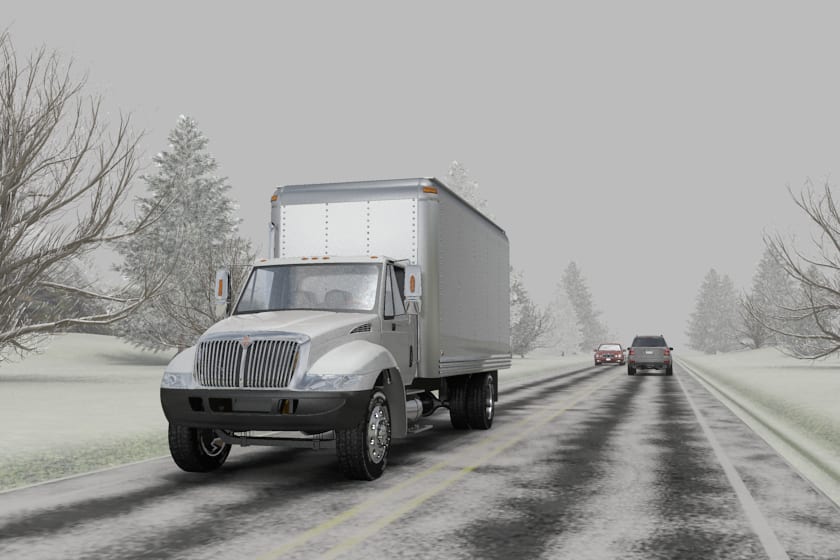
When driving on snowy or icy roads, it can take up to 10 times longer to stop.
Illustration: ITI
Winter operations bring a higher likelihood of truck drivers facing slippery surfaces and poor visibility, increasing the risk of crashes. Are your drivers prepared for bad weather?
The shipping and transportation industry ranks just behind first responders for the highest number of injuries that cause time away from work, according to the National Safety Council. And according to the Bureau of Labor Statistics, the average cost to the employer for those injuries is $40,000.
Winter operations bring additional risks, with snow, black ice and other dangers. Driver training can help reduce the chances of injuries from crashes or from slips and falls.
First, see how much you already know with the following winter-driving safety quiz:
1. True or False: Reducing the air pressure in your tires improves traction.
A: False: Reducing air pressure doesn’t improve traction. It reduces steering ability and can cause a blowout if the tire overheats.
2. Which of these two common incidents is more likely to happen: A vehicle collision or an out-of-vehicle slip and fall?
A: Slips and falls are the No. 1 cause of driver injuries, and 22% of those injuries are serious enough that drivers miss 30 or more days of work.
3. Which weather condition causes more crashes — rain or snow?
A: Actually, rainy weather conditions cause five times more accidents than snowy conditions.

Bridges and overpasses can ice before roads.
Illustration: ITI
4. Which is the most common reason a truck will go into a skid: driving too fast, excessive breaking/decelerating too quickly for the conditions, over-steering, or over-acceleration?
A: Going too fast. Driving fast is easy. It is stopping that’s a challenge.
5. When driving on a wet road, drivers should: reduce speed by 10, 25 or 30%?
A: Reduce speed by 25%. For example, if you’d drive 55 mph in ideal conditions, reduce speed to 40 mph when the road is wet.
6. In winter, drivers should never let their fuel tank get below: 10%, 25% or 30%?
A: 25%. There are two reasons to keep your truck at least 25% full. First, a full tank reduces condensation that can plug up your fuel line. Second, if road conditions take a turn for the worse, you’ll be glad to have more fuel than you thought you’d need.
7. On what day of the week are drivers most likely to get into a deadly collision?
A: Saturday is the most common day for fatal collisions in winter, and the odds spike during winter holidays. During the week, Friday is the most dangerous day.
8. When driving on snowy or icy roads, it can take up to 5, 10 or 20 times longer to stop?
A: 10 times longer. Increase your following distance accordingly.
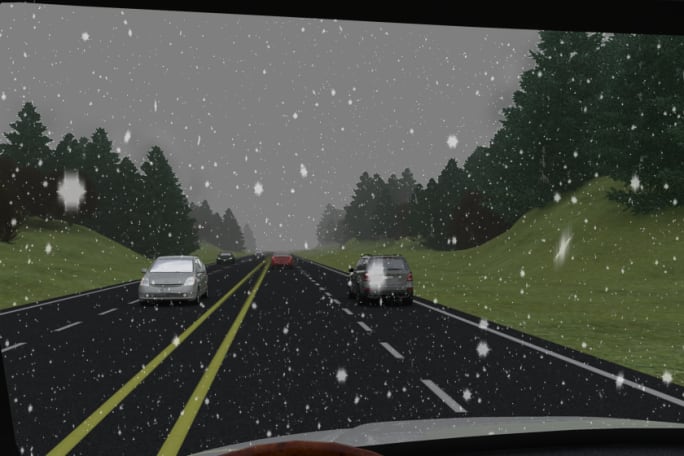
Snow not only can make roads slippery, but also lessen visibility.
Illustration: ITI
9. In snowy weather, what should drivers do every time they pull over: Check weather conditions, check headlights, check reflectors or all of the above?
A: All of the above. Weather conditions can change throughout the day, so check each time you stop for fuel or a rest break. Clear accumulated snow, ice or road grime off your lights and reflectors. This helps you see better and increases the chance other drivers will see you. Keeping your lights and reflectors clean can also help you avoid getting pulled over. Observable defects are the primary reason for DOT inspections. The weather will already be slowing you down, and a traffic stop will only put you farther behind. Experienced drivers often carry spare bulbs and fuses, as well.
10. What should drivers do if they start to skid? Brake lightly and steer in the opposite direction of the skid? Ease off the accelerator, steer toward a reference point and into the skid? Or, honk your horn to alert others and steer away from oncoming traffic?
A: Ease off the accelerator, steer toward a reference point and into the skid. If your vehicle has a manual transmission, you should also slowly depress the clutch pedal while you ease off the accelerator.
Now that you realize you may not know as much as you thought you did about winter driving safety, let’s explore some tips.
Remember to follow these general safe winter driving tips:
Go slowly and increase following distance.
Be gentle with acceleration and braking.
Plan routes to avoid hills when possible.
Carry and use chains in states that require them (and practice putting them on before the flakes begin to fall).
Wear boots appropriate for winter weather.
Keep survival supplies in the vehicle in case it gets stuck.
Ensure that you have the proper emergency supplies before you begin your trip:
Anti-gel fuel additive for diesel engines
Extra headlight bulbs and fuses
Safety flares or reflective triangles
Tire chains
Wiper blades and antifreeze wiper fluid
Ensure that you have the following personal survival gear:
Food and water
Cell phone with fully charged battery and a cell phone charger
Sturdy boots
Hat and gloves
Headlamp or flashlight
Medicine, if needed
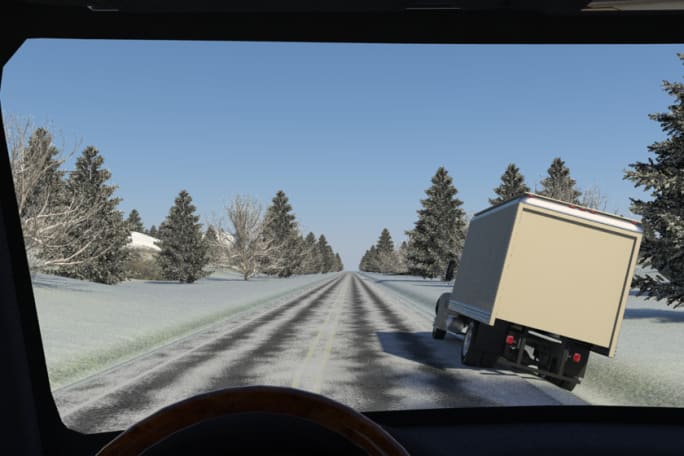
Keep survival supplies in the vehicle in case it gets stuck.
Illustration: ITI
Conducting a pre-trip inspection is particularly important in the winter months:*
Battery: Ensure that your battery is charging and holding a charge. Did you know that freezing temperatures can reduce your battery power by half? Make sure your battery box cover isn’t cracked or damaged.
Brakes: If your truck has slack adjusters, look for loose, damaged or missing hardware (such as pins) and check for proper operation.
Chains: Inspect your chains for broken or bent links.
Skill practicing: Mentally rehearse winter maneuvers such as turning into skids, using three points of contact when entering or leaving the vehicle, and increasing following distance in bad visibility.
Tires: Make sure your tire tread far exceeds the required minimums (4/32 of an inch on steer tires and 2/32 of an inch on rear tires).

Snow isn't the only winter weather factor that can limit visibility. Fog can be a problem, too.
Illustration: ITI
The following should be verified daily:
Fuel up at the end of the day and never let your vehicle get below ¼ of a tank
Check the weather report throughout the day as weather conditions may change
Clear ice and snow from your headlights, taillights, reflector lights and markers
Check antifreeze and windshield wiper fluid levels
Ensure that the defroster is working properly and remove paperwork and other items that could block proper airflow.
Inspect your exhaust system for leaks. Carbon monoxide poisoning can be deadly!
Keep the following in mind when pulling over:
Brake lightly: Applying light pressure to the brakes will heat up the drums before you pull over to park
Lights: Remove ice, snow and road film from taillights, reflectors, marker lights and headlights
Weather: Check the weather forecast to see if conditions have changed
Taking appropriate winter driving precautions can ultimately save time, money and reduce your chance of injury. Winter throws a lot at operations, and it's hard to know where to focus limited training time.
*A free ITI pre-trip inspection checklist is available.
About the Author: Thom Schoenborn is vice president of marketing for Instructional Technologies Inc. (ITI), which provides online training to transportation and logistics companies.ITI has several winter courses available, and a simple winter training guide for different types of fleets.This article was authored and edited according to HDT editorial standards and style to provide useful information to our readers.
More Safety & Compliance

FMCSA Pauses Biennial-Update Enforcement Amid Motus Transition
Carriers whose updates were due on or after June 1 have more time, while FMCSA works to stabilize its new registration system and warns of phishing sites impersonating its new carrier registration system, Motus.
Read More →
ZF Expands Commercial Vehicle Push in North America
ZF is expanding its North American commercial-vehicle presence with new transmission applications, electrification, trailer technology and autonomous-driving systems.
Read More →
Truck Drivers Need More Than Another Alert
Fleets have more visibility into truck health, safety events, and driver activity than ever. The next challenge is turning all that information into useful guidance for the person who has to decide what to do next.
Read More →
Tesla Wants a Self-Driving Semi. Are Cameras Enough?
Could Tesla’s camera-only autonomous driving technology work on an 80,000-pound Semi? In this commentary, HDT's Deborah Lockridge takes a look at Tesla, Cybercab, and how autonomous trucks see the road.
Read More →
What DOT’s Automated Vehicle Strategy Means for Trucking
The U.S. Department of Transportation issued a new automated-vehicle strategy that outlines plans for driverless-truck regulations, cross-state freight corridors, and federal safety standards.
Read More →
NYC Expands Speed, Pedestrian Safety Tech Across Fleet
New York City is expanding intelligent speed assistance and pedestrian-alert systems across its municipal fleet, moving the technologies from pilot programs into vehicle procurement and retrofit requirements.
Read More →
FMCSA Removes 110 Truck Driver Training Schools from Certified ELDT List
Federal regulators also are targeting more than 160 additional training providers and launching a nationwide audit of third-party CDL skills testers as part of a broader crackdown on trucking fraud.
Read More →
Beyond DOT Compliance: What Makes a Trucking Fleet Truly Safe?
A trucking fleet can follow every rule and still make unsafe decisions. The real test comes when safety conflicts with freight, productivity, or cost.
Read More →
Hours of Service Pilot Programs: FMCSA Readies for 2027 Rollout
Two pilot programs could eventually reshape hours-of-service rules, giving truck drivers options to pause their 14-hour clock or use longer split sleeper rest periods.
Read More →
New Guide Offers Pet Safety Tips for Truck Drivers
Hundreds of thousands of pets travel in truck cabs. A new safety guide from Volvo Trucks and the Center for Pet Safety offers practical advice for truck drivers who bring dogs and cats along for the ride.
Read More →