




What Fleets Should Consider When Selecting an Alt Fuel Powertrain
Here are six key factors for heavy-duty truck fleets to consider when selecting an alternative fuel powertrain, according to NACFE's latest report.

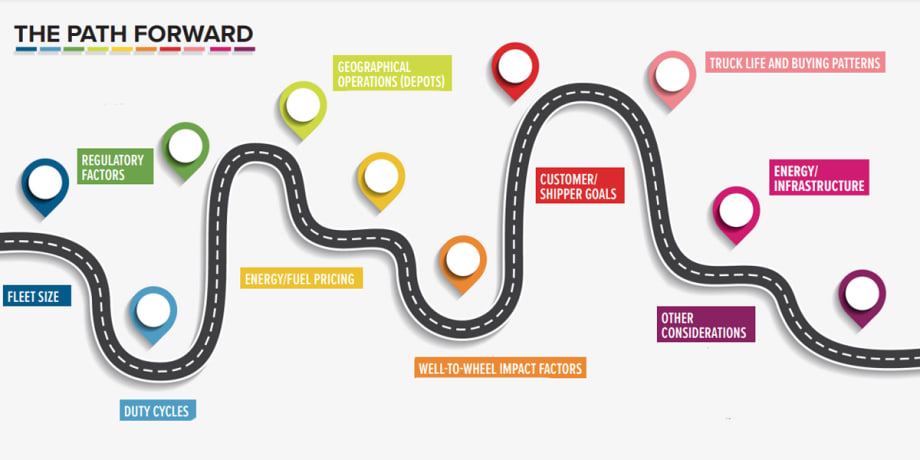
Graphic: NACFE
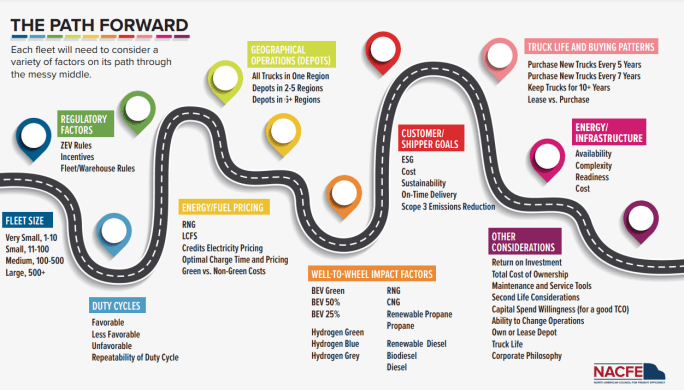
NACFE outlined the major factors fleets should consider when selecting an alternative fuel powertrain.
Graphic: NACFE
The North American Council for Freight Efficiency has identified six key factors for heavy-duty truck fleets to consider when selecting which powertrain to operate, especially alternative fuel powertrains.
In a recently-released report entitled, “The Messy Middle: A Time For Action,” NACFE concluded that now is the time for fleets to begin to wade into the “messy middle” of decarbonizing trucking. With so many powertrain options at hand, including battery-electric, hydrogen and natural gas, the decision-making process can be challenging.
NACFE outlined the major factors fleets should consider, which will help make a sound decision. The key factors are:
Well-to-Wheel Impact
Regulations
Duty Cycles
Fuel Pricing
Infrastructure
Customer and Shipper Goals
Well-to-Wheel Impact
When considering an alternative fuel from diesel, NACFE officials say it’s important to fleets to consider the where the energy being used to produce the fuel is coming from.
In battery-electric powertrain options, for example, fleets must work with the local utility to understand the mix of energy being used to produce the electricity.
Is it all coal or natural gas?
What percentage is renewable or nuclear?
“The average mix of sources throughout the US is approximately 40% renewable or nuclear,” NACFE writes in the report. “If the energy production source is at or above this threshold, electrification is good for the environment. If it is not at this level, work with your utility to understand their transition to decarbonization.”
Renewable natural gas has a negative carbon intensity, due to the use of methane as the feedstock, which is very harmful to the environment, NACFE wrote.
“Natural gas that is not renewable still emits 10% less CO2 than diesel, “ according to the report.
Ask: How green — meaning produced from renewable energy — is the hydrogen as you start operating your hydrogen vehicles and how so into the future?
Regulations
Regulatory developments over the next five to 10 years will impact which powertrain options are reliable and practical.
NACFE suggests fleets consider the following questions:
What are the upcoming regulatory factors facing your fleet?
Are you in an area where a zero-emission vehicle is or will be required?
Related to the upcoming EPA ultra-low NOx requirements. Are there additional costs of an engine that meets regulations?
What are possible reliability problems that could create more downtime?
Are solutions other than diesel more reliable or cost effective?
Duty Cycles
“When it comes to alternative fuels, duty cycle matters. If the duty cycle is more regional with stop-and-go runs and lighter loads, then electrification could be a good option,” NACFE wrote in the report. “If you run long haul, then [hydrogen fuel cells] (once the technology matures) or RNG might be the correct solution.”
NACFE suggests fleets consider the following questions:
What type of duty cycle does your fleet run?
How far does the vehicle travel?
What is the typical load?
How often does the vehicle return to base?
How many hours a day it operates?
Where do you operate your vehicle? In flat regions or mountainous ones?
Are temperatures moderate or extreme?
Fuel Pricing
The cost — both from a capital and operational standpoint — and the volatility of the fuel or energy source needs to be understood along with the fleet’s energy demand, NACFE officials wrote.
Infrastructure
After estimating the energy or fuel demand of your fleet, NACFE suggests looking into:
Availability of electricity
What type of chargers are best for your operation
The schedule required to install the chargers
Where fueling stations are
Customer and Shipper Goals
More companies are making sustainability commitments and goals. Fleets need to understand how their powertrain solutions address these needs, NACFE wrote.
“In the past, all that mattered was cost and whether the goods arrived on time. Today shippers are asking fleets what they are doing to reduce their carbon footprint,” NACFE wrote.
More Fuel Smarts

How Volvo Updated Its D13 for EPA 2027 [Watch]
Volvo’s updated D13 promises lower emissions without sacrificing performance or fuel economy. Take a closer look at what changed inside the engine in this HDT Spotlight video.
Read More →
Diesel Price Spike Shortens Payback for Natural Gas Trucks, Report Says
Energy Vision estimates fleets could recover the higher purchase price of an RNG-fueled Class 8 tractor in 1.3 to 2.8 years under current fuel-price scenarios.
Read More →
Calstart Becomes Catalyst Mobility, Reflecting Broader Focus
Calstart is now Catalyst Mobility, reflecting the nonprofit’s growing national role in clean transportation, including zero-emission trucks, infrastructure and incentive programs.
Read More →

Record Diesel Prices Squeeze Trucking Fleets
Average U.S. diesel prices have climbed to nearly $6 a gallon, surpassing the 2022 record as tight refinery capacity and Middle East disruptions keep fuel costs elevated.
Read More →
How Fuel Delivery Shapes Engine Performance
Fuel delivery depends on more than what happens at the injector. For fleet, maintenance and technical professionals, looking at the full path from pump to injector can provide useful context for understanding engine performance.
Read More →
East Coast Port Launches $45M Electric Truck Push
The Port Authority of New York and New Jersey announced millions in incentives for zero-emission drayage trucks, yard tractors, and new charging hubs near the port.
Read More →
California Bill Could Shed Light on Electric Truck Prices
Why do battery-electric Class 8 trucks remain so expensive? A California bill headed to Gov. Gavin Newsom would give fleets and state agencies more visibility into what manufacturers charge.
Read More →
Detroit Opens Orders for EPA 2027 Engines
Detroit isn’t starting from scratch to meet EPA 2027 diesel emissions standards. Its Gen 6 DD13 and DD15 engines keep much of today’s platform while updating the fuel and aftertreatment systems.
Read More →
Zero-Emission Truck Corridor Planned for West Coast
California, Oregon, Washington, British Columbia and Baja California are coordinating plans for truck charging and hydrogen fueling from Canada to Mexico.
Read More →
A Closer Look at Kenworth’s Electric T880E Vocational Truck [Video]
Learn more about Kenworth's T880E battery-electric vocational truck at the Paccar Technical Center, including its range, applications, upfitting considerations, and PTO options, in this HDT Spotlight video.
Read More →