




What Exactly Constitutes an Underinflated Truck Tire?
Why should we worry about defining underinflation? Because of the Federal Motor Carrier Safety Administration's CSA (Compliance, Safety, Accountability) enforcement program.

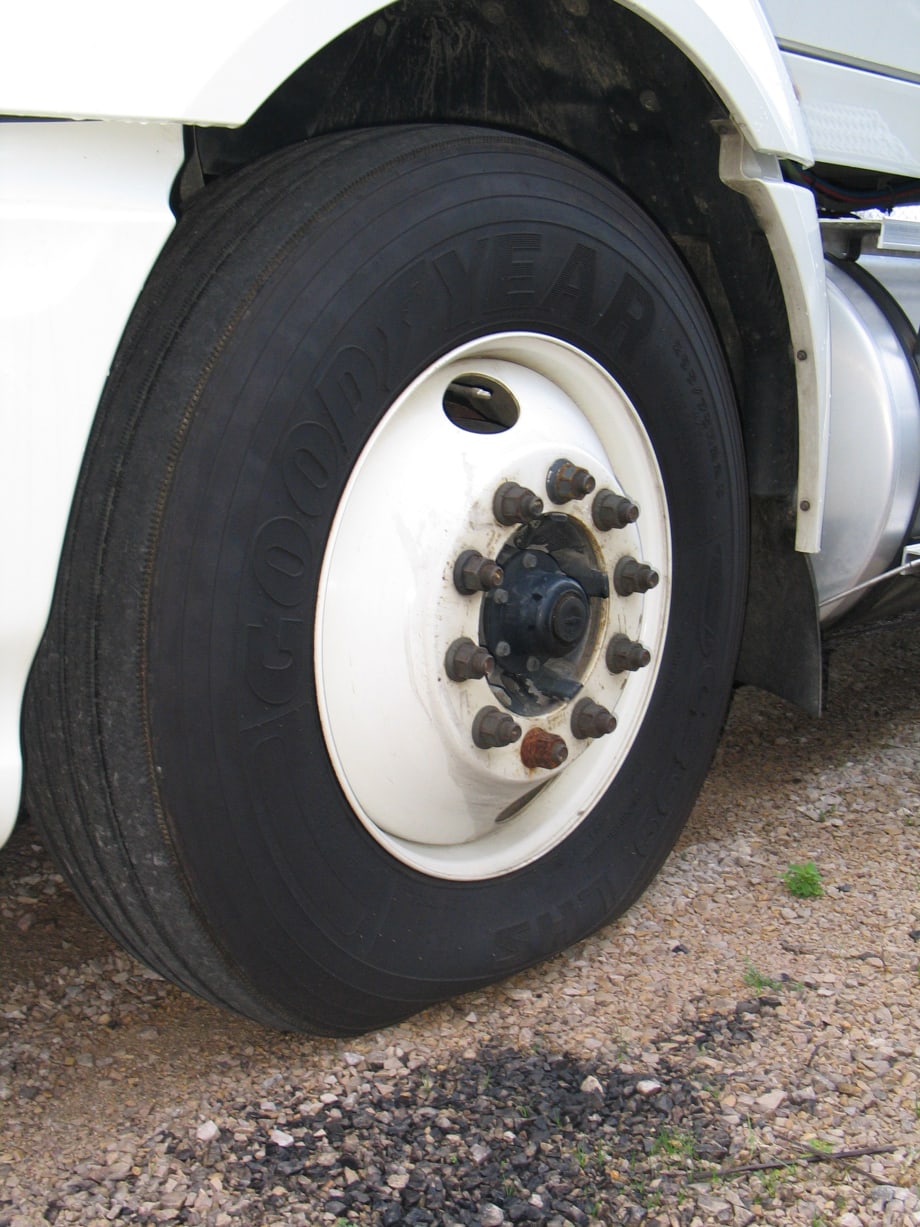
"Underinflated" isn't always this obvious. Enforcement officials are looking for a usable definition. (Photo by Evan Lockridge)
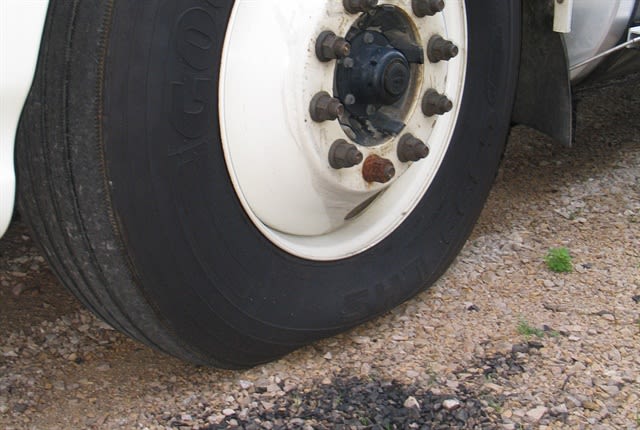
"Underinflated" isn't always this obvious. Enforcement officials are looking for a usable definition. (Photo by Evan Lockridge)
We've all heard the claims that running tires underinflated hurts fuel economy (1 to 1.5% for every 10% under, they say), increases tire wear and wrecks casings.
So what is underinflated?
By definition, it's any pressure less than the minimum recommended for the tire load. For example, a steer tire with a load of 6,000 pounds would be underinflated at 105 psi (see below). A drive tire loaded to 4,520 pounds would be underinflated at 75 psi. It all depends on the load on the tire and the minimum inflation pressure for the load.
Why should we worry about defining underinflation? Because of the Federal Motor Carrier Safety Administration's CSA (Compliance, Safety, Accountability) enforcement program.
The Commercial Vehicle Safety Alliance is currently exploring how to define underinflation for enforcement purposes. CVSA has already settled on a definition of a "flat" tire: 50% of the max cold inflation pressure stamped on the sidewall of the tire, e.g., 60 psi in a tire stamped for its max load at 120 psi inflation pressure. That's clean and simple; now CVSA wants a similarly clean and simple definition of under-inflated.
That won't be as easy.
Peggy Fisher, president of Tire Stamp, led a discussion at this year's annual meeting of ATA's Technology and Maintenance Council on the subject and failed to resolve the question. Difficulty arises because of an almost outdated DOT requirement that evaluations of hot or in-service tires be temperature-compensated.
"DOT inspectors won't usually check tire pressure unless they suspect a problem, like the tire looks soft," Fisher said. "The problem is they have nothing to go by except what's stamped on the tire. To determine the proper inflation pressure of a tire, they need to know the temperature of the tire and the load on the tire. All that comes into play in determining the proper inflation pressure of a tire."
Back in the days of tube tires, it was established that inspectors would subtract 15 psi from the gauged pressure of the tire to compensate for temperature. For example, a hot tire gauged at 85 psi would be considered cold-inflated to 70 psi. If that seems low, consider that according to the Goodyear's and Bridgestone's Load & Inflation tables, a 70-pound tire can still carry a load of 3,875 pounds. Michelin allows up to 4,500 pounds at 70 psi. Even at 3,875 pounds per tire, that would still allow 31,000 pounds over a tandem axle group. Is that tire actually underinflated with a light load?
There was also a CVSA official in the room at TMC. Kerri Wirachowsky of CVSA's vehicle committee, said the definition has to be simple or officers won't get it right.
"I don't think a lot of trucks get citations for underinflation, but they are getting written up on the inspection reports and that's just as impactful as far as CSA is concerned," she said. "As an officer checking tire pressure at roadside, I might not be at a scale; I don't know the load or the temperature of the tire. There's no way I can tell the variation between hot and cold. If you're going to make a reg change, get rid of the minus-15 and go to the lowest common denominator."
TMC and CVSA are still working on this, and a solution doesn't seem close at this point. But maybe this information can help you in a DataQ challenge. Is that 70-psi tire really underinflated?
Load & Inflation Table examples
Michelin 275/80R22.5
Steer 5,980 @ 105 psi; 6,175 @ 110 psi
Drive/trailer 4,770 lb single @ 75 psi
Bridgestone 295/75R22.5
Steer 5980 @ 105 psi; 6175 @ 110 psi
Drive/trailer 4540 lb single @ 80 psi
Goodyear 295/75R22.5
Steer 5,980 @ 105 psi; 6175@110
Drive 4,690 @ 75 psi
Read more about tire inflation in the July issue of HDT.
More Drivers

Truck Drivers Need More Than Another Alert
Fleets have more visibility into truck health, safety events, and driver activity than ever. The next challenge is turning all that information into useful guidance for the person who has to decide what to do next.
Read More →
FMCSA Removes 110 Truck Driver Training Schools from Certified ELDT List
Federal regulators also are targeting more than 160 additional training providers and launching a nationwide audit of third-party CDL skills testers as part of a broader crackdown on trucking fraud.
Read More →
Hours of Service Pilot Programs: FMCSA Readies for 2027 Rollout
Two pilot programs could eventually reshape hours-of-service rules, giving truck drivers options to pause their 14-hour clock or use longer split sleeper rest periods.
Read More →
Medical Cards, English Proficiency Reshape Roadcheck Violations
Medical-card violations jumped to the top of the driver out-of-service list during CVSA’s 2026 International Roadcheck, while English-language proficiency violations appeared among the leading violations for the first time.
Read More →
Driver Trust Can Make or Break the Success of Fleet Safety Technology
New Teletrac Navman research suggests that onboarding, transparency about driver data, and positive feedback can play a significant role in how commercial drivers respond to safety and coaching technology.
Read More →
EEOC Sues KLLM Over Alleged Sex Discrimination in Driver Training
KLLM is facing a federal sex-discrimination lawsuit over policies the EEOC alleges put female truck driver trainees at a disadvantage.
Read More →
FMCSA Moves to Codify English Language Requirements for Commercial Drivers
By changing regulations on English-language proficiency requirements for commercial drivers, rather than relying on a guidance memo, the FMCSA said future administrations won't be able to walk back the Trump administration's stricter enforcement with just a memo.
Read More →
Drivers Put Western Star Trucks to the Test at Star Nation Experience
Watch to get an inside look at the Western Star trucks, technology, and community behind the Star Nation Experience 2026!
Read More →
Trump Administration Looks to Put More Veterans Behind the Wheel
The Freedom Haulers program pulls together existing and expanded programs at several federal agencies to recruit veterans to drive commercial heavy-duty trucks and cut the red tape for them to get a CDL, training, and employment.
Read More →
Putting Mack’s Command Steer to the Test
A test drive of Mack’s Command Steer active steering system evaluates how it can make truck driving easier and less tiring.
Read More →