




Vocational Sales Climb as Construction, Energy Grow
Demand for vocational trucks and trailers continues to be pushed by oil and gas producers, road building and municipal business, according to truck manufacturers and researchers. Revivals in housing and commercial construction are also factors as vocational Class 8 retail truck sales are up 9.2% through July compared to last year, and should be up by 16.4% for all of 2014.

Demand for vocational trucks and trailers continues to be pushed by oil and gas producers, road building and municipal business, according to truck manufacturers and researchers. Revivals in housing and commercial construction are also factors as vocational Class 8 retail truck sales are up 9.2% through July compared to last year, and should be up by 16.4% for all of 2014.
“The second half recovery that everybody’s been predicting is finally coming to pass,” says Steve Tam at ACT Research, who follows power-unit sales, in reference to the stronger forecast for the last five months of the year. “We’re getting back to where the (truck) population was before the thing derailed in ’08.”
Pent-up demand – which boosted truck manufacturing after the Great Recession – is another continuing factor, as both vocational and freight-hauling fleets replace worn-out equipment.
Trailer sales are up “pretty much across all vocational categories,” says Frank Maly, who tracks trailer activity for ACT Research. Dry and liquid bulk tankers have risen after a slump in 2012, as have flatbeds. All are used by oil and gas producers to carry chemicals, sand, pipes and cement used in drilling and fracking. End-dump trailer sales are also up.
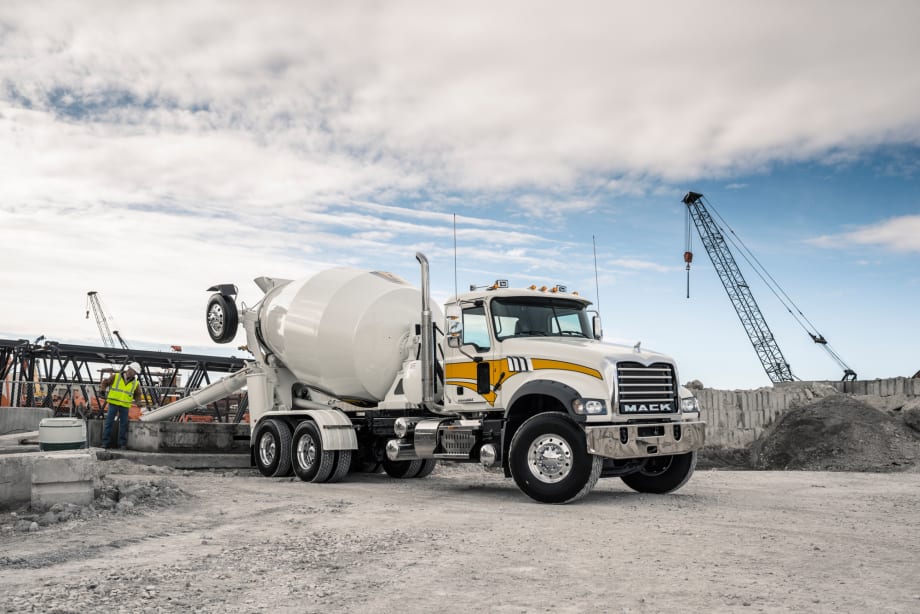
“One of the biggest developments this year is increased purchases by the concrete industry, specifically mixers and concrete pumpers,” says Stu Roselli, Mack Trucks’ vocational product manager. Charlie Cook, vocational marketing manager at Peterbilt, agrees: “We’re seeing particularly strong sales of mixer trucks, which of course are used in a broad range of construction projects.”
Front-discharge mixer trucks – niche vehicles serving a niche market – have also revived after the market all but stalled in the recession. Oshkosh Truck and Terex Advance are again busy building new chassis with mixer bodies done by an affiliate (McNeilus for Oshkosh) and in-house (at Terex, which shut down for a year to redesign its plant and its truck product).
Indiana Phoenix, the third front-discharge maker, continues its primary activity of building glider kits, using recycled powertrains in new chassis with new cabs, barrels and drive apparatus. Phoenix has also built tank trailers for a client which sold them to oil and gas producers.
Municipalities are buying hydro-vacuum trucks, among other types, and replacing aging vehicles, adds Cook at Peterbilt. “Road building, residential and commercial construction are all rebounding, and in some areas, booming,” he says.
“Vocational demand stems mainly from fleets replacing older fleets with newer, more fuel-efficient vehicles,” says John Felder, vocational marketing manager at Volvo Trucks. “We believe there is increasing demand in the construction market and road construction/renewal projects, and oil field applications.”
Daimler Trucks has likewise seen a burgeoning of the vocational market. Its Class 8 Freightliner and Western Star models were up by 36% in the first three months of 2014, according to Richard Howard, senior vice president of sales and marketing. Overall Class 6-8 vocational sales were up 24% in this year’s first quarter and 9% in the second quarter.
Daimler is determined to capture more vocational sales. Howard says its biggest market-share gains will be in vocational, and it expects to have 32% of the Class 8 market in the United States, Canada and Mexico by year’s end.
“We’re at 30.8% (of Class 8) at the end of the second quarter," says Dave Hames, Daimler Trucks North America’s general manager, marketing and strategy. “Our goal in 2009 was to achieve a number one position in that market by 2015, and we’re gaining share completely at the expense of other manufacturers.”
Vocational growth comes at a good time for Navistar International, which last year added the Cummins ISB and this year converted its own 9.3-liter diesels to selective catalytic reduction. The N9 and N10 (called MaxxForce 9 and 10 in their former non-SCR configurations), are now the primary powerplants in International’s severe-service models. Although they weren't available until July, the upgrade now should result in more vocational sales, says Emile Sabol, vocational sales director.
“It has been getting the product out there that has been slowing us up,” he says. “We have been putting a lot of demos out into the market place with a lot of our customers, and we believe more utility, crane, construction and municipality customers will come on board now that we have SCR products for the vocational market."
He also says the combination of the ISB with the Allison 3000 transmission will also have a big impact on the utility market.
All manufacturers have specific models for vocational applications, and two of them were new last year: Peterbilt’s 567, which has begun replacing the 365 and 367, and Kenworth’s T880, which is taking over for the T800. The old models will stay in production until interest in them wanes. The new ones are catching on quickly, gaining close to half of new orders by mid-year.
The T880 and 567 share a wider cab developed under auspices of their Paccar parent. Each division outfits and trims its cab to remain distinctive, and has engineered chassis improvements to make them drive and perform better.
“We have customers who are loyal to the T800,” says Alan Fennimore, Kenworth’s vocational segment manager, “but when they get in the T880 and look around, they say ‘Wow – this is nice.’”
Caterpillar executives are happy about continued growth in sales of their Cat Truck, an enhanced version of Navistar’s PayStar 5900 series. It just expanded with the addition of a CT681 with a forward-set steer axle that joins the original CT660 axle-back model.
“We have seen sales of Cat Trucks grow every year since launch,” says Ron Schultz, truck sales and support manager. “We have definitely seen an uptake in 2014 as the economy continues to rebound and the rest of 2014 is looking very positive.”
More Equipment

How Volvo Updated Its D13 for EPA 2027 [Watch]
Volvo’s updated D13 promises lower emissions without sacrificing performance or fuel economy. Take a closer look at what changed inside the engine in this HDT Spotlight video.
Read More →
Michelin Tire Improves Efficiency and Durability for Regional Fleets
The Michelin X Multi Energy D2 is a regional haul drive tire engineered to help fleets improve fuel efficiency, durability and traction in demanding stop-and-go operations.
Read More →
ZF Expands Commercial Vehicle Push in North America
ZF is expanding its North American commercial-vehicle presence with new transmission applications, electrification, trailer technology and autonomous-driving systems.
Read More →
Tesla Wants a Self-Driving Semi. Are Cameras Enough?
Could Tesla’s camera-only autonomous driving technology work on an 80,000-pound Semi? In this commentary, HDT's Deborah Lockridge takes a look at Tesla, Cybercab, and how autonomous trucks see the road.
Read More →
Kodiak: Driverless Long-Haul Truck Launch on Track for 2026
Kodiak AI says its driverless long-haul safety case is 93% complete and it remains on track to begin commercial operations by year-end 2026.
Read More →
What DOT’s Automated Vehicle Strategy Means for Trucking
The U.S. Department of Transportation issued a new automated-vehicle strategy that outlines plans for driverless-truck regulations, cross-state freight corridors, and federal safety standards.
Read More →
East Coast Port Launches $45M Electric Truck Push
The Port Authority of New York and New Jersey announced millions in incentives for zero-emission drayage trucks, yard tractors, and new charging hubs near the port.
Read More →
PlusAI Going Public to Fund Autonomous Truck Launch
A SPAC deal could provide PlusAI with up to $300 million as it works toward a 2027 commercial launch of factory-built autonomous trucks.
Read More →
NHTSA Moves to Rewrite Truck Fuel-Economy Rules
The National Highway Traffic Safety Administration says it lacks authority to regulate medium- and heavy-duty truck engines separately from complete vehicles, but the existing standards have not yet been eliminated.
Read More →
Detroit Opens Orders for EPA 2027 Engines
Detroit isn’t starting from scratch to meet EPA 2027 diesel emissions standards. Its Gen 6 DD13 and DD15 engines keep much of today’s platform while updating the fuel and aftertreatment systems.
Read More →