




Truck Suspension Maintenance Can Pay Off
Suspensions are not yet completely maintenance-free. Thorough inspections can keep small problems from becoming big ones.

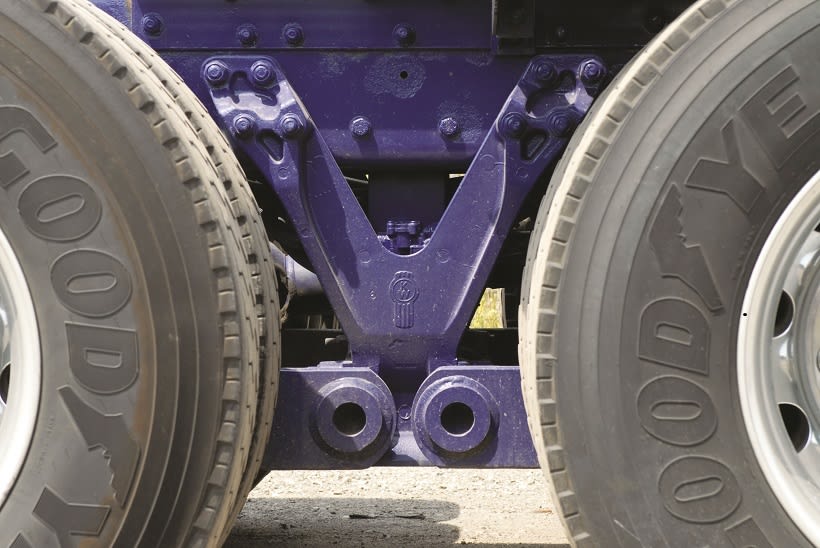
Different types of suspensions experience different types of failures. You may not notice a problem until it shows up as irregular tire wear.
Photo: Jim Park
Do your suspensions keep you awake at night? Probably not. They tend to be pretty reliable and don’t require a lot of shop time. Still, problems can sneak up as the equipment ages. It might be safe to leave them more or less alone for the first few years, but you don’t want to ignore them completely.
We talked to a few fleets to find out what their pain points were and found surprisingly little. Jarit Cornelius, vice president of maintenance and compliance at Ethridge, Tennessee-based Sharp Transportation, says he spent just over $4,000 on suspension-related maintenance and repairs so far this year on his 140 power units.
“We have 360 trailers in the fleet and our maintenance costs year-to-date are $9,318,” he says. “Of that figure, 78% of the cost was for airbag replacements on 2003-2005 model-year trailers. I don’t even worry about that. A 15-year-old air bag owes me nothing.”
As robust as they are, things do go wrong. Cornelius likens a suspension to a diesel particulate filter. “DPFs don’t fail as a root cause – it’s usually something upstream,” he explains. “There’s usually some external factor that places undue stress on the suspension components, like not matching dual-tire diameters or running with a dry fifth-wheel top plate. They can cause uneven loading and excess torque on parts of the system, which speed up normal wear. You may not notice the problem directly on the suspension, but you’ll see increased tire wear, irregular tire wear, failed shock absorbers and the like. Those are symptoms of suspension problems that probably have another root cause.”
If you have tire wear problems on drive axles, the likely cure might be an alignment, but the alignment might reveal the real source of the problem. According to Mike Beckett of MD Alignment of Des Moines, Iowa, the average truck that visits his shop needs $1,000 worth of suspension work before he can even start doing an alignment.
Beckett says the average 3.5- to 4-year-old truck with half a million miles on it will have some undercarriage issues, such as loose U-bolts and loose wheel bearings. “You’ve got four and a half hours of labor at $90 an hour and you haven’t even replaced a part yet,” he says. “Chances are, the spring-eye bushings on the rear suspension, if you have them, are worn out too, so now we have to press bushings into all of them. You’ve now spent $1,000 and we haven’t even begun the alignment.”
Beckett says he frequently sees loose U-bolts on under-slung suspensions where the weight of the truck hangs on the U-bolt. Over time, the bolts stretch and the assembly loosens, he says.
“When you see air bags cocked in at the bottom, that usually indicates the U-bolts have stretched and the axle is moving within the assembly,” he notes. “This can be difficult to detect when looking down at the assembly. The usual signs are not obvious from that vantage point, such as rust streaks running from the bolt. Get under it and look.”
Beckett suggests torqueing the suspension U-bolts when the truck is new, again at 5,000 miles because they stretch a lot when they are new, and every 50,000 miles after that.
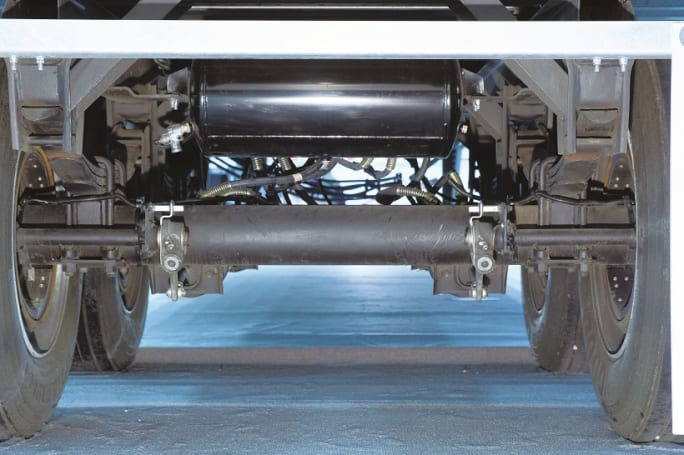
All interconnected parts respond to other components in the suspension system. A problem in one part of the suspension may indicate a failure with another part of the system.
Photos: Jim Park
Canaries in the truck bay
Kevin Tomlinson’s approach to suspension maintenance is eyes-on and hands-on. “There’s not much in terms of ongoing maintenance, but our techs are under the tractor every 15,000 miles,” says the director of maintenance at South Shore Transportation of Sandusky, Ohio. “We hardly need to grease anything anymore, but we look closely for damage and loose fasteners.”
Shock absorbers and leveling valves remain about the only moving parts in a tractor suspension, and they do need periodic inspection.
“Visually inspect them for leaking hydraulic fluid, broken end connections, worn bushings or cylinders and over-extension,” says David Brinkman, category director for suspension products at Stemco. “Replace any shock absorbers that can be easily compressed or extended, or if you find leaking hydraulic fluid.”
Monroe says in addition to leaks, symptoms that shocks may need replacing include physical damage such as dents or worn/broken mounts, and cupped or uneven tire wear.
Shocks, it should be said, tend to fail as the result of some other problem, as do tires. They are the canaries in the coal mine, so to speak. “The shock tries to compensate for other problems in the suspension,” Beckett says. “After a while, if the problems are bad enough, it just gives up.”
Height control valves and leveling arms are mechanical parts and not immune to failure. Occasionally, drivers will tamper with the valve adjustment or bend the arm to “improve the ride” of the truck. In doing so, they risk upsetting the driveline angle, which can damage U-joints and possibly pinion bearings.
“It’s a simple check,” Brinkman says. “The height control valve leveling arm should move to the intake position when placed under load, which should allow air to enter the air springs. When the load is removed, the leveling arm should move to the exhaust position to indicate that it is allowing air to escape. And after both operations, it should move back to the neutral position.”
In addition to a visual inspection for damage, the frame should be lifted, and the air bag allowed to extend so any debris that may have accumulated between the rubber and the metal piston can be removed. If you don’t, that’s an invitation for abrasion damage, says Brinkman.
When all is said and done, and the truck is back on the road, record the results of the inspection when damage or wear is discovered.
Ken Mckibben, president of transportation consultant Single Source Transportation Solutions, says failure analysis can save the fleet lot of money. “All those PM inspections add up over the year, and while they are worth every penny, if you can track problems over a period of time, you can maybe spec those problems out of future equipment purchases,” he says. “At the very least you’ll know what to expect from your equipment over time.”
More Maintenance

Color Match Smarter: Tools That Restore & Perform
For fleet managers and collision repair professionals keeping heavy-duty trucks on the road, getting the color right the first time isn't just about appearance — it's about efficiency, turnaround time, and bottom-line results. Discover how today's digital color tools are transforming the repair process from guesswork to precision.
Read More →
Wrong Repair Prompts Recall of Freightliner, Western Star 4x2 Trucks
DTNA is recalling more than 2,400 trucks that received an incompatible software fix instead of the hardware repair required to address brake valve corrosion.
Read More →
Truck Drivers Need More Than Another Alert
Fleets have more visibility into truck health, safety events, and driver activity than ever. The next challenge is turning all that information into useful guidance for the person who has to decide what to do next.
Read More →
The Maintenance Checks Trucking Fleets Should Prioritize Before Fall Freight Picks Up
Making it through August isn’t the same as being ready for the next several months of operation. Find out what systems may have suffered from summer heat and need to be checked out before fall.
Read More →
What Three Fleets Are Doing Differently When Buying Truck Parts in 2026
With freight improving but costs still climbing, fleet maintenance executives explain how they're balancing price, quality, and supplier relationships.
Read More →
Paccar Recalls 2027 Trucks Built This Summer for Possible Electrical Problem
The nearly 6,000 Kenworth and Peterbilt trucks in the recall could potentially lose engine power, among other things.
Read More →
Will API PC-12 Oil Change Trucking Fleet Maintenance?
The new API PC-12 heavy-duty engine oil category reflects the changing demands of modern diesel engines. But fleets like Foodliner are looking to getting their own data before making decisions on adopting the new oils and questions such as extending oil drain intervals.
Read More →
Brake Safety Week to Focus on Drums and Rotors
Commercial vehicle inspectors are focusing on truck brakes during CVSA's Brake Safety Week, August 23-29.
Read More →
Possible Battery-Cable Fires Prompt Recall of 15,000+ International MV and HV Trucks
On the recalled vehicles, manufacturing variations can cause the battery interconnect cable to contact the auxiliary stud and hold down the bracket.
Read More →
Rush, MCT Team Up to Grow Refrigeration Service Network
The joint venture will operate MCT's network of Carrier Transicold dealerships and mobile service locations, with the companies promising greater service capacity and uptime for refrigerated fleets.
Read More →