




Truck Buying Options: New, Used, Buy or Lease
What’ll it be, buddy? New or used? Buy or lease? A salesperson could throw those questions at a prospective buyer and get a combination of answers, and none of them would be absolutely wrong. Because like everything in trucking, “it depends.”

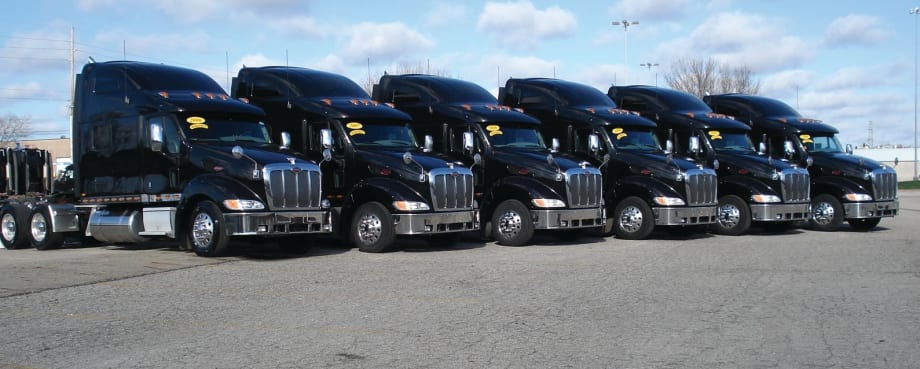
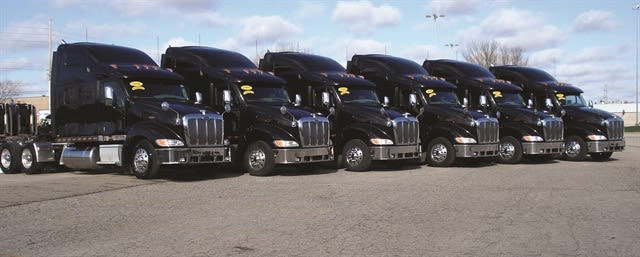
What’ll it be, buddy? New or used? Buy or lease? A salesperson could throw those questions at a prospective buyer and get a combination of answers, and none of them would be absolutely wrong. Because like everything in trucking, “it depends.”
The choice has become more critical since the cost of a new over-the-road tractor has climbed to well over $100,000 and a midrange truck can be $75,000 or more. Manufacturers blame the price increases on government safety and exhaust-emissions requirements, and on inflation of the costs of materials used in building the complex vehicles.
New or used?
Why buy a new truck? “Low maintenance and less downtime,” says J.P. Heineman, a salesman at Truck Country’s Cedar Rapids, Iowa, location. “Downtime – that’s number one. A half a million-mile used truck might still be OK, but you get to 600,000, 700,000, 800,000 miles, and that’s when things start nickel and diming you.”
The cost of purchasing is higher, but your maintenance cost is much lower with a new truck, he says. New trucks have the latest technology that can save on fuel and other operating costs and help avoid accidents, as well as clean up the environment. The selective catalytic reduction now used by all heavy-duty diesel engine makers deals with nitrogen oxide in the exhaust and takes stress out of the engine.
But choosing new or used “depends on the customer and on the application,” Heineman says. For instance, he says, someone who doesn’t want to deal with diesel exhaust fluid will have to buy used. A key factor is mileage.
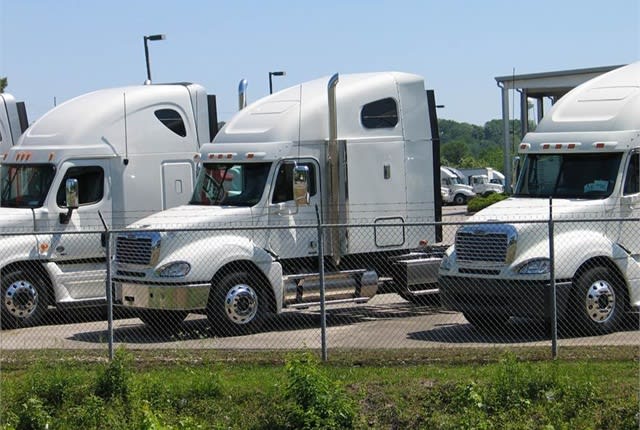
Good used trucks cost substantially less than new and can perform well.
But research their reputations before buying.
“If the customer is contemplating new or used, and he runs a lot of miles and has the means to go new, I’m putting him in a new truck. If a customer is putting 2,000 miles a year on the truck hauling crops out of his 180 acres, and then he parks it for 10 months of the year, he should buy used.”
You can’t beat used trucks on price, he says. “You can get two for one – that’s probably the biggest advantage. If you’re buying used trucks, your overhead is not near what it is when you buy new.”
Just be sure you have the trucks in the proper application – primarily, that your operation is the same or close to what the truck was originally built for.
“There have been some discouraging times with some of the emissions things we’ve had to contend with,” Heineman says. “But things have begun to turn around. The air coming out of the exhaust is as clean as can be. It just takes a lot of sensors to make it.” New engines with EPA-2010 emissions get better fuel economy than the EPA-2007 engines, he points out.
What makes, models and specifications are good bets when buying used?
Penn Commercial Vehicle Solutions in Glenmore, Pa., with 13 other locations in three states, works on all kinds of trucks. Hank Grahn, sales director for fleet maintenance, also notes the fuel-efficiency benefits of newer equipment. The new trucks are also more reliable.
However, he says, “There’s certainly a risk involved in buying equipment from ’07 and later. It’s viable, but you have to go in with your eyes open, you have to do your homework. Just because a vehicle has low mileage doesn’t mean it’s a creampuff. It might be low mileage because it’s been troublesome.”
In deciding which used models might be the best buy, Grahn recommends talking to the people who service and repair them for a living. And talk to customers who use them.
The Internet is also a good tool, he says. “Not everything is true, but there’s a lot of data out there that’s in the public domain.”
There’s actually an alternative to new and used trucks, and it’s the glider kit.
The glider kit option
A glider is a new truck without a powertrain. Rebuilt or remanufactured components usually take the place of the new engine, transmission and rear axles. A ready-to-work glider typically sells for more than a used truck, but for substantially less than a comparable new truck, and can give similar performance.
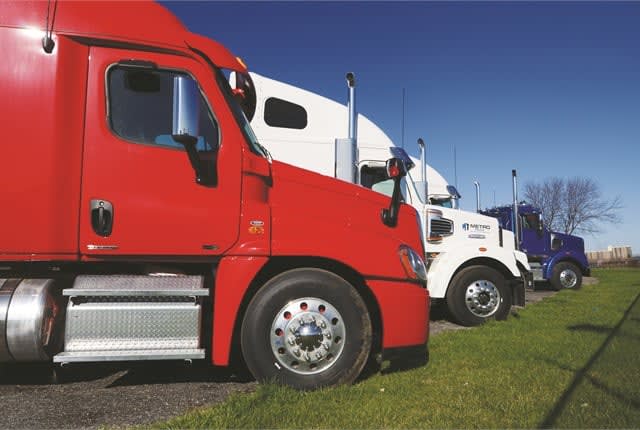
New trucks usually are more reliable and cost less to maintain than used, though there have been glaring exceptions with emissions equipment.
Kenworth and Peterbilt offer a few models as gliders, but Freightliner supplies the most. It will make glider versions of almost any medium- or heavy-duty new truck in its lineup, and actively markets them.
“Gliders are a viable option to buying a used truck,” says Riley Asher, vice president for fleet services at Clarke Power Services in Springfield, Mo. “They’re good for driver retention because from a driver’s point of view it’s a new truck. Fleets like them, too, from a safety viewpoint – it’s got new brakes, tires, and electrical systems.”
Buy or lease?
Cash is king when acquiring any vehicle, but most customers have to finance it somehow. That leads to the question, buy or lease? Large motor carriers have the expertise to manage all aspects of vehicle ownership, from getting volume deals and maintenance and warranty administration to fuel purchasing and reselling. So they usually buy. But some mix in some equipment leases as well, says Joe Gallick, vice president of dedicated services at NationaLease.
For smaller carriers and owner-operators, buying is the usual route. It makes sense if interest rates are low (as they now are), if dealers or truck builders offer good trade-in allowances, and if there’s enough equity in the trucks to be traded to take care of the down payment. New-truck dealers are affiliated with “captive” financing and leasing companies as well as working with banks for loans, and most independent dealers also have access to financing sources.
For consumer-goods manufacturers and merchants for whom trucks are tools to get their products to market – private fleets – leasing can make sense. Saving the “downstroke” on a new truck frees capital that can be better spent on production machinery, store remodeling or a thousand other uses that are closer to a company’s core business.
The same is true with for-hire carriers that could use such capital to build a new shop, or to expand the fleet further than would otherwise be possible through buying.
“One of the things a leasing company offers is financing so a company’s capital lines are kept open,” Gallick says. “It’s reasonable credit at no down payment – 100% financing – instead of going to a bank or lender to buy trucks, where you’d have to put money down.”
That’s possible because the leasing company has more outlets for that vehicle if the original operator defaults, he explains. The leaser also has a good grasp of the vehicle’s residual value.
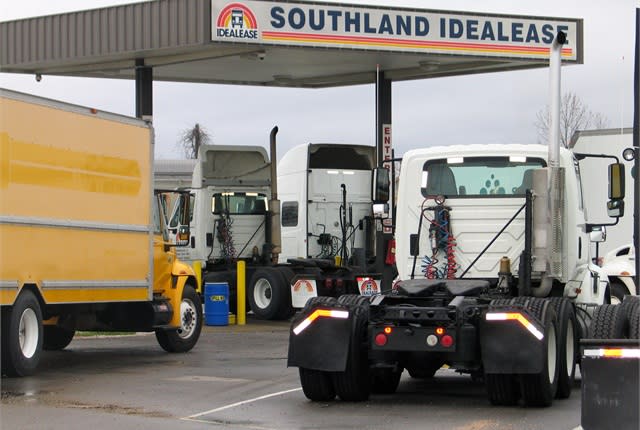
The cost of ownership of a new over-the-road tractor is well over $100,000, which has the potential to sway some customers towards leasing or buying used.
“There are a lot of gray areas in between, and a lot of structures where, for instance, the truck dealer might be aggressive in residual values,” Galick says. “The resale market is fluid. It’s predictable to a degree, but all the things you can’t predict, like the economy and government mandates, that might have an impact on demand and value, are factors.”
Like big fleets, leasing companies also can cope if the used-truck market is weak when the planned ownership or leasing cycle is up. They can simply keep the truck longer, but might have more uses for it.
“Sometimes lessors can extend a term or lease it to someone else for a year or so until the market for used vehicles improves, assuming useful life remains and there are miles where the maintenance curve won’t increase much,” Galick says.
Leasing is also possible for experienced owner-operators, he explains. Lease payments are comparatively low because they cover depreciation but not equity in a truck, so an owner-operator can afford a better vehicle than he or she might otherwise be able to afford. Good credit is necessary, but sometimes an individual trucker can get backing on a lease or even a loan.
Shippers have been known to do this in return for a reliable source of transportation.
Credit now is more available than it was in the depths of the Great Recession, and companies such as NationaLease (an association of 165 truck leasing and rental and logistics companies, and some dealers) have plenty of competition in companies such as Ryder, Penske, Paclease, IdeaLease, not to mention regional and local sources of loans and leases.
So whether you lease or buy, you have many options.
More Fleet Management

Color Match Smarter: Tools That Restore & Perform
For fleet managers and collision repair professionals keeping heavy-duty trucks on the road, getting the color right the first time isn't just about appearance — it's about efficiency, turnaround time, and bottom-line results. Discover how today's digital color tools are transforming the repair process from guesswork to precision.
Read More →
FMCSA Pauses Biennial-Update Enforcement Amid Motus Transition
Carriers whose updates were due on or after June 1 have more time, while FMCSA works to stabilize its new registration system and warns of phishing sites impersonating its new carrier registration system, Motus.
Read More →
2026 Blueprint for Countering Smarter Supply Chain Theft
Cargo theft is no longer just the cost of doing business. It's a multi-billion-dollar criminal enterprise exploiting vulnerabilities across your fleet, drivers, and supply chain.
Read More →


How Telematics Improves Visibility, Control, and Performance in Refrigerated Fleets
Explore how telematics help refrigerated fleets improve visibility, uptime, efficiency, compliance, and cargo protection across connected cold chain operations.
Read More →
What the U.S.-Canada Trade War Means for Trucking
Escalating U.S.-Canada tariffs could disrupt cross-border freight, reduce truck volumes, raise costs, and create new uncertainty for carriers on both sides of the border.
Read More →
What Are Trucking’s Top Concerns for 2026?
The American Transportation Research Institute wants to know what's worrying trucking fleet managers, drivers, and other stakeholders in its annual Industry Issues survey.
Read More →
American Trucking Associations Looks for a New Leader
ATA President and CEO Chris Spear abruptly left his job at the association on August 21, at a pivotal time for the trucking industry.
Read More →
Public Wi-Fi Cybersecurity Risks: How Truck Drivers and Fleets Can Protect Their Data
Public Wi-Fi can expose truck drivers and fleets to credential theft, malware, and other cyber threats. Here’s how to reduce the risk on the road.
Read More →
For Nicky Cupp, Fleet Innovation Starts With Frustration
HDT Truck Fleet Innovator Nicky Cupp turns everyday pain points at Fraley & Schilling into opportunities for better technology and smarter processes.
Read More →
Adam Buttgenbach’s Approach to Electric Trucks: Start With Where They Fit
HDT Truck Fleet Innovator Adam Buttgenbach helped PepsiCo build one of North America’s largest EV fleets by focusing on where electric trucks make operational sense.
Read More →