




Trimble Builds on the Promise of a Unified Platform
A unified and open computing platform shared by all its product lines, customers, and vendors is a key to Trimble’s businesses within the trucking and logistics space.

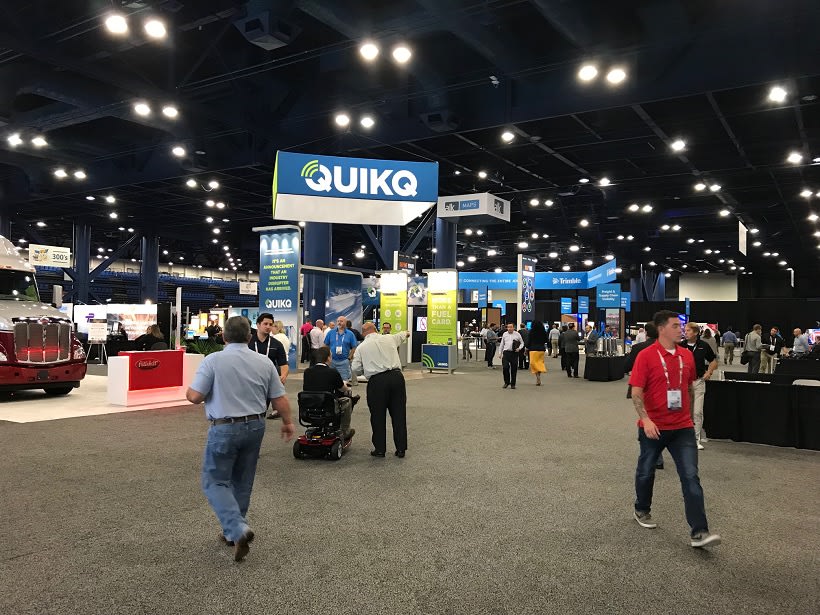
Trimble held its in.sight 2018 user conference where executives spoke about how a unified and open computing platform shared by all its product lines, customers and vendors is a key to its businesses within the trucking and logistics space.
Photo: Jim Beach
A unified and open computing platform shared by all its product lines, customers, and vendors is a key to Trimble’s businesses within the trucking and logistics space, company executives said in interviews during the company’s in.sight 2018 user conference and expo, held in Houston Sept. 9-12.
A unified platform means more collaboration, quicker development and ultimately, the company feels, a competitive advantage within the market place.
“As we get more and more data in to the transportation cloud, you get access to more data, you can integrate that data and make more real-time decisions it’s not just looking backward, it’s looking forward,” said Bryn Fosburgh, president Trimble Transportation Enterprise.
“It was an Ah Ha! moment,” added Mark Botticelli, chief technology officer, Trimble Transportation. “The cloud will have APIs that our customers and our internal groups will use to develop things. We will have all of this rich data from all parts of the supply chain, which gives us a unique advantage.”
Thomas Fansler, president Trimble Transportation Mobility said the unified cloud affects development of new products because there is more collaboration. It also enables the company to use advanced data analytics to address problems fleets have with vehicle diagnostics, driver behavior and other areas. “You can solve big problems with the data density created by having it under one platform. You can see relationships that may not be apparent otherwise. Not many companies can do that.”
Fansler noted that throughout Trimble’s various business units, there are some 1.2 million telematics devices. “Then you connect the enterprise piece and the mapping piece” and that boosts product optimization. “You can have forward-looking information that allows for better decision making.” Predictive maintenance is a good example of this, he said.
Analytics in other areas can also be improved via the unified platform. The company’s driver retention module is a case in point, according to Keith Mader, Trimble Transportation vice president analytics. Using data from the telematics device, they can tell if a driver is getting too few miles or too many. “We look at all the factors that will lead someone to become unhappy in their work. “The common platform improves analytics tremendously.” And driver retention is something they were able to do with “data we already had. We just had to apply the data science to it. The availability of the data and ease of access and working with it just changed,” with the unified platform.
Plus, there are the benefits of opening their cloud to customers and vendor partners. Talking about unifying TMW, PeopleNet, 10-4 Systems and ALK, Trent Lezer, vice president North American technology, Trimble Transportation Mobility said, “the evolution we’re seeing, one of the things we recognize is that our clients are creative.” That leads to the possibility of collaboration not only within Trimble, but with others as well. “We want to open up our eco -system so customers can contribute to it,” he said. “To create a safe, secure sand box, a managed eco-system where we can put our applications, but vendor partners and clients can put their applications there too. A big focus is to enable our clients.”
Lezer cited the company’s TruETA application as an example of combining all the information they can access from a common cloud. “If a mapping company like ALK wasn’t part of Trimble,” we wouldn’t be able to do it as effectively.
The common platform is still in the early stages and work remains to be done bringing all the elements together. In addition to having the apps, data and other items from each of the transportation entities in the platform, there is the development of a single sign-on and authentication process so users can easily access information across the platform.
“There are steps to get to the single platform, Lezer said. “You take a step back and look at the system.” Components required include a data pipeline and data store. “Trimble has the common data pipeline. That’s powerful – it has scale that is hard to reproduce for one company. Then there’s authentication and access control. Those are “the stepping stones.”
As part of the authentication process includes user roles, specific users within a fleet will have access to specific dashboards: the safety manager will have one view; the maintenance manager will have another.
The bottom line for Trimble’s transportation groups is that people are “having conversations and collaboration is happening that I’ve never seen happen before,” Lezer said.
More Fleet Management

Color Match Smarter: Tools That Restore & Perform
For fleet managers and collision repair professionals keeping heavy-duty trucks on the road, getting the color right the first time isn't just about appearance — it's about efficiency, turnaround time, and bottom-line results. Discover how today's digital color tools are transforming the repair process from guesswork to precision.
Read More →
FMCSA Pauses Biennial-Update Enforcement Amid Motus Transition
Carriers whose updates were due on or after June 1 have more time, while FMCSA works to stabilize its new registration system and warns of phishing sites impersonating its new carrier registration system, Motus.
Read More →
2026 Blueprint for Countering Smarter Supply Chain Theft
Cargo theft is no longer just the cost of doing business. It's a multi-billion-dollar criminal enterprise exploiting vulnerabilities across your fleet, drivers, and supply chain.
Read More →


How Telematics Improves Visibility, Control, and Performance in Refrigerated Fleets
Explore how telematics help refrigerated fleets improve visibility, uptime, efficiency, compliance, and cargo protection across connected cold chain operations.
Read More →
What the U.S.-Canada Trade War Means for Trucking
Escalating U.S.-Canada tariffs could disrupt cross-border freight, reduce truck volumes, raise costs, and create new uncertainty for carriers on both sides of the border.
Read More →
What Are Trucking’s Top Concerns for 2026?
The American Transportation Research Institute wants to know what's worrying trucking fleet managers, drivers, and other stakeholders in its annual Industry Issues survey.
Read More →
American Trucking Associations Looks for a New Leader
ATA President and CEO Chris Spear abruptly left his job at the association on August 21, at a pivotal time for the trucking industry.
Read More →
Public Wi-Fi Cybersecurity Risks: How Truck Drivers and Fleets Can Protect Their Data
Public Wi-Fi can expose truck drivers and fleets to credential theft, malware, and other cyber threats. Here’s how to reduce the risk on the road.
Read More →
For Nicky Cupp, Fleet Innovation Starts With Frustration
HDT Truck Fleet Innovator Nicky Cupp turns everyday pain points at Fraley & Schilling into opportunities for better technology and smarter processes.
Read More →
Adam Buttgenbach’s Approach to Electric Trucks: Start With Where They Fit
HDT Truck Fleet Innovator Adam Buttgenbach helped PepsiCo build one of North America’s largest EV fleets by focusing on where electric trucks make operational sense.
Read More →