Tribe Express Takes the Long View on Driver Retention
Boasting a turnover rate as low as 33%, Tribe Express’ roster includes veteran truckers between 50 and 60 years old, as well as an increasing number of younger (age 28 to 35) and female drivers.
David Cullen・[Former] Business/Washington Contributing Editor
Founded in 2010 with five trucks as logistics provider Tribe Transportation’s asset-based arm, Tribe Express now has over 235 trucks and it plans to be running 350 by year’s end. But the truckload carrier recognizes it can only field more trucks if it can find and keep qualified drivers.
Ad Loading...
While the driver roster boasts many veteran truckers, between 50 and 60 years old, the carrier is seeing significant growth in both the number of younger (age 28 to 35) and female drivers it employs. Most importantly, its turnover rate is “generally as low as 33%,” says Matt Handte, executive vice president. He credits that success to “showing our employees how important they are to us and how much we value their efforts.”
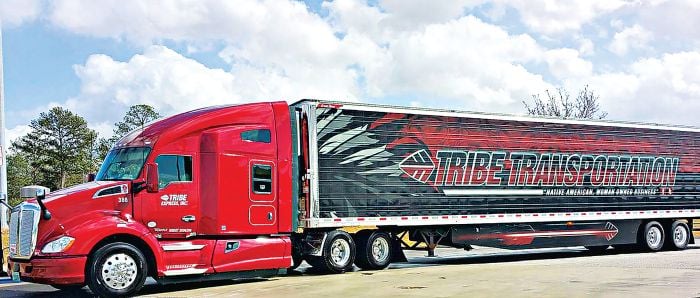
Helping in a big way to express that appreciation is Tribe’s premium equipment. The fleet is currently buying Kenworth T680 tractors with 76-inch sleepers, which Handte credits with both finding and keeping drivers. The trucks are powered by Paccar MX-13 engines, rated at 455 hp and driven through Eaton Fuller Advantage automated manual transmissions.
Ad Loading...
Given that Tribe drivers run a lot of miles – about 250,000 on average for teams and 125,000 for solos — the company believes it’s crucial to provide them with a comfortable truck. The sleepers boast a drawer-style refrigerator, rotating table, and room for a microwave. The cabs feature the OEM’s SmartWheel steering wheel, Driver Performance Center, and radio with high-performance speakers as well as SiriusXM satellite radio and enabled Bluetooth.
Tribe recently also opted to outfit its entire fleet with EpicVue in-cab satellite TV and its DirectTV programming packaged with truckers in mind. After ordering 200 EpicVue systems in late 2015, the company has committed to buying another 100 in-cab satellite TV systems for new tractors being added this year.
The fleet is installing the satellite TV systems in existing trucks based on driver seniority and expects to complete that work in six months. EpicVue will be installed in new trucks as they are placed into service.
“EpicVue offers the kind of value and comfort we try to provide drivers by giving them the ability to watch a game, movie or program they might watch at home,” says Handte. He figures the investment will quickly pay dividends in driver retention. “It can cost us $2,000 to recruit, train, and orient a new driver,” he says, “and an empty seat can cost $5,000 per week in lost revenue.
“That makes the payback on EpicVue for installation and subscription costs very fast,” he continues. “Based on how positively our drivers have reacted to our decision to equip the entire fleet with satellite TV, we believe the systems will lower our turnover rate even further.”
Fleet Snapshot
Who: Tribe Express
Where: Gainesville, Ga.
Fleet: 238 tractors (mostly Kenworth T680), 400 Great Dane refrigerated trailers
Operations: The asset-based truckload carrier specializes in hauling temperature-controlled freight, including refrigerated and deep-frozen goods as well as pharmaceuticals.
Fun Fact: The fleet is a division of Native American woman-owned Tribe Transportation, one of the fastest-growing minority carriers in North America.
Challenge: Recruiting and retaining enough drivers to keep pace with its rapid service growth.
After three decades in trucking, Harold Perry shares what he's learned about driver safety, mentorship, and helping the next generation build confidence behind the wheel.
Fleets have more visibility into truck health, safety events, and driver activity than ever. The next challenge is turning all that information into useful guidance for the person who has to decide what to do next.
Federal regulators also are targeting more than 160 additional training providers and launching a nationwide audit of third-party CDL skills testers as part of a broader crackdown on trucking fraud.
Two pilot programs could eventually reshape hours-of-service rules, giving truck drivers options to pause their 14-hour clock or use longer split sleeper rest periods.
Medical-card violations jumped to the top of the driver out-of-service list during CVSA’s 2026 International Roadcheck, while English-language proficiency violations appeared among the leading violations for the first time.
New Teletrac Navman research suggests that onboarding, transparency about driver data, and positive feedback can play a significant role in how commercial drivers respond to safety and coaching technology.