




Tracking Tire Performance
If you were serious about getting the best odds on a pro basketball bet, you'd research the heck out of the starting lineups, and know in advance that Kobe Bryant's sprained ankle doesn't seem to be much of a liabilit

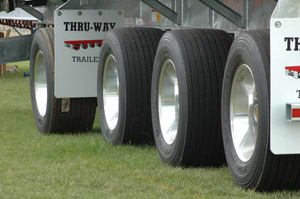
So many brands of tires, so many wheel positions, so many options. Data tracking can help evaluate tire performance. (Photo by Jim Park)
If you were serious about getting the best odds on a pro basketball bet, you'd research the heck out of the starting lineups, and know in advance that Kobe Bryant's sprained ankle doesn't seem to be much of a liability
at all. The Lakers have gone four-and-oh since he was sidelined, posting a profitable mark of 3-1 against the spread in those games. Knowing who is in, who is out, who is hurt, and who is hurting gives you an edge in guessing the spreads. Knowing the numbers pays in betting.
The same applies in truck maintenance - except the outcome should be less of a gamble.
A good tire tracking program - and we don't mean software in this instance - can reveal your tire cost per mile to five digits right of the decimal point using just simple arithmetic and basic spreadsheet skills. More advanced programs - now we're talking software - can also tell you that tire cost per mile remains constant down to 6/32s of an inch on drive tires, but below that, costs spike upwards.
Why? The software might not reveal the reason why, but it provides clues. Careful analysis might show, for instance, that puncture wounds occur more frequently as the tread becomes thinner, which would reveal an increase in costs due to on-road failures between 6/32s and 4/32s. Next, you'd want to assess the cost/benefit of pulling the tires at 6/32s rather than 4/32s to minimize the likelihood of a puncture and a road-service call while giving up 2/32s of tread life.
You can't do that if you're just eyeballing your tires, but even a paper and pencil system is better than guessing.
Goodyear's commercial tire marketing communications manager, Tim Miller, speaks highly of the Technology and Maintenance Council's Recommended Practice number 208 - designed to track and analyze durability and operating costs.
"TMC's RP 208 is a great model for tracking tire expenses," he says. "It works whether you manage only a handful of vehicles and fill in the worksheets with a pencil, or if you're inputting data electronically from a much larger fleet."
The RP 208 template is limited, however, to tracking and revealing raw costs. It was not designed to track individual tires. It won't track wear rates, provide failure analysis, or monitor fuel economy differences across various tire brands and models.
But as the fleet size increases, keeping records the old-fashioned way becomes more difficult - and labor intensive. The data you get is only as good as the information you put into your system, and what you get out of it varies with the complexity of the system. Taking tire management and performance tracking to a higher level requires a tire management system.
Unique identifiers
Even a relatively simple performance tracking system requires a unique identifier on each tire. Branding is one option, says Doug Jones, customer engineering support manager for Michelin Americas Truck Tires. Bar coding, chipping and RFID tags are others.
"Branding is the simplest method, but requires manual data entry for the life of the tire; writing down the number or putting it into the system with a keypad or something," he says. "Bar coding allows the identifier to be scanned with a reader, which will flow the information into the tracking program automatically."
The next step up, he explains, is chipping, or inserting a computer chip into the tire that can be scanned with a reader. Dumb chips, like bar codes or brands, just identify the tire. Smart chips and RFID tags will record and store data from the tire for input to the system. These can provide pressure readings at intervals, high and low pressure readings, mileage, high temperature indications, etc.
Bar code patches and RFID tags are available from suppliers such as Tire-Track LLC. These are customer-installed devices attached to or mounted inside tires for tracking purposes. The tag has to become a permanent part of the tire to provide cradle-to-grave tracking. Some products will withstand the retread process; others will not, so buy carefully.
Jones says RFID tagging is still pretty expensive because it's new, so it's not as common as bar coding. "Plus," he notes, "You have to keep the tag with the tire, and that could create problems when remounting tires after service or during retreading. If you mix up the tag with another tire, your data is at risk."
RFID technology will become more common, and currently, the tire makers, along with TMC and the Society of Automotive Engineers, are working on protocols so that going forward, there will be compatibility across tire brands and hopefully the tracking software providers too.
Identifying individual tires takes performance tracking to the next level. The most basic function available would be tracking on and off mileage and inventory control. Both useful in their own right, but from there, the sky is the limit.
Data mining
For some fleets, simply tracking on and off mileage and recording pressure checks is sufficient. But more sophisticated fleets - and that doesn't necessarily mean bigger - can harvest and aggregate data in ways that make your head spin. You now can, for example, compare Michelin versus Bridgestone steer tires on the right or left position on a Freightliner Cascadia in long haul versus local service, or track wear patterns on different brands of tires mounted on Kenworth suspensions versus Mack suspensions.
That's in addition to basic inventory control, casing control and warranty claims management. The advantage of the more sophisticated software packages is that they are often menu-driven, and priced by the options you need to track.
Squarerigger's Revolution Tire Management System starts with a wireless handheld data collection tool called Inspector. It eliminates data entry by capturing tread depth and pressure readings wirelessly and flows that information directly to your database. Menu options on the reader allow you to bring up specific vehicles, where tire data has previously been entered. After scanning the tire with the bar code reader, users record current inspection data, including pressure and tread depth at up to three positions on the tire.
Data can be entered manually via a key pad or a stylus, or with the optional Quick-Check probe. It's a Bluetooth device that checks tread depth and pressure in seconds, and flows it to the handheld Inspector.
"The learning time for the device is about five minutes," says Squarerigger's Nathan Walker. "A complete yard check of a three-axle tractor would typically take less than five minutes. It's highly visual, with an axle footprint icon that shows the position of the tire. That links to a similar screen on the desktop application to maintain continuity."
There's a screen on the reader where tire wear or damage is noted, using standard VMRS codes.
In the desktop application, standard maintenance functions such as tire rotation can be noted and recorded in a simple drag-and-drop function. Tires can be switched from unit to unit, axle to axle, moved to inventory, taken out of service, or shipped out for retreading. And with two-way data exchange, changes made in the desktop are automatically uploaded to the Inspector.
Suffice it to say, if there's some detail that needs to be captured related to your tires, this package does it.
Where the system really shines, notes Ed Cooper, is when you subscribe. "There's a function which uploads blind data to our data center over night. We track brand, vocation, type of equipment, etc., and we aggregate the data from customers all over the world, for all different types of equipment, manufacturers, sub-models, and so on. We can then provide information back to fleet, based on a sampling of a million tires rather than just across your fleet, with everything a fleet could want to know about any tire brand's performance in any application at any wheel position on any piece of equipment," says Cooper. "We'
More Maintenance

What Three Fleets Are Doing Differently When Buying Truck Parts in 2026
With freight improving but costs still climbing, fleet maintenance executives explain how they're balancing price, quality, and supplier relationships.
Read More →
Paccar Recalls 2027 Trucks Built This Summer for Possible Electrical Problem
The nearly 6,000 Kenworth and Peterbilt trucks in the recall could potentially lose engine power, among other things.
Read More →
Will API PC-12 Oil Change Trucking Fleet Maintenance?
The new API PC-12 heavy-duty engine oil category reflects the changing demands of modern diesel engines. But fleets like Foodliner are looking to getting their own data before making decisions on adopting the new oils and questions such as extending oil drain intervals.
Read More →
Brake Safety Week to Focus on Drums and Rotors
Commercial vehicle inspectors will be focusing on brakes during CVSA's Brake Safety Week, August 23-29.
Read More →
Possible Battery-Cable Fires Prompt Recall of 15,000+ International MV and HV Trucks
On the recalled vehicles, manufacturing variations can cause the battery interconnect cable to contact the auxiliary stud and hold down the bracket.
Read More →
Rush, MCT Team Up to Grow Refrigeration Service Network
The joint venture will operate MCT's network of Carrier Transicold dealerships and mobile service locations, with the companies promising greater service capacity and uptime for refrigerated fleets.
Read More →
ConMet Expands Aftermarket Brake Drum Lineup With TruCast
A new heavy-duty truck brake drum option in the aftermarket gives customers more flexibility within the ConMet product family.
Read More →
Mack Expands Premium Service Contract Coverage to Medium-Duty MD
With a service contract, inspections, preventive maintenance and repairs can be handled in a single visit instead of multiple ones.
Read More →
Maintenance in the Messy Middle Part 5: Battery-Electric Trucks
No oil changes. No diesel exhaust fluid. No exhaust aftertreatment. But NACFE battery-electric trucks still require specialized maintenance procedures.
Read More →
Trucking Fleets Faced Record Operating Costs During Third Year of Freight Recession
ATRI's annual operational cost report shows carriers trimmed fleets, delayed equipment purchases, and ran older trucks as expenses continued to outpace freight rates.
Read More →