




The Art and Science of Truck and Engine Diagnostics
Diagnostics took a while to become a high art, though for for a long time it was a human one.
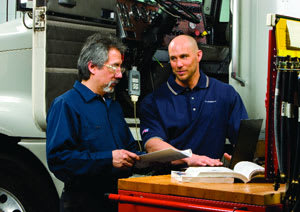
Diagnostics took a while to become a high art, though for for a long time it was a human one.
You could easily argue that it's no longer a human activity at all, given how much can be accomplished by digital gizmos that can tell you who made a lousy shift in truck #6554 two Wednesdays ago just east of El Paso at 3:19 in the afternoon. If you ask.
Things were different back in the days of horses and buggies, when hauling freight was a somewhat simpler mechanical enterprise than it is now. You could see every single part of your trailer, and when something broke it didn't take a zillion hours of shop time to figure it out.
And, best of all, it was never a wiring issue.
Your one-horse "engine" (maybe you hauled heavy and needed two) wasn't really a whole lot different. When the nag pulled up lame you probably just needed a new shoe, simple enough. And when he was just plain too old to move and turned around to give you The Look in response to your "giddup," well, the story was clear.
Then, for a very long time, it was the era of The Stare. Once engines began to be made mostly of iron instead of equine flesh and bone, and we multiplied their paltry power by means of steel gears, the art of mechanical diagnosis was born. Really, from that point until the advent of the electronic engine - which is very recent indeed - mechanics were often to be found standing 10 feet away from the failed truck and staring at the darned thing. Sometimes they huddled in groups. Maybe the shop super joined them, as if ingenuity could be expanded by piling one befuddlement on top of another.
In the first few decades of this second era, the art of engine diagnostics began with desperately simple questions like, is it getting fuel?
There were many who stared a lot back in the day, certainly. But it really did become an art for some folks, the intuitive ones, those with imagination. The guys who took it to its highest level were elevated to star status in the shop, maybe even in the town at large.
Truck Whisperers, they could've been called.
Things got progressively more complicated, so we devised another means of multiplying ingenuity amongst mortals. We began calling mechanics "technicians." It was a brilliant stroke in theory, the logic being that the moniker made the mechanic more confident and thus better matched him to any given problem's complexity.
When electronically controlled engines rolled onto the scene in the mid-80s and early '90s, some of them sputtering, dashboards awash with mysterious twinkling lights, some operations went so far as to equip their shops with computers. Never mind that they were usually tired old machines the front office had battered for a few years before sending them out back to the poor old maintenance lads. Some technicians spent as much time diagnosing desktop computer glitches as they did programming engine parameters and figuring out their faults.
Today, removing editorial tongue from cheek, the nature, the very concept of complexity gets re-defined every day, yet the diagnostic art has changed radically and become easier than ever.
However, there are those fleet managers who haven't exploited the wonders of the microchip and the literally countless diagnostic tools now available.
And if we're to believe a recent survey by Arsenault Associates, makers of Dossier fleet-management software, that's a whole bunch of folks. According to that survey, admittedly an informal one, less than 44% of fleets maintain their vehicles using software designed for that specific purpose. Almost 34% reported that they still use either paper and pencil - or nothing at all - to keep maintenance records.
An abundance of anecdotal evidence backs this up.
We can presume, I think, that if truck and trailer maintenance is managed this way, then at least a third of American fleets definitely aren't equipped to answer the driver's question as to what that flippin' red light means. And they certainly don't know it's shining until he calls.
The combination of a technician shortage and the increasing complexity of our machinery has meant more and more fleets are leaving diagnostics to the professionals at the truck dealer or engine distributor. Probably not such a bad idea in most cases, but are truck owners - and drivers, for that matter - actually helpless?
Not at all, and that gets truer all the time, because every modern-era truck has more sensors than the Yankees have fans. Or detractors. Add to all those sensors the combination of GPS and satellite and/or cell-based communications. No longer does a truck have to be in a shop bay and plugged into a laptop in order to lay its soul bare. That can be done from anywhere, and it's called telematics.
It's astonishing how many diagnostic tools are out there to catch all that data and make sense of it, and not just the obvious "traditional" analyzers from companies such as Snap-on/Nexiq, SPX/OTC or Noregon that you see on serious shop floors. In fact there are so many that we couldn't possibly do the traditional round-up article here, getting comment from everybody who plays in this arena. We'd need the entire issue.
Instead, a brief update on the onboard diagnostic systems that the Environmental Protection Agency made popular with the advent of 2010-model-year engines. The more you look at this, the more it seems to be good news.
That is to say, onboard diagnostics equals No Big Deal. OBD is the quiet component in the Environmental Protection Agency's 2010 emission regime, a demand that truck manufacturers install diagnostic systems to make sure that emission control systems are working as they should. They must alert the driver if a repair is needed and retain that diagnostic information long enough for repairs to be made.
The rule, truly massive at 474 pages, is essentially the same as a California program instituted several years ago, and not unlike rules for passenger cars and light trucks that were cast in stone back in the 1990s.
The new standards apply to all major emission control systems and their sensors in diesel and gas highway trucks with gross weights over 14,000 pounds, but they're being phased in. In model years 2010 through 2012, manufacturers will have to meet the requirements in just one of their heavy-duty engine families. Starting in 2013, all engine families will have to comply.
Cummins, for example, has OBD working on "Family 1" ratings in its ISX15 line. That means the lower power ratings of 400, 425, and 450 horsepower. Come 2013, all remaining 15-liter engines plus the 11.9-liter ISX will be included. In fact, says Ben Zwissler, the company's chief engineer in charge of diagnostics/OBD, Cummins already has OBD working on all its engines right now, the main difference being that only ISX15 Family 1 motors have the driver-alert dash lamp engaged.
The EPA even specifies where that lamp must go, by the way, mounted on the left side of the dash. It has to be amber in color and be bright enough to be visible under all lighting conditions.
The new EPA rule also changed things for engines in trucks under the 14,000-pound level, though they already had a diagnostic requirement. Previously their warning systems were set off when a given component was about to fail completely. Now they have to be calibrated to a lower threshold, the same one set for heavier trucks.
The only controversial part of the OBD rule is the so-called "right to repair" issue, namely the access that independent shops have to repair and maintenance information. This isn't fully resolved in practice, but the EPA rule specifically says the requisite information, along with the most capable tools, website access, and training, must be
More Maintenance

Color Match Smarter: Tools That Restore & Perform
For fleet managers and collision repair professionals keeping heavy-duty trucks on the road, getting the color right the first time isn't just about appearance — it's about efficiency, turnaround time, and bottom-line results. Discover how today's digital color tools are transforming the repair process from guesswork to precision.
Read More →
Wrong Repair Prompts Recall of Freightliner, Western Star 4x2 Trucks
DTNA is recalling more than 2,400 trucks that received an incompatible software fix instead of the hardware repair required to address brake valve corrosion.
Read More →
Truck Drivers Need More Than Another Alert
Fleets have more visibility into truck health, safety events, and driver activity than ever. The next challenge is turning all that information into useful guidance for the person who has to decide what to do next.
Read More →
The Maintenance Checks Trucking Fleets Should Prioritize Before Fall Freight Picks Up
Making it through August isn’t the same as being ready for the next several months of operation. Find out what systems may have suffered from summer heat and need to be checked out before fall.
Read More →
What Three Fleets Are Doing Differently When Buying Truck Parts in 2026
With freight improving but costs still climbing, fleet maintenance executives explain how they're balancing price, quality, and supplier relationships.
Read More →
Paccar Recalls 2027 Trucks Built This Summer for Possible Electrical Problem
The nearly 6,000 Kenworth and Peterbilt trucks in the recall could potentially lose engine power, among other things.
Read More →
Will API PC-12 Oil Change Trucking Fleet Maintenance?
The new API PC-12 heavy-duty engine oil category reflects the changing demands of modern diesel engines. But fleets like Foodliner are looking to getting their own data before making decisions on adopting the new oils and questions such as extending oil drain intervals.
Read More →
Brake Safety Week to Focus on Drums and Rotors
Commercial vehicle inspectors are focusing on truck brakes during CVSA's Brake Safety Week, August 23-29.
Read More →Possible Battery-Cable Fires Prompt Recall of 15,000+ International MV and HV Trucks
On the recalled vehicles, manufacturing variations can cause the battery interconnect cable to contact the auxiliary stud and hold down the bracket.
Read More →
Rush, MCT Team Up to Grow Refrigeration Service Network
The joint venture will operate MCT's network of Carrier Transicold dealerships and mobile service locations, with the companies promising greater service capacity and uptime for refrigerated fleets.
Read More →