




Test Drive: Hyundai’s Xcient Fuel Cell Truck
A new, driver-focused interior suggests Hyundai is closing in on serial production and deployment of its Xcient fuel cell truck in North America.

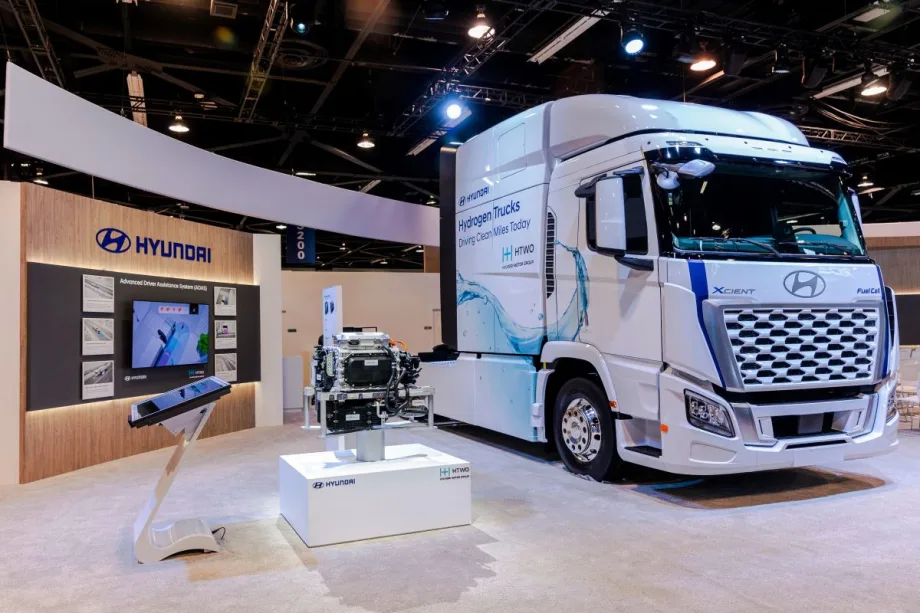
Hyundai's deliberately meticulous approach to the U.S. truck market appears to be gaining steam.
Photo: Hyundai
Driving the Hyundai Xcient fuel-cell truck has become something of an annual ritual for me at ACT Expo. And this year was no different. On a bright and windy California afternoon I once again climbed into the cab of a gleaming white Xcient tractor. As always, the goal was to see how the truck performed and what’s new with Hyundai’s constantly evolving design.
A Slow Rollout Explained
Admittedly, a convention center parking lot is not the ideal setting for a Class 8 truck test drive. Hyundai knows this. Which is why it has promised a more formal test drive in the future.
But its slow rollout for the Xient Fuel Cell truck is understandable.
The OEM has been eying the North American heavy truck market for decades, now.
It’s a market sector that has proven notoriously difficult for Asian truck OEMs to penetrate, despite having stables of outstanding vehicles in use worldwide.
Mainly, I suspect, this is because the heavy truck design parameters in North America are so wildly different from those found in Asia. Most designs are cabovers with design priorities placed on maneuverability in tight urban settings and maximized fuel economy. So, it’s easy to see why Asian truck models find it much easier going in Europe than in North America.
But the advent of aggressive (and now uncertain) diesel exhaust emissions driven by the California Air Resource Board regulations in the U.S. gave Hyundai the opening it was looking for.
The OEM has been developing hydrogen fuel cell technology for heavy trucks for years. It has even run extensive tests of its trucks on public roads in Europe. Hyundai felt it was years ahead of other truck OEMs in hydrogen fuel cell technology.
In 2020 Hyundai announced it would bring fuel-cell cabover trucks to the U.S. and the OEM has been working on perfecting that technology ever since. There is, after all, a lot to get right: Hyundai is a brand-new OEM in the North American heavy truck space, after all. And it is coming to market with a brand-new propulsion technology. It’s understandable that Hyundai wants to get everything right from the get-go.
An All-New Cab Interior
All Xcient trucks in the U.S. are painted a brilliant pearl white. It’s a thoroughly modern-looking Class 8 cabover design. The truck has a decidedly broad-shouldered stance when view from the front. And – like all Class 8 cabovers – it appears to tower over the pavement in a way that conventional models don’t.
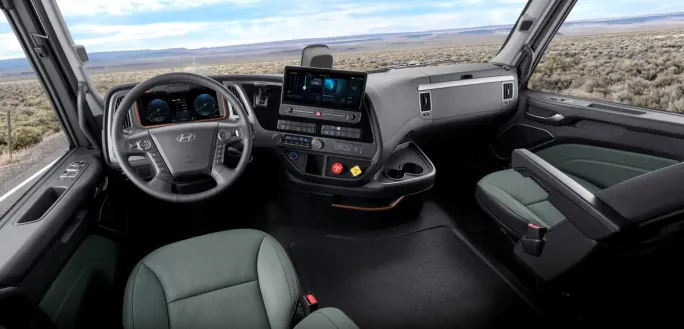
A new, driver-focused interior for the Xcient is a sign Hyundai is nearing the start of serial production for the new truck.
Climbing into the cab is straight-forward. Hyundai has provided ample handholds and steps to assist drivers and keep them safe when entering or exiting the truck.
In my past Xcient test-drives, the focus has always been on the fuel cell powertrain. Understandably, Hyundai was eager to showcase its technology and demonstrate not only that it worked, but that it was a viable alternative to diesel-powered Class 8 trucks.
On this drive, however, something new immediately jumped out at me: The all-new, modern interior and amenity upgrades inside the Xcient cab.
Earlier Xcient examples I’d driven had extremely basic, nondescript interiors. Again – understandable as the focus of those early trucks was on proof-of-concept for the hydrogen fuel cell powertrain.
But now the Xcient boasts a thoroughly modern interior with plush, fully adjustable, air-ride seats and a new interior, highlighted by a new dash and door trim.
Most striking, however, is the new driver-vehicle interface, dominated by a large, easy-to-reach display screen mounted in the center of the dash. The display screen angled toward the driver, naturally. And accented by climate controls and stereo.
Directly in front of the driver is an all-new digital gauge cluster that is brilliantly lit and easy to read even in bright California sunlight.
The Xcient’s steering column is fully adjustable and topped off by a large, leather-wrapped steering wheel. The steering wheel itself features an array of large control buttons and toggles. These controls are clearly marked with large, read-at-a-glance icons and are easy to reach and accurately engage. The transmission selector stalk is mounted down and low on the right-side of the steering wheel.
Views from the cab are commanding, particularly over the front end of the truck – as is often the case with Class 8 cabovers. And that was a definitely advantage given the amount of traffic at the ACT Expo test drive area at the Anaheim Convention Center.
The drive itself – through a cone course at parking lot speeds was unremarkable. And that’s exactly what Hyundai intends.
The Xcient drivetrain is remarkably smooth and quiet. The truck accelerates briskly. And the adjustable regenerative braking system works so well I drove in one-pedal mode during my laps around the cone course. In fact, the only time I needed to apply the service brake was when coming to full stop at the pedestrian crossing leading to the test drive parking area.
Why a Quiet Interior Matters for ZEVs
The Xcient’s interior is amazingly quiet as well. And I mention this because it’s an important point that I believe will get talked about more as battery-electric and fuel-cell trucks enter the marketplace.
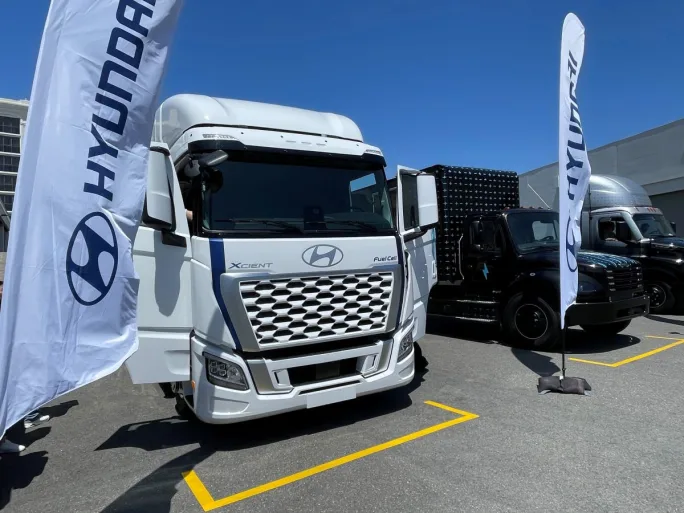
The Xcient proved to be extremely quiet -- both inside the cab and out --during a test drive at ACT Expo 2025.
Photo: Jack Roberts
These zero-emission powertrains are so quiet, that interior cabin noises that used to be drowned out by a diesel powertrain can suddenly become noticeable and distracting. I predict that mitigating rattles, pops and squeaks that don’t get much attention inside the cab of diesel trucks will soon be a priority for OEMs building zero-emissions trucks. And it’s clearly an issue Hyundai engineers have already given a great deal of thought to.
Hyundai – as always – remains famously tight-lipped about its timeline for when the Xcient will enter into mass production in the U.S. The introduction of a brand-new interior for the Xcient leads me to believe that Hyundai is very near to finalizing the design of its first-ever U.S. heavy truck.
That development, coupled with Hyundai and Plus’ announcement of a conceptual autonomous, hydrogen-powered freight ecosystem, lead me to believe that the is very close to launching the Xcient in North America.
More Fuel Smarts

How GP Transco Builds Fuel Savings a Fraction at a Time
Aerodynamic specs, solar panels, and driver incentives help GP Transco turn small efficiency gains into savings it can reinvest in its people.
Read More →
Trucking’s Diesel Squeeze Isn’t Letting Up
With diesel topping $6 a gallon nationally, ATA's Bob Costello explains why fleets should prepare for continued pressure at the pump.
Read More →
FlowBelow Redesigns Trailer AeroSlider to Cut Fuel Use
The lighter trailer aerodynamic system installs in less than 45 minutes, according to the company, with potential payback in under a year depending on fuel prices and trailer mileage.
Read More →
Why Diesel Price Relief Efforts May Fall Short
Diesel prices have eased from September’s record high, but doubts about additional Russian supply and limits on dyed-diesel tax relief mean trucking fleets still face expensive fuel. And prices could go higher.
Read More →
Why Small Fuel Savings Matter in Trucking
Can better fuel economy help pay for driver raises? In this podcast, GP Transco explains how small efficiency gains create room to reinvest in its people.
Read More →
How GP Transco Cuts Trucking Fuel Costs, a Tenth of a Gallon at a Time
What’s another tenth of a mile per gallon worth? GP Transco shares how equipment upgrades and driver coaching turn small gains into meaningful fuel savings.
Read More →
Electric Yard Tractors Move Beyond Pilots
Operating-cost savings have overtaken sustainability goals as the leading reason surveyed fleets are adopting battery-electric terminal tractors, according to new NACFE research.
Read More →
Geotab Links Fleet Card to Vehicle Data
The new card combines fuel discounts with telematics-based purchase controls. Geotab’s analysis also points to potential savings from choosing lower-priced fuel stops.
Read More →
Fleet Economics Shape Electric Truck Outlook
ACT Research expects costs, charging infrastructure, and technology improvements to drive zero-emission commercial vehicle adoption as federal regulations and incentives retreat.
Read More →
Wex Adds Cardless Fuel Payments for Over-the-Road Customers
A new fuel card feature for Wex customers offers convenience and security.
Read More →