




Test Drive: Ford's New Power Stroke Diesel's a Smoothie
There apparently was never any question whether Ford Motor Co.'s new Power Stroke diesel would be another V-8 because, as an engineer explained when it was announced last year, "V-8s are in Ford's DNA.

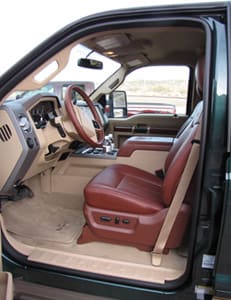
King Ranch seats have thick, soft leather like that on a quality baseball mitt, but they're part of a high-end trim package. (Photo by Tom Berg)
There apparently was never any question whether Ford Motor Co.'s new Power Stroke diesel would be another V-8 because, as an engineer explained when it was announced last year, "V-8s are in Ford's DNA."
Ford wasn't the first to build a V-8, but Henry Ford popularized it in the days of inline 4's and 6's, starting in 1932 with the famous "flathead" V-8 for cars and light trucks. Its original maximum output was a racy 65 horsepower, but today's versions make five times that much.
Through the years, Ford designed and built its own gasoline V-8s, and some pretty good straight 6's, as well (in the early years its inline six-cylinder engines actually had more torque, so were arguably better engines, at least for trucks). Ford's latest V-8 is the new 6.2-liter version for the latest SuperDuty pickup trucks, which will go into production this summer.
But Ford's first diesel was supplied by Navistar International, in the early 1980s. This arrangement seemed to go fine until model-year 2004 and the 6-liter version of the Power Stroke, which soon exhibited serious problems. High warranty claims weren't being shared enough by Navistar, Ford claimed, and sued. Navistar countersued, alleging that Ford's development of its own diesel violated their supply agreement. They settled their differences in 2009 and the agreement ended. Navistar stopped making Power Strokes and Ford has begun building its new 6.7-liter diesel in Mexico.
The new Power Stroke was the main topic of enthusiastic presentations and conversation by company marketers and engineers at a ride-and-drive event in Arizona in March. Any mention of the outgoing Navistar-made product was met by scowls, and never mind that the Ford folks had heaped praise on a corrected 6.4-liter version just three years previous. The new Ford 6.7 is not just better, they said, but it's been tested over 10.3 million miles. And it really is a pretty nice engine to drive - smoother, quieter and cleaner-burning - and claims some big numbers: 390 horsepower with torque of 735 pounds-feet, enough to carry as much as 6,520 pounds and pull up to 24,400, but with better fuel economy.
The 2011-model SuperDuty itself is also pretty nice, with sharper edges to its bold, chromed nose, a wider "clamshell" hood for better access to engine and accessories, and freshened interiors. All kinds of electronic "infotainment" stuff can be had, but I ignored most of it and just drove. Most of the F-250, 350 and 450 pickups at the event were SuperCrew four-doors with top-of-the-line Lariat or King Ranch trim.
I grabbed King Ranchers when I could because I covet their thick, soft leather seats that remind me of my old 10-dollar Wilson baseball mitt. Back in the 1950s I'd smack-smack-smack a pocket into it with a 98-cent hardball while listening to radio broadcasts of the old Milwaukee Braves games. I'm sure my favorite player, big, sluggin' first baseman Joe Adcock, had a Wilson mitt. And if he were still alive he'd surely drive a Ford F-250 with the King Ranch interior (even if he was from Louisiana and not Texas). He could afford the $4,000-plus upcharge for the package, which includes convenience and appearance items never dreamed of in the '50s.
But back to the engine: Just a few of the SuperDuty pickups at the Arizona event had the new 6.2-liter gasoline V-8, and I never got to drive one. So all I can comment on is the Power Stroke, and it's a smoothie. It idles very quietly and can hardly be heard from inside the cab unless it's working hard. The truck's smooth, too. We drove SuperDuties both empty and loaded, and the on-pavement ride was fine either way - firm but with little or no hint of roughness unless the road or trail was rough.
At one point we pulled loaded trailers up a 4- to 6-percent highway grade south of Prescott, and all the trucks showed power and stability. The lighter trailers hardly made the engines breathe hard, but one of 'em weighed 22,000 pounds and this gave the engine a workout. Diesel-powered Dodges and Chevys were provided for comparison.
Firmly in my memory from a similar event for then-new '08 SuperDuties in Texas Hill Country was how the Navistar-made 6.4 diesel had to rev to make power, usually 3,300 rpm or more with a heavy trailer. Well, I thought, it's a V-8 and it's got to spin. But the new Ford 6.7 runs about 500 rpm slower, and only 200 to 300 rpm higher than a Dodge Ram's inline-6 Cummins Turbo Diesel. The Power Stroke cruises at 1,600 to 1,700 rpm, where it makes its maximum torque.
Low cruise revs for Fords are possible with a new TorqShift 6-speed with overdrive gearing in 5th and 6th, and a lower (higher numerical) 1st gear than with the 5-speed TorqShift. Six-speed automatics are where heavy-duty pickups are at, and Ford is dropping the 6-speed manual transmission it offered through 2010. Almost no one wants a "stick" anymore, the Big Three builders say.
The TorqShift 6, as Ford calls it, changes gears so smoothly that I could seldom feel it, and it works with an integral exhaust brake in the turbocharger. It automatically downshifts to let the brake hold road speed on downgrades, which it will usually do without any application of service brakes. Its selector can be pulled to an M for Manual mode, and a spring-loaded thumb switch on the lever lets the driver up- or downshift as he or she pleases, as long as the engine would be in its proper rev range. A Tow-Haul mode, activated by a push button on the end of the lever, prolongs time in each gear during acceleration and makes more aggressive downshifts while slowing. (General Motors and Dodge trucks have these features, too.)
The 6-speed tranny's electronically controlled torque converter supports a "live" power take-off drive so equipment can be operated not only while standing still (as before), and also now while the truck's moving. This lets a dump body spread dirt or gravel and a tanker spray water or whatever along a trail, something Fords couldn't do before, and, Ford folks claim, competitors still can't. When the PTO's engaged, engine revs automatically bump from idle to 750 rpm.
The TorqShift 6 will be standard with both the 6.7 diesel and the 6.2 gasoline V-8. The new gas engine is standard in F-250s and 350s, while the current 6.8-liter Vortec gasoline V-10 with the 5-speed TorqShift is standard in the F-450 and 550. All the 2011 F-SuperDuties can be ordered with the new 6.7 diesel, and its upcharge is no higher than it was for the discontinued 6.4 diesel (though its list price was $7,835). (The new Power Stroke is too large to fit in E-series vans, so those become gasoline-only when stocks of Navistar diesels run out.)
Back to the pickup: 4x4 SuperDuties are very capable off-road and on rough trails, as was proven to us at a quarry northwest of Phoenix. Electronic Hill Descend, activated by a switch on the dash, controls downward speed, and E-Lock, engaged by pulling on the 4WD rotary switch, enhances traction. With the TC in 4-Low, an inclinometer appears on the dash info display to show how far the truck's leaning.
Need to tow? An integral trailer brake controller links the towed vehicle's brakes with the truck's, and there's a Sway Control function that operates the brakes wheel-by-wheel if on-board sensors feel any yawing in the trailer. For easy backing to a ball-hitch trailer there's an optional rear-facing camera. Buyers who plan to pull serious trailers can pick a factory-installed fifth-wheel hitch kit that includes two extra crossmembers under the bed and electrical hookups. It costs about $400 versus maybe $1,000 for an aftermarket installation.
While we're talking money, basic specs sheets with list prices were in each of the demo trucks, and some prices were in the $50,000s and into the low $60,000s. Of course, these are not merely very capable pickups, but limousines that can carry you and up to five passengers in style while hauling almost anything that'll fit
More Equipment

How Volvo Updated Its D13 for EPA 2027 [Watch]
Volvo’s updated D13 promises lower emissions without sacrificing performance or fuel economy. Take a closer look at what changed inside the engine in this HDT Spotlight video.
Read More →
Michelin Tire Improves Efficiency and Durability for Regional Fleets
The Michelin X Multi Energy D2 is a regional haul drive tire engineered to help fleets improve fuel efficiency, durability and traction in demanding stop-and-go operations.
Read More →
ZF Expands Commercial Vehicle Push in North America
ZF is expanding its North American commercial-vehicle presence with new transmission applications, electrification, trailer technology and autonomous-driving systems.
Read More →
Tesla Wants a Self-Driving Semi. Are Cameras Enough?
Could Tesla’s camera-only autonomous driving technology work on an 80,000-pound Semi? In this commentary, HDT's Deborah Lockridge takes a look at Tesla, Cybercab, and how autonomous trucks see the road.
Read More →
Kodiak: Driverless Long-Haul Truck Launch on Track for 2026
Kodiak AI says its driverless long-haul safety case is 93% complete and it remains on track to begin commercial operations by year-end 2026.
Read More →
What DOT’s Automated Vehicle Strategy Means for Trucking
The U.S. Department of Transportation issued a new automated-vehicle strategy that outlines plans for driverless-truck regulations, cross-state freight corridors, and federal safety standards.
Read More →
East Coast Port Launches $45M Electric Truck Push
The Port Authority of New York and New Jersey announced millions in incentives for zero-emission drayage trucks, yard tractors, and new charging hubs near the port.
Read More →
PlusAI Going Public to Fund Autonomous Truck Launch
A SPAC deal could provide PlusAI with up to $300 million as it works toward a 2027 commercial launch of factory-built autonomous trucks.
Read More →
NHTSA Moves to Rewrite Truck Fuel-Economy Rules
The National Highway Traffic Safety Administration says it lacks authority to regulate medium- and heavy-duty truck engines separately from complete vehicles, but the existing standards have not yet been eliminated.
Read More →
Detroit Opens Orders for EPA 2027 Engines
Detroit isn’t starting from scratch to meet EPA 2027 diesel emissions standards. Its Gen 6 DD13 and DD15 engines keep much of today’s platform while updating the fuel and aftertreatment systems.
Read More →