





Related: Test Drive - Caterpillar’s New CT681
Supplementing Dump Trucks with 'Slingers'
Dump trucks can do a lot of hauling and delivery work, but there’s a limit to how precisely certain loads can be placed. One alternative is the “slinger,” which adds a high-capacity conveyor-belt mechanism to a hopper body.
May 26, 2015
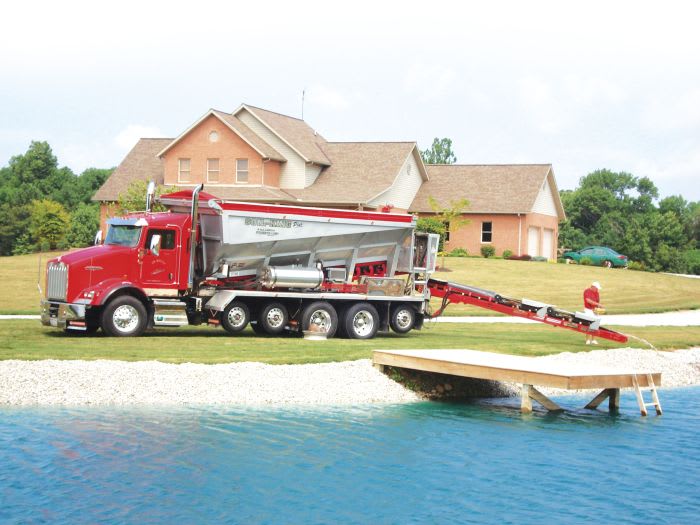
A slinger places stone and other materials exactly where a customer wants it. The driver operates the conveyor from inside the cab or outside, with a remote control box.
2 min to read
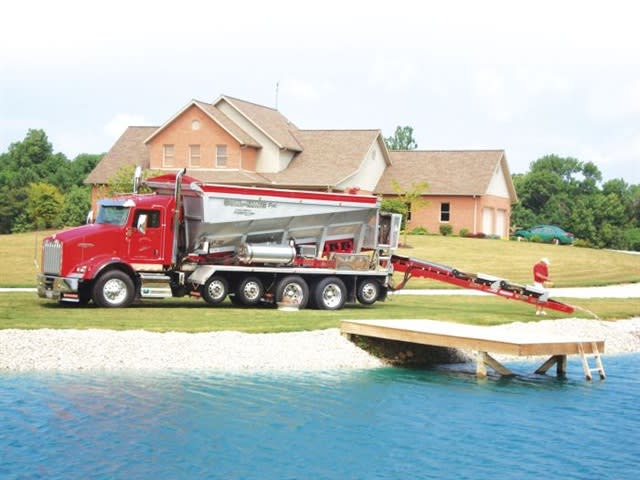
A slinger places stone and other materials exactly where a customer wants it. The driver operates the conveyor from inside the cab or outside, with a remote control box.
Dump trucks can do a lot of hauling and delivery work, but there’s a limit to how precisely certain loads can be placed. One alternative is the “slinger,” which adds a high-capacity conveyor-belt mechanism to a hopper body and throws materials exactly where customers want.
An enthusiastic user is Bob Broerman, owner of Go Bucks Trucking, a dump-truck operation in New Bremen, Ohio. He has four slinger trucks and is acquiring a fifth. It will have a low-profile unit, a Pan American Soil King Extreme, mounted on a Kenworth T800 glider chassis that he’s assembling in his shop.
“I started in the slinger business in 2004,” he says. “It’s a real labor saver for a customer. He just tells me the delivery details over the phone and I do it. It will throw 100, 120 feet in back of the truck, if you can’t back a dump truck up to where the load needs to go or get a skid steer [bucket machine] in. We get into some interesting places. We can back up to a building and throw it in.”
The driver runs the conveyor belt at high speed to throw materials over long distances. Or he slows it for precise placement of stone, gravel, dirt, mulch and other materials at close ranges.
Slinger bodies are expensive, Broerman acknowledges. A new dump truck costs about $200,000 including chassis and body, and a new low-pro slinger-equipped truck exhibited at the World of Concrete show earlier this year was priced at $312,000. Using a glider-kit chassis instead of a new one reduces that to $272,000.
“They can pay for themselves if you get the word out,” he says. “We get an extra $3 a ton for the slinger. In the first year I’d charge the dump-truck rate just to show ‘em what you can do with it.”
Not everyone is as big a fan. An operator near Columbus, Ohio, told HDT that he sold off a pair of slingers because he found them troublesome and they needed too much labor to keep running. Broerman comments, “If you don’t have a good operator it’ll cost you money. It’s a matter of keeping belts tight and greased.”
Subscribe to Our Newsletter
More Equipment

How Volvo Updated Its D13 for EPA 2027 [Watch]
Volvo’s updated D13 promises lower emissions without sacrificing performance or fuel economy. Take a closer look at what changed inside the engine in this HDT Spotlight video.
Read More →
Michelin Tire Improves Efficiency and Durability for Regional Fleets
The Michelin X Multi Energy D2 is a regional haul drive tire engineered to help fleets improve fuel efficiency, durability and traction in demanding stop-and-go operations.
Read More →
ZF Expands Commercial Vehicle Push in North America
ZF is expanding its North American commercial-vehicle presence with new transmission applications, electrification, trailer technology and autonomous-driving systems.
Read More →
Tesla Wants a Self-Driving Semi. Are Cameras Enough?
Could Tesla’s camera-only autonomous driving technology work on an 80,000-pound Semi? In this commentary, HDT's Deborah Lockridge takes a look at Tesla, Cybercab, and how autonomous trucks see the road.
Read More →
Kodiak: Driverless Long-Haul Truck Launch on Track for 2026
Kodiak AI says its driverless long-haul safety case is 93% complete and it remains on track to begin commercial operations by year-end 2026.
Read More →
What DOT’s Automated Vehicle Strategy Means for Trucking
The U.S. Department of Transportation issued a new automated-vehicle strategy that outlines plans for driverless-truck regulations, cross-state freight corridors, and federal safety standards.
Read More →
East Coast Port Launches $45M Electric Truck Push
The Port Authority of New York and New Jersey announced millions in incentives for zero-emission drayage trucks, yard tractors, and new charging hubs near the port.
Read More →
PlusAI Going Public to Fund Autonomous Truck Launch
A SPAC deal could provide PlusAI with up to $300 million as it works toward a 2027 commercial launch of factory-built autonomous trucks.
Read More →
NHTSA Moves to Rewrite Truck Fuel-Economy Rules
The National Highway Traffic Safety Administration says it lacks authority to regulate medium- and heavy-duty truck engines separately from complete vehicles, but the existing standards have not yet been eliminated.
Read More →
Detroit Opens Orders for EPA 2027 Engines
Detroit isn’t starting from scratch to meet EPA 2027 diesel emissions standards. Its Gen 6 DD13 and DD15 engines keep much of today’s platform while updating the fuel and aftertreatment systems.
Read More →