




Related: How E-Commerce Trends Are Affecting Final Mile Logistics
Strength in E-Commerce Could Stress Holiday Season Capacity
Rising overall retail sales — both e-commerce and traditional — and the pressure to deliver products more quickly has led to more truckload and LTL delivery points, not fewer, resulting in greater pressure on capacity.
by Avery Vise
September 21, 2018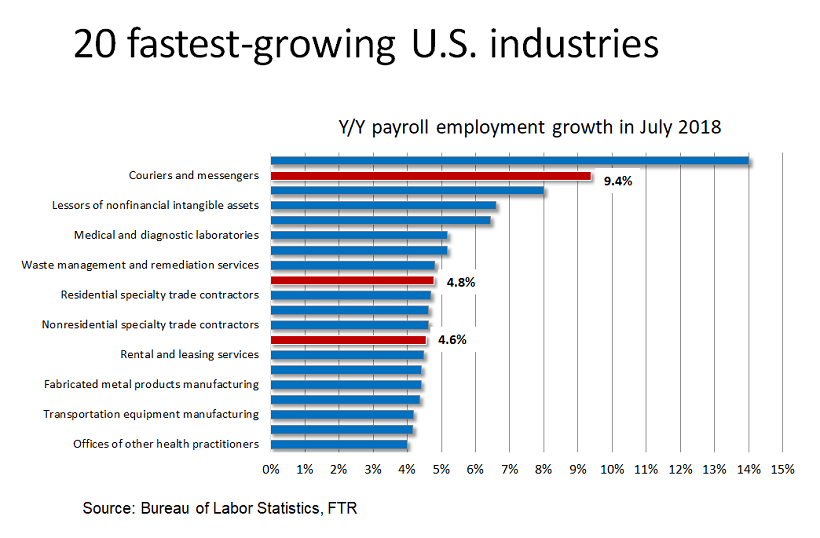
E-commerce is changing the employment landscape. Couriers and messengers was the second-fastest growing U.S. industry year over year. Warehousing and storage and non-store retail — two related industries — also were among the 20 fastest-growing industries.
Source: Bureau of Labor Statistics, FTR
3 min to read
Carriers and shippers know too well the implications of the tight U.S. labor market on trucking capacity. For-hire trucking companies have barely been able to add workers at the same rate as the overall economy, but a related sector is growing much more rapidly. In addition to “truck transportation,” the Bureau of Labor Statistics tracks figures for a category called “couriers and messengers.” It’s a related segment that includes not only parcel delivery operations like UPS and FedEx, but also other local delivery operations – even things like bicycle messengers in major cities.
In recent years, parcel has grown and local delivery operations have developed as consumers purchase more goods online rather than in stores. The trend tends to feed on itself. E-commerce puts pressure on weaker “brick-and-mortar” retailers, which are cutting back on locations – or, like Toys R Us, shutting down altogether. With fewer brick-and-mortar options, more people buy online.
We see strong evidence of this trend in the July 2018 BLS jobs data. Couriers and messengers was the second-fastest growing U.S. industry year over year. Warehousing and storage and non-store retail — two related industries — also were among the 20 fastest-growing industries.
Between 2011 and 2015, couriers and messengers employment generally remained between 500,000 and 600,000 workers. Since the end of 2014, the number of payroll employees in the segment has jumped 23.6% to just under 750,000. During the same period, truck transportation employment increased just 2.7% to about 1.48 million.
One effect of this growth is to put pressure on the supply of potential drivers. Individuals involved in “last mile” delivery obviously tend to be home more often than those working in truckload. And drivers working at the heavier end of local distribution — so-called “white glove” deliveries of items like furniture, appliances, and electronics — often get gratuities.
E-commerce also adds to the demand on capacity. Goods must get from suppliers to distribution/fulfillment centers by truck. Rising overall retail sales — both e-commerce and traditional — and the pressure to deliver products more quickly has led to more truckload and LTL delivery points, not fewer, resulting in greater pressure on capacity.
As we look at the fall freight season, the U.S. has – so far – avoided the huge disruptions that flowed from hurricanes Harvey and Irma in 2017. On the other hand, this will be the first holiday freight season since implementation of the electronic logging device (ELD) mandate. Also, other sectors that spur freight demand — manufacturing and construction, for example — are stronger than they were a year ago, and inventories-to-sales ratios are lower, which puts still more pressure on transportation.
We have seen some modest recent stabilization in the spot market, although the market remains far tighter than the long-run average. Perhaps aggressive driver recruiting and added equipment are finally having some effect, but it’s far too soon to declare an end to the capacity crunch. The time between now and December will be the real test.
Avery Vise is vice president of trucking research at the transportation research and analysis firm FTR, responsible for the content of all trucking oriented reports, publications, and analyses. This article was authored and edited according to the standards of HDT’s editors to provide useful information to our readers.
Subscribe to Our Newsletter
More Fleet Management

Sponsored•September 16, 2026
Color Match Smarter: Tools That Restore & Perform
For fleet managers and collision repair professionals keeping heavy-duty trucks on the road, getting the color right the first time isn't just about appearance — it's about efficiency, turnaround time, and bottom-line results. Discover how today's digital color tools are transforming the repair process from guesswork to precision.
Read More →
FMCSA Pauses Biennial-Update Enforcement Amid Motus Transition
Carriers whose updates were due on or after June 1 have more time, while FMCSA works to stabilize its new registration system and warns of phishing sites impersonating its new carrier registration system, Motus.
Read More →
Sponsored•September 14, 2026
2026 Blueprint for Countering Smarter Supply Chain Theft
Cargo theft is no longer just the cost of doing business. It's a multi-billion-dollar criminal enterprise exploiting vulnerabilities across your fleet, drivers, and supply chain.
Read More →


Sponsored•September 1, 2026
How Telematics Improves Visibility, Control, and Performance in Refrigerated Fleets
Explore how telematics help refrigerated fleets improve visibility, uptime, efficiency, compliance, and cargo protection across connected cold chain operations.
Read More →
What the U.S.-Canada Trade War Means for Trucking
Escalating U.S.-Canada tariffs could disrupt cross-border freight, reduce truck volumes, raise costs, and create new uncertainty for carriers on both sides of the border.
Read More →
What Are Trucking’s Top Concerns for 2026?
The American Transportation Research Institute wants to know what's worrying trucking fleet managers, drivers, and other stakeholders in its annual Industry Issues survey.
Read More →
American Trucking Associations Looks for a New Leader
ATA President and CEO Chris Spear abruptly left his job at the association on August 21, at a pivotal time for the trucking industry.
Read More →
Public Wi-Fi Cybersecurity Risks: How Truck Drivers and Fleets Can Protect Their Data
Public Wi-Fi can expose truck drivers and fleets to credential theft, malware, and other cyber threats. Here’s how to reduce the risk on the road.
Read More →
For Nicky Cupp, Fleet Innovation Starts With Frustration
HDT Truck Fleet Innovator Nicky Cupp turns everyday pain points at Fraley & Schilling into opportunities for better technology and smarter processes.
Read More →
Adam Buttgenbach’s Approach to Electric Trucks: Start With Where They Fit
HDT Truck Fleet Innovator Adam Buttgenbach helped PepsiCo build one of North America’s largest EV fleets by focusing on where electric trucks make operational sense.
Read More →