




Shop Lifts can Increase Productivity, Employee Satisfaction
Ask technicians whether they prefer working in a puddle under a truck on a creeper or out in broad daylight under a truck hoisted 70 inches in the air. Using vehicle lifts in the shop can increase productivity, but lifts can also be a great way to boost employee morale and retention.
December 23, 2019

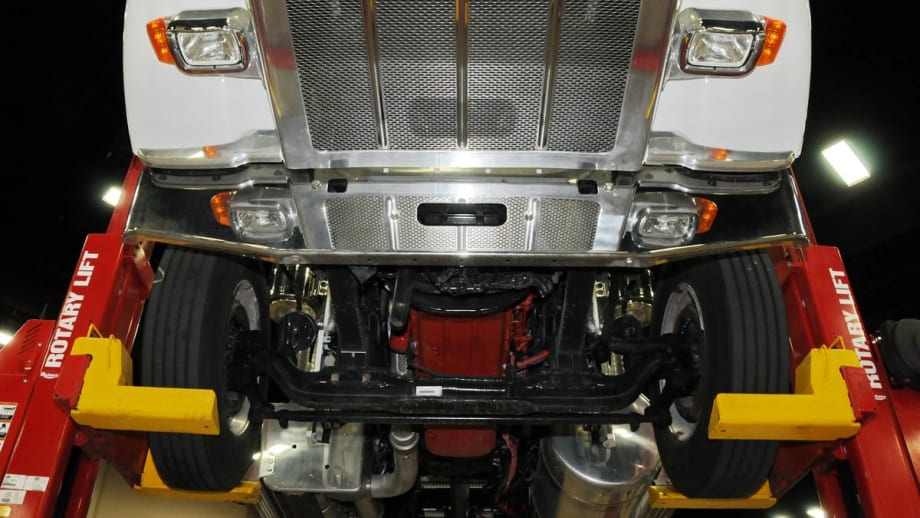
Lifts get your maintenance problems off the ground and up into the air where technicians can see what they are doing without contorting themselves on a creeper.
Photo: Jim Park
6 min to read
Laying down on the job is frowned upon on most workplaces, but many fleet maintenance shops routinely expect their best people to do their best work while flat on their backs. While creepers can be a convenient way conducting a quick inspection or making a fast adjustment, they aren't conducive to productivity or employee happiness.
Using lifts in your shop instead of floor jacks, jack stands, creepers and pits can improve both while reducing workplace injuries. Lifts provide much more convenient and comfortable access to every part of a truck that needs service. Lifts allow technicians get more work done in less time with less chance of an injury.
"When using a lift, ergonomic working heights and convenient controls can result in less physical strain -- and fewer injuries -- for your techs," explains Doug Spiller, Rotary Lift's director of heavy-duty product management. "When it comes to safety, a lift provides more access and better lighting to the undercarriage. And techs are less likely to get debris in their eyes and ears with a lift than when they’re lying on a creeper under a truck."
Vehicle lifts also help decrease the number of accidents and injuries suffered by workers, which results in fewer lost-work hours and healthier employees. And in the long run, fleets could also see reductions in their workers compensation premiums, Spiller adds. "The same can’t be said of creepers. The awkward positions that creepers force workers into can lead to muscle strain, particularly in the back and neck. They also increase the likelihood of burns on uncooled parts and exposure to potentially toxic fluids."
Of course, not all under-chassis work is done on a creeper, but different types of lifts can dramatically increase productivity. In a fleet with a high vehicle turnover rate, such as when doing oil changes and PM inspections, allowing the technician to walk about under the truck with an easily accessible toolbox can cut service times dramatically.
In attempting to visualize the work its technicians were doing and how much time was wasted on trips to the tool crib or parts room, Randy Obermeyer of Batesville Logistics decided to track his technicians' movements on particular jobs.
"We looked at how the technicians were moving around the shop during a PM an did spaghetti diagrams to track their movements around the truck during a PM," he says. "That gives you an indication of unnecessary movements: supervisor's office, oil filter crusher, garbage cans, tool crib and parts rooms."
In the end, he manages to cut 30 minutes from his PM work by doing simple things like getting the techs to fill their water bottles before beginning the project and moving the garbage cans closer to the service bay.
Now consider the difficulty of maneuvering a creeper under a truck, with wires and air hosing lying about, squeezing under the aero fairings, etc. There's a ton of time wasted in all that wriggling and flopping around on creepers.
"Short-term efficiencies add up, but so does your long-term maintenance savings when you
purchase a high-quality lift," Spiller emphasizes.
Better shop space utilization
Depending on what you plan to do with the lift and what type of lift you need, you can optimize the shop design based around the work. Drive-through bays equipped with platform lifts, for example, can be used for quick triage inspections, regular between-PM vehicle inspections, oil changes and the like. Segregating that work and equipping the bay according give the techs all the tools they need basically at their fingertips.
Platform lifts can be drive-on, back-off or drive-on, drive-off, depending on the layout of the shop and the yard. There is practically no set-up time required beyond driving the truck onto the lift and hoisting it into the air. Techs can get to work on the truck almost immediately.
Fleets that opt for portable column lifts have the flexibility of bringing the lifts to the truck, which means the work can be done anywhere with the appropriate vertical clearance and a solid floor. They even work outside on concrete aprons.
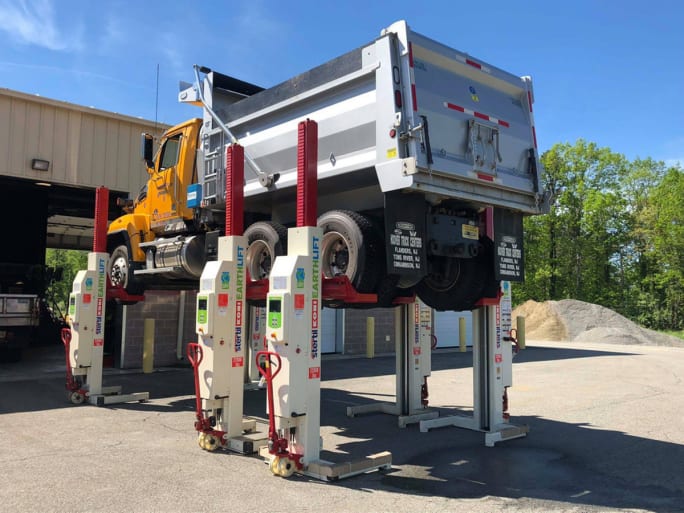
Mobile column lifts can be used anywhere there's a suitable surface and adequate overhead clearance.
Photo: Stertil-Koni
"Mobile column lifts are easy to set up and use," says Peter Bowers, technical sales support manager at Stertil-Koni. "One person can set up six column lifts and have a truck up in the air in under 10 minutes."
Just ask one of your techs whether they prefer working in a puddle under a truck on a creeper or out in broad daylight under a truck hoisted 70 inches in the air.
While higher pay, better benefits and more vacation time are a few ways to entice technicians to your shop, don’t overlook better working conditions. "Many top technicians seek work in OEM dealerships, in part because of dealers’ investment in superior technology—including lifts," notes Spiller. "By installing technologically advanced lifts in your shop, you can better compete with the dealers when it comes to recruitment and retention.
"Making investments in top-quality shop equipment like vehicle lifts you’re showing that you value your employees, which contributes to better morale and more professional attitudes," he adds.
Lift operation training
While adding a lift or multiple lifts to your shop will increase productivity, in most cases it will not increase your training burden. Operator training should be offered by the supplier and equipment installer. The top suppliers will provide initial training prior to commissioning the lift and offer follow-up training, online learning and video instruction as the need arises.
"Nothing is more important than safety," stresses Bowers. "It begins with the right mentality in the shop, communication and training. And we do that training."
While there are no formal operator certifications required for using lifting equipment, technicians need to be competent in their operation, the unit's safety features, and where applicable, the setup and operation of the lift. The Occupational Health and Safety Administration does not have any specific regulations or requirements related to the use of lifts, rather it defers to the Automotive Lift Institute (ALI), which certifies lift equipment in the U.S., Canada and other countries.
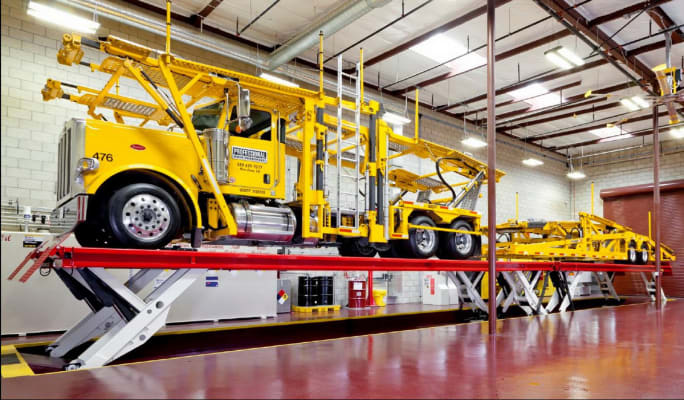
Platform lifts offer drive-on, drive-off flexibility. With this carrier, it takes less time to do an oil change than to drop and rehook the trailer. Lifts can be real time savers.
Photo: Stertil-Koni
Every technician in the shop should be trained on the proper operation of each lift they will use. This lift-specific training should be based on the lift manufacturer-provided instructions and warning labels, as well as the ALI publications "Quick Reference Guide, Safety Tips" and the ANSI/ALI ALOIM (current edition) "Standard for Automotive Lifts Safety Requirements for Operation, Inspection and Maintenance."
For an easy reminder of basic lift safety tips, ALI's offers an updated and expanded Automotive Lift Safety Tips Card and Safety Tips Poster. Both feature 13 tips for safe lifting, including lift operation, maintenance and inspection. The Safety Tips Card is small enough to hang on a lift or tool bench. At 30 inches wide and 45 inches tall, the poster is easy to read from a distance and can be hung in a service bay break room or training room as a daily workplace safety reminder.
All ALI safety materials are available from ALI member companies or online at www.autolift.org/ali-store
Subscribe to Our Newsletter
More Maintenance

Sponsored•September 16, 2026
Color Match Smarter: Tools That Restore & Perform
For fleet managers and collision repair professionals keeping heavy-duty trucks on the road, getting the color right the first time isn't just about appearance — it's about efficiency, turnaround time, and bottom-line results. Discover how today's digital color tools are transforming the repair process from guesswork to precision.
Read More →
Wrong Repair Prompts Recall of Freightliner, Western Star 4x2 Trucks
DTNA is recalling more than 2,400 trucks that received an incompatible software fix instead of the hardware repair required to address brake valve corrosion.
Read More →
Truck Drivers Need More Than Another Alert
Fleets have more visibility into truck health, safety events, and driver activity than ever. The next challenge is turning all that information into useful guidance for the person who has to decide what to do next.
Read More →
The Maintenance Checks Trucking Fleets Should Prioritize Before Fall Freight Picks Up
Making it through August isn’t the same as being ready for the next several months of operation. Find out what systems may have suffered from summer heat and need to be checked out before fall.
Read More →
What Three Fleets Are Doing Differently When Buying Truck Parts in 2026
With freight improving but costs still climbing, fleet maintenance executives explain how they're balancing price, quality, and supplier relationships.
Read More →
Paccar Recalls 2027 Trucks Built This Summer for Possible Electrical Problem
The nearly 6,000 Kenworth and Peterbilt trucks in the recall could potentially lose engine power, among other things.
Read More →
Will API PC-12 Oil Change Trucking Fleet Maintenance?
The new API PC-12 heavy-duty engine oil category reflects the changing demands of modern diesel engines. But fleets like Foodliner are looking to getting their own data before making decisions on adopting the new oils and questions such as extending oil drain intervals.
Read More →
Brake Safety Week to Focus on Drums and Rotors
Commercial vehicle inspectors are focusing on truck brakes during CVSA's Brake Safety Week, August 23-29.
Read More →Possible Battery-Cable Fires Prompt Recall of 15,000+ International MV and HV Trucks
On the recalled vehicles, manufacturing variations can cause the battery interconnect cable to contact the auxiliary stud and hold down the bracket.
Read More →
Rush, MCT Team Up to Grow Refrigeration Service Network
The joint venture will operate MCT's network of Carrier Transicold dealerships and mobile service locations, with the companies promising greater service capacity and uptime for refrigerated fleets.
Read More →