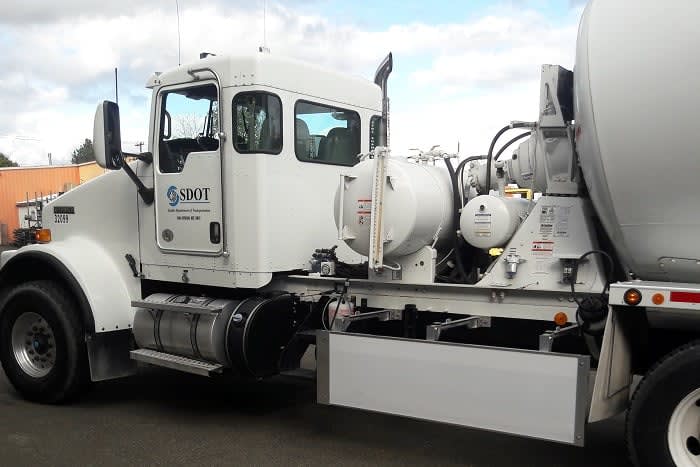
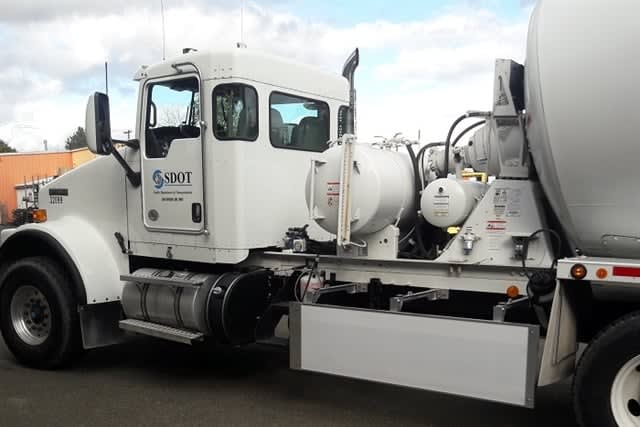
The side-impact guard closes the gap ahead of Kenworth mixer truck’s rear tandem to keep people from falling under the chassis and being run over. Photo: Walker Blocker
3 min to read
The side-impact guard closes the gap ahead of Kenworth mixer truck’s rear tandem to keep people from falling under the chassis and being run over. Photo: Walker Blocker
Safety advocates pushing for side-impact guards say the devices save lives in several overseas countries where they’re required, and in fact there’s a bill in Congress that would mandate them in the U.S. Whether we see such a rule or not, Seattle’s Department of Transportation sees value in side guards and has begun using them.
Ad Loading...
“We’re trying to stay ahead of the game,” says the city DOT’s fleet manager, Ricardo Sahagun. “We’re trying to increase safety for pedestrians and bicyclists. We encourage the use of bike lanes and for people to do a lot of walking around the city. Knock on wood, so far we haven’t had any accidents, but we have heard of incidents in other cities.”
Such devices work by physically covering the open space between the front and rear wheels of a truck. They keep people from blundering under the chassis and being run over by its rear wheels. Side guards can also protect auto occupants by preventing a complete underride of the truck or trailer.
Ad Loading...
The fleet experimented with homemade metal guards on a pair of flatbed trucks, Sahagun said. But they’re heavy, so he obtained lighter-weight products from Walker Blocker, a year-old arm of a long-established local manufacturer, Allied Body. First to get them were a dozen Ford F-series flatbed trucks and a Kenworth T800 mixer. The guards have aluminum frames and composite panels, and are in several lengths to fit between varying wheelbases and underbody equipment.
Cost was about $15,000 for the 12 sets of Ford guards and $2,500 for the Kenworth guards, he said. They weigh 20 to 30 pounds each. Side guards were also applied to the long tongue of a pup-type dump trailer.
The guards were built to meet and exceed specifications of the Volpe National Transportation Systems Center, a research group that is encouraging their widespread adoption. Volpe calls for strength sufficient to withstand 400 pounds of static pressure; Walker increased that to 650 pounds, and the test guard deflected but did not break, said representative Doug Strauss. Guards come in standard 2-, 3- and 5-foot lengths, plus custom sizes.
“We are doing a pilot program with Portland [Oregon] right now and their garbage companies,” he said. “Garbage trucks are always around people, and this past August a lady was killed in Portland by going under the garbage truck and being run over by the rear tire.” Chicago and the District of Columbia have also mandated their trucks have the side guards, he adds.
“We’re one of several cities that have made a pledge to reduce deaths to zero by 2025,” said Seattle spokesperson Mafara Hobson when interviewed about the project for a local TV newscast. “It’s part of a safety campaign. We feel that we’re leading by example.”
Fleet Snapshot
Who: City of Seattle Department of Transportation
Where: Seattle, Washington
Fleet: Approximately 220 cars and light-, medium-, and heavy-duty trucks, plus 230 pieces of maintenance and construction equipment
Operations: Supports the building and maintaining of roads, bridges, and other infrastructure, and general municipal transport needs
Fun Fact: Fleet Manager Ric Sahagun is one of the more jovial people you’ll ever talk to.
Challenge: Avoiding hurting or killing people who might collide with the sides of trucks.
Carriers whose updates were due on or after June 1 have more time, while FMCSA works to stabilize its new registration system and warns of phishing sites impersonating its new carrier registration system, Motus.
ZF is expanding its North American commercial-vehicle presence with new transmission applications, electrification, trailer technology and autonomous-driving systems.
Fleets have more visibility into truck health, safety events, and driver activity than ever. The next challenge is turning all that information into useful guidance for the person who has to decide what to do next.
Could Tesla’s camera-only autonomous driving technology work on an 80,000-pound Semi? In this commentary, HDT's Deborah Lockridge takes a look at Tesla, Cybercab, and how autonomous trucks see the road.
The U.S. Department of Transportation issued a new automated-vehicle strategy that outlines plans for driverless-truck regulations, cross-state freight corridors, and federal safety standards.
New York City is expanding intelligent speed assistance and pedestrian-alert systems across its municipal fleet, moving the technologies from pilot programs into vehicle procurement and retrofit requirements.
Federal regulators also are targeting more than 160 additional training providers and launching a nationwide audit of third-party CDL skills testers as part of a broader crackdown on trucking fraud.
Two pilot programs could eventually reshape hours-of-service rules, giving truck drivers options to pause their 14-hour clock or use longer split sleeper rest periods.
Hundreds of thousands of pets travel in truck cabs. A new safety guide from Volvo Trucks and the Center for Pet Safety offers practical advice for truck drivers who bring dogs and cats along for the ride.