




Save Fuel, Ease Stress with in-Cab Nav
In-cab navigation improves fleet efficiency and safety and can help cut driver stress. Reducing out-of-route miles alone may be enough to pay for some systems, according to industry experts

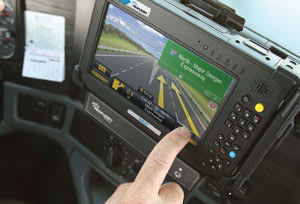
In-cab navigation improves fleet efficiency and safety and can help cut driver stress. Reducing out-of-route miles alone may be enough to pay for some systems, according to industry experts.
"Truck-specific directions can cut out-of-route miles by 7% to 10%," says Dan Popkin, vice president of business development worldwide, enterprise solutions, at ALK Technologies. And there are safety benefits, he adds, citing evidence that shows a significant number of accidents occur when drivers are lost.
Steve Katz, director of sales-U.S. for Blue Tree Systems, says navigation is attractive to fleets because they want to travel the minimum legal, safe miles between locations and they want to provide drivers with a sense of security.
"We are seeing many fleets with 100% owner-operators using our system as an incentive to achieve improved efficiency and reduced miles," he says.
Jed Duggan, vice president/general manager, Harris Trucking, Lynchburg, Va., added ALK's CoPilot Truck in-cab navigation when his company deployed Qualcomm's Mobile Computing Platform.
"I was trying to reduce accidents by not making wrong turns or hitting high bridges on a restricted route," he says. "If we can prevent an incident, it pays for itself right there." There are the added benefits of reducing driver inconvenience and cutting fuel costs by reducing out-of-route miles.
Truck-specific devices
Navigation devices are everywhere. Most smartphones and tablets have a navigation application. Consumer-grade navigation devices for the family car are easy to find and relatively inexpensive. But navigating the family car on vacation is quite a bit different from navigating a tractor-trailer combination.
That brings up the first thing fleets need to consider when deploying navigation technology: They must use truck-specific navigation that allows a user to key in truck size, weight and load (hazmat, etc.) characteristics.
"Consumer products just won't work," says Bill Nimchuk, associate product manager for PeopleNet. PeopleNet's system integrates with navigation products from ALK and NaviGo. Both of those are "truck-focused, it's what they do," he says.
Dave Marsh, vice president of research and development at Rand McNally, says truck-specific navigation helps provide more efficient routing and will include information on stops along the way with truck amenities, fuel stops and other trucker-related points of interest. And perhaps most important, it keeps trucks off of roads they shouldn't be on.
Truck-specific navigation has helped R&M Transportation, Omaha, according to Michelle Leist, director of safety. "We've not had one citation for being on a restricted route" since deploying the system, she says.
Even narrowing it down to truck-specific routing, however, leaves a host of options, including smartphone-based systems, in-dash options from some truck makers, stand-alone devices, and systems that use your existing in-cab communications setup.
The next thing to consider is your business. What kind of devices do you have now? What kind of business system are you operating? Do you already deploy a mobile communications solution? What kind of back-office routing products are you using?
Integrating with telematics
There are a number of advantages to integrating an in-cab navigation solution with your existing in-truck communications and telematics system, according to Blue Tree's Katz.
"The advantage available in navigation via an existing telematics system, which typically would not be available from stand-alone or OEM solutions, is that the telematics system may be integrated with the fleet's routing/dispatch system," he says. "That integration can extend into the cab, making automatic stop-to-stop navigation available to the driver without any entry or action on the drivers part. This provides a high level of ease of use, and also helps the fleet ensure that the path traveled is the one that they have built as the optimal one."
Integration of the onboard system, dispatch and navigation has been a huge benefit for fleets, agrees Brian McLaughlin, president of PeopleNet.
Integrating a navigation system with an existing telematics system reduces the number of screens in a truck, he points out.
"Fleets don't want multiple screens in the truck and don't want to pay for multiple cell networks," he says. "They want one network and one display."
Exploring options
Things to consider include driver ease of use, ease of installation and driver acceptance.
How your driver interacts with the device giving navigation direction will affect the type of system you choose.
"You need to ask yourself, 'What is the business reason for your device?'" says ALK's Popkin. "If you need to use your device outside of the cab - signature capture or scanning deliveries, for instance - that will have an impact on your decision."
The devices a fleet may already have are also important to consider, Popkin notes. "Have you already purchased smartphones or tablets for your drivers? Then you'll want a solution that will run on those devices," he says. "A software-as-a-service product with a smartphone might be the way to go."
Christian Schenk, vice president of product market for XRS Corp., (formerly Xata), says the options offered by traditional in-cab communication/ telematics providers have changed in recent years due to the explosion of mobile devices and advances in mobile computing platforms.
"Currently, we offer a couple of different things," he says. Its XataNet offering is a proprietary system available on its 4- or 7-inch display with a navigation solution from ALK. For its cloud-based Turnpike product, "It's up to the fleets," Schenk says. "They can deploy whatever navigation solution they want because Turnpike will run anything that runs on Android. We have some fleets that are running ALK's Co-Pilot Truck on Turnpike, some are using free Google solutions, some are using other options. There are a lot of options available."
With these abundant options, however, are possible pitfalls, Schenk warned. "One area where fleets get tripped up is when they get one route from their dispatch system and the navigation system gives them a different route. You end up with conflicting results just because you get different answers to the same questions.
"You should make sure there is a single source of truth for the route data and navigation data."
Stand-alone devices
While there are a number of benefits in integrating a navigation system with an existing in-cab communications and telematics solution, not all carriers use these technologies.
While fleets need to be concerned that the product they buy is "truck-specific," there also are stand-alone devices designed for trucking, some from the same names known for consumer GPS. The trucking-specific devices often include additional features such as fuel tax reporting or automated hours-of-service logs.
Rand McNally's March noted that his company has been dealing with truck-specific routes for years and offers both a navigation device as well as a more comprehensive mobile computer platform that includes navigation and many other features.
Rand McNally's new TPC 7600 not only offers navigation, but is a fully compliant electronic on-board recorder that tracks and manages hour of service. It includes back-end monitoring via a web portal, two-way communication with the ability to send email attachments, on-board scanning and printing, in-cab video playback plus connectivity via cellular and Wi-Fi communications.
Cobra Electronics' 8000 Pro HD for professional drivers features truck-specific routing with truck-specific points of interest powered by ProMiles and TruckDown. A quick info tab shows the nearest travel center, weigh station, rest area and mile marker. Map updates and live traffic are included for the lifetime of the product.
The Garmin dezl 560LMT trucking navigator features lifetime map updates, lifetime traffic services, North America maps, U.S. and Canada trucking routes, trucking-related points of interest, IFTAfuel logging capability, lane assist and Bluetooth. The unit can also automatically log hours of service and warn you of violations.
Mobile apps
Schenk predicts you won't see as many truckers looking for navigation devices. Instead they will be looking for a navigation app they can put on their smartphone. The newest version of Co-Pilot, for example, is available on Android.
Schenk says mobile solutions may prove to be the most cost effective for many fleets.
"If you look at the old way, you'd pay for a subscription and then every single month you would pay something else for the support of that product, because every time there was a change to our software, it would have to be tested against the navigation software," he says.
"When you go into this mobility world, that complexity goes away. You no longer have to be a conduit to that customer. They can buy whatever they want off the market. If a fleet can buy navigation software for $ 100, owns it for life, and doesn't pay a monthly support fee, those economics are a lot better and the ROI is much faster."
OEMs
Another option for fleets is to spec a navigation system when ordering new trucks. Most truck OEMs now offer in-dash navigation options.
Kenworth Trucks, for instance, offers NavPlus, an on-board navigation system with truck routes specified by load and truck specifications provided by Garmin. The system also offers information about height and weight restrictions so drivers can steer clear of restricted roads and streets.
The system also includes Bluetooth wireless technology so drivers can use their cell phones in "hands-free" mode. Sister Paccar company Peterbilt offers a similar system, SmartNav.
Navistar offers a proprietary system delivered through its driver information display, according to Sherwin Gilbert, manager of strategy and business development. A Rand McNally system is offered as a lower-cost solution, and the company will introduce a new Android-based system that will replace the current driver display. The new system will be capable of running ALK's navigation software and have the ability to interface with a telematics unit. Gilbert says demand for these systems is moderate to light, but that carriers have been showing more interest.
As with all purchasing decisions, whether or not a fleet should adopt in-cab navigation comes down to the bottom line. But managers have more options now than ever to find the right fit for their operation.
From the September 2012 issue of HDT
More Fleet Management

Geotab Links Fleet Card to Vehicle Data
The new card combines fuel discounts with telematics-based purchase controls. Geotab’s analysis also points to potential savings from choosing lower-priced fuel stops.
Read More →
How MFA Helps Protect Trucking Fleets
Multi-factor authentication adds protection when passwords are stolen. Here’s how it works and where fleets should start.
Read More →
How Better Freight Data Helps Trucking Teams Get Ahead of Disruption
Trucking and logistics teams have plenty of data. The problem is getting the right information in front of the right people soon enough to act. Better-connected data can help teams spot trouble earlier and make smarter decisions before small problems become big ones.
Read More →

Trimble: Taking Artificial Intelligence in Trucking Beyond Faster Tasks
At Insight 2026, Trimble executives argued that fleets may need to redesign workflows to get more from AI as it introduced new products and enhancements. AI’s value will depend on how fleets combine automation with their people's knowledge.
Read More →
Build a bulletproof fleet: Uniting ELDs and dash cams for total compliance
An ELD can prove compliance, but it cannot always prove what happened on the road. Discover how uniting accurate ELD data with AI-powered dash cam video can help your fleet strengthen compliance, defend against liability, protect drivers and reduce operational costs.
Read More →
Nominations Open for HDT Emerging Leaders
Heavy Duty Trucking is looking for accomplished trucking fleet professionals under 40 who are making an impact and helping lead the industry forward.
Read More →
Why Private Fleets Are Taking More Freight
Private fleets are putting their own trucks on demanding customers and high-cost lanes as companies seek greater control over service, costs, and capacity.
Read More →
Color Match Smarter: Tools That Restore & Perform
For fleet managers and collision repair professionals keeping heavy-duty trucks on the road, getting the color right the first time isn't just about appearance — it's about efficiency, turnaround time, and bottom-line results. Discover how today's digital color tools are transforming the repair process from guesswork to precision.
Read More →
FMCSA Pauses Biennial-Update Enforcement Amid Motus Transition
Carriers whose updates were due on or after June 1 have more time, while FMCSA works to stabilize its new registration system and warns of phishing sites impersonating its new carrier registration system, Motus.
Read More →
2026 Blueprint for Countering Smarter Supply Chain Theft
Cargo theft is no longer just the cost of doing business. It's a multi-billion-dollar criminal enterprise exploiting vulnerabilities across your fleet, drivers, and supply chain.
Read More →