




Roller Floor Systems Reduce Load/Unload Times for Certain Fleets
While roller floor systems are often found in the air cargo sector, a number of other fleets use them to cut loading and unloading times.

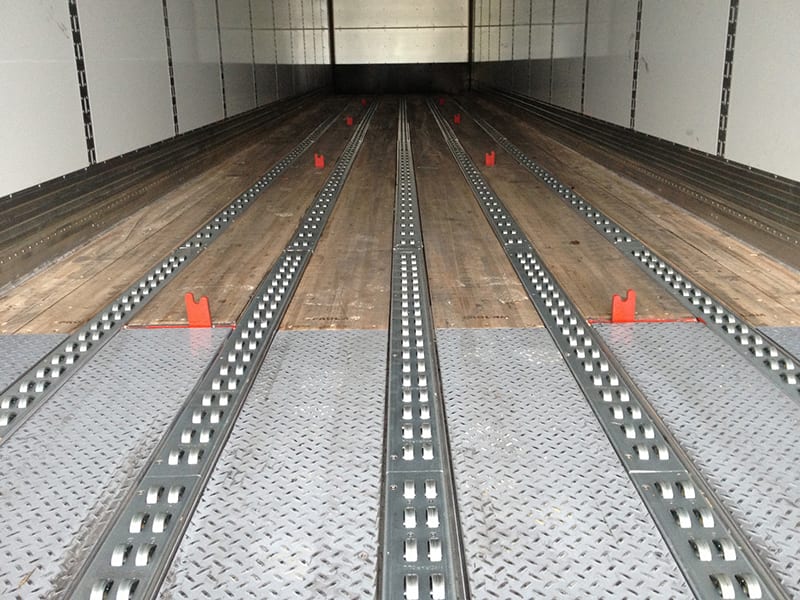
Photo: Jim Park
How long do you typically spend at a loading dock? Even when everything is going just swimmingly well, you're looking at 30 minutes minimum, sometimes as much as an hour if the forklift driver isn't sufficiently motivated. How would you like to be in and out of a dock, discharging a full load, in 90 seconds?
Roller floors are common in the beverage industry, says Jim Youse, president of Rollerbed Systems of West Wyoming, Pennsylvania, nothing they can transfer pallets of empty beverage cans from the trailer to the dock in a minute and a half.
"That's such a high-volume industry, every second saved precious," he explains. "In some instances, with really high-volume customers, they have trucks arriving every few minutes. They just don't have time to unload with a forklift."
Another application where roller floors are common is in dedicated lanes where a manufacturer serves a high-volume customer located nearby. A load of auto parts, for example, could be loaded at a plant 5-10 miles from the assembly plant, and the parts are rolled on and rolled off in a matter of minutes. The empty racks are loaded back on and the truck is on its way.
"In applications like that, the parts producer can pay for the roller system in less than two years with the savings from reducing the number of trucks, trailers and drivers required from perhaps two or three to just one," says Brett Murrill, president of Loading Automation of Wilmington, North Carolina. "In really quick turn-around applications, a roller floor is a real time and labour saver."
Roller floor systems can also be extraordinarily useful when the customer doesn't have a loading dock, Murrill points out. A pallet jack is one way of moving the pallets from the front of the trailer to rear but stowing the pallet jack might displace a pallet. Or if the pallets are heavy, they can be difficult for the driver and the risk of injury increases.
"A roller floor in this application can make the driver's life much easier and safer, and it saves time as well," Murrill says.
Roller floors metal tracks built into the trailer floor with integral metal rollers. The tracks are raised and lowered as needed by a series of small air bags placed along the length of the roller track.
In Ancra's Retract-a-Roll II system, for example, when the airbag is inflated, the rollers rise above the floor lifting the cargo with it. Once they are raised above the floor and sitting on the rollers, the driver can pull the pallet to the rear of the trailer, or push a pallet being loaded to the front of the trailer with minimal effort. Once the pallet is in place, some systems have locks in the track to keep a pallet from moving while the other pallets are positioned.
Once the load is in place, the airbag is deflated and the rollers drop below the floor leaving the cargo sitting firmly in place.
The pneumatics are powered directly from of the trailer's existing air supply. In Ancra's case, there's also a safety interlock that automatically lowers the rollers when the trailer parking brakes are released.
Roller systems can be installed in rows of four, six, or eight rollers as cargo weight demands. And the rollers themselves can be spaced at intervals, usually 4-6 inches apart, as the underside of the pallets (the stringers) dictate.
"Depending on the configuration, they work just fine with a standard CHEP pallet of 40 by 48 inches," says Murrill.
In addition to a basic pneumatic roller system, Loading Automation and Rollerbed Systems offer a variety of powered systems that will move cargo on or off the trailer. The both offer "slipchain" systems that use an electric motor mounted in the nose of the trailer to move loads of up to 60,000 pounds, such as large machines that might otherwise need to be shipped on a flat deck, into or out of the vehicle.
Both companies also offer T-Bar systems that will pull off a full load of pallets in one movement onto a roller system installed in the customer's loading dock.
"Almost everything in transportation is highly automated now except the loading and unloading process," says Youse. "We still rely heavily on manual labor to load and unload trailers, even if it’s motorized. But a roller floor system can automate this process too, and in some cases really speed it up."
Murrill says the ballpark price for a basic roller floor system along the line of what UPS, FedEx and other air freight transporters use, is about $12,000-$14,000. Automated systems can run into the $45,000 range. In a dedicated lane with a high-volume customer, cutting loading and unloading times to minutes rather than hours could produce a quick payback – especially in the era of automated driver logs.
More Equipment

How Volvo Updated Its D13 for EPA 2027 [Watch]
Volvo’s updated D13 promises lower emissions without sacrificing performance or fuel economy. Take a closer look at what changed inside the engine in this HDT Spotlight video.
Read More →
Michelin Tire Improves Efficiency and Durability for Regional Fleets
The Michelin X Multi Energy D2 is a regional haul drive tire engineered to help fleets improve fuel efficiency, durability and traction in demanding stop-and-go operations.
Read More →
ZF Expands Commercial Vehicle Push in North America
ZF is expanding its North American commercial-vehicle presence with new transmission applications, electrification, trailer technology and autonomous-driving systems.
Read More →
Tesla Wants a Self-Driving Semi. Are Cameras Enough?
Could Tesla’s camera-only autonomous driving technology work on an 80,000-pound Semi? In this commentary, HDT's Deborah Lockridge takes a look at Tesla, Cybercab, and how autonomous trucks see the road.
Read More →
Kodiak: Driverless Long-Haul Truck Launch on Track for 2026
Kodiak AI says its driverless long-haul safety case is 93% complete and it remains on track to begin commercial operations by year-end 2026.
Read More →
What DOT’s Automated Vehicle Strategy Means for Trucking
The U.S. Department of Transportation issued a new automated-vehicle strategy that outlines plans for driverless-truck regulations, cross-state freight corridors, and federal safety standards.
Read More →
East Coast Port Launches $45M Electric Truck Push
The Port Authority of New York and New Jersey announced millions in incentives for zero-emission drayage trucks, yard tractors, and new charging hubs near the port.
Read More →
PlusAI Going Public to Fund Autonomous Truck Launch
A SPAC deal could provide PlusAI with up to $300 million as it works toward a 2027 commercial launch of factory-built autonomous trucks.
Read More →
NHTSA Moves to Rewrite Truck Fuel-Economy Rules
The National Highway Traffic Safety Administration says it lacks authority to regulate medium- and heavy-duty truck engines separately from complete vehicles, but the existing standards have not yet been eliminated.
Read More →
Detroit Opens Orders for EPA 2027 Engines
Detroit isn’t starting from scratch to meet EPA 2027 diesel emissions standards. Its Gen 6 DD13 and DD15 engines keep much of today’s platform while updating the fuel and aftertreatment systems.
Read More →