




Roadability Regulations and Drayage Truck Inspections: What to Know
New federal "roadability" regulations that clear up who's supposed to be responsible for intermodal equipment infractions - basically, the owner of the chassis in question - have been in effect since December 17

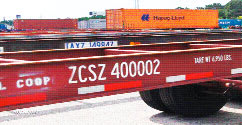
Ten-character alpha-numeric code painted on ocean-container chassis can establish vehicle ownership -- and therefore who should get any ticket for equipment infractions -- if it is in a global registry.
New federal "roadability" regulations that clear up who's supposed to be responsible for intermodal equipment infractions - basically, the owner of the chassis in question - have been in effect since December 17.
They've made life easier for many drivers who pull container chassis, even if not all of them have found relief. Some law enforcement officers and roadside inspectors are still writing tickets to drayage drivers, according to industry sources.
But take heart. There's a magic word that should cause the guy with the ticket book to pause and ponder, and then cite the truly responsible party. It's 49 CFR 390.21(g)(4)(v). Yes - blurt out the exact regulation, because that's what anyone with a badge should understand, advises Tom Malloy, a vice president at the Intermodal Association of North America. It stipulates how chassis ownership may be displayed, and that includes the 10-character alpha-numeric code painted on every chassis.
The code should establish ownership, no matter what's stenciled or decaled elsewhere on the chassis, because of a recently established database. More on these get-out-of-jail passes in a bit, but first some background.
Starting in the 1950s, ocean containers revolutionized the shipping business with their speed of loading and offloading, and security for the goods inside. But the chassis they're carried on en route to consignees are essentially semi-trailers that are subject to mechanical malfunctions. Police enforced equipment safety laws on the chassis as they did for other trailers, more or less blaming drivers for lack of maintenance by the steamship lines that owned them.
This basic injustice - and that's what it is for drivers and owner-operators who have no power to right the wrongs - was a given in the container business. Motor carriers first petitioned federal authorities to do something about it 12 years ago, Malloy says, and it took that long for the new regs to be proposed, repeatedly debated, rewritten and finally approved and published.
The situation has been complicated by "migration" of chassis ownership from steamship lines to leasing companies. Steamship lines avoided the regulations' new systematic maintenance requirements by getting out of the business of owning and supplying chassis to dray operators. A ship line's name might still be on the chassis, but a leasing company probably now owns it but hasn't yet changed the lettering.
That drivers still get fix-it tickets that carry fines is maddening, but should not be too surprising, given the breadth of the enforcement community involved. The word has to get down to the inspector and officer on the street, and years from now there will still be a few who are ignorant of the roadability regs. But that won't be because the Intermodal Association and federal agencies haven't tried to educate the ticket writers, Malloy says.
Tickets are still being written in certain jurisdictions whose chiefs insist that identifying marks, especially the federal Department of Transportation number, be painted or stenciled to every vehicle, he explains. That is no longer necessary if that 10-character code, like ZCSZ 400002 in the photo on the next page, is entered in a database. Its license plate number should also work. Of course, the officer must know of the database that will provide the ownership information, and how to access it.
The database is known as the Global Intermodal Equipment Register, or GIER (pronounced "gear"). It's for ocean container chassis, not the longer chassis for domestic containers. GIER can be reached via a toll-free number: 1-877-511-GIER (4437), where a voice-prompt system tells the caller what to input. If the vehicle's 10-character code is in the GIER, it will identify the company that owns the vehicle, plus its DOT and phone numbers. "Write the ticket to that outfit, officer," the dray driver can say.
The register can also be accessed online at http://GIERregistry.com. Click on the Equipment Inquiry button and enter the information asked for. That includes a time and date, the 10-character code and a few other things. Up should pop the company of ownership's identity and contact information. Access to GIER can also be done with ASPEN software used by equipment inspectors.
All this and more are in Inspection Bulletin 2011-02, Identifying Intermodal Equipment Providers for Intermodal Chassis, issued by the Commercial Vehicle Safety Alliance on January 14. View it on the organization's website, www.cvsa.org.
In a good world, officers will know about GIER and how to use it. If so, it might be thanks to educational webinars recently run by the intermodal association, the CVSA and the Federal Motor Carrier Safety Administration, Malloy says. Several two-hour sessions were run in early March for CVSA coordinators in the various states. They are to get the word to state and municipal inspectors whose employers are members of CVSA. Because it's an imperfect world, some of them might not have been enlightened.
That's when a savvy driver can politely say to the officer, "GIER" and "390.21 (g)(4)(v)" - that's three-90 point 21, paren g, paren 4, paren vee. Yessir. Look it up, please, sir. Under the Roman numeral 'v' you'll see that the alpha-numeric code is one permissible way for ownership of the chassis to be displayed, provided that the code is entered in the Global Intermodal Equipment Registry. You're welcome, sir - glad to help.
From the April 2011 issue of HDT.
More Equipment

ZF Expands Commercial Vehicle Push in North America
ZF is expanding its North American commercial-vehicle presence with new transmission applications, electrification, trailer technology and autonomous-driving systems.
Read More →
Tesla Wants a Self-Driving Semi. Are Cameras Enough?
Could Tesla’s camera-only autonomous driving technology work on an 80,000-pound Semi? In this commentary, HDT's Deborah Lockridge takes a look at Tesla, Cybercab, and how autonomous trucks see the road.
Read More →
Kodiak: Driverless Long-Haul Truck Launch on Track for 2026
Kodiak AI says its driverless long-haul safety case is 93% complete and it remains on track to begin commercial operations by year-end 2026.
Read More →
What DOT’s Automated Vehicle Strategy Means for Trucking
The U.S. Department of Transportation issued a new automated-vehicle strategy that outlines plans for driverless-truck regulations, cross-state freight corridors, and federal safety standards.
Read More →
East Coast Port Launches $45M Electric Truck Push
The Port Authority of New York and New Jersey announced millions in incentives for zero-emission drayage trucks, yard tractors, and new charging hubs near the port.
Read More →
PlusAI Going Public to Fund Autonomous Truck Launch
A SPAC deal could provide PlusAI with up to $300 million as it works toward a 2027 commercial launch of factory-built autonomous trucks.
Read More →
NHTSA Moves to Rewrite Truck Fuel-Economy Rules
The National Highway Traffic Safety Administration says it lacks authority to regulate medium- and heavy-duty truck engines separately from complete vehicles, but the existing standards have not yet been eliminated.
Read More →
Detroit Opens Orders for EPA 2027 Engines
Detroit isn’t starting from scratch to meet EPA 2027 diesel emissions standards. Its Gen 6 DD13 and DD15 engines keep much of today’s platform while updating the fuel and aftertreatment systems.
Read More →
Carrier Transicold Adds All-Electric TRU for Stationary Cold Storage
Carrier Transicold’s new Vector 8200 all-electric transport refrigeration unit gives fleets a diesel-free option for temporary refrigerated and frozen trailer storage.
Read More →
A Closer Look at Kenworth’s Electric T880E Vocational Truck [Video]
Learn more about Kenworth's T880E battery-electric vocational truck at the Paccar Technical Center, including its range, applications, upfitting considerations, and PTO options, in this HDT Spotlight video.
Read More →