





Related: Tougher Tires for Regional Trucks
Regional vs. Long-Haul Tires
Round and black is a definition often applied to tires of any stripe, but it does a disservice to the technology and engineering behind optimizing tires for specific applications.
March 4, 2019
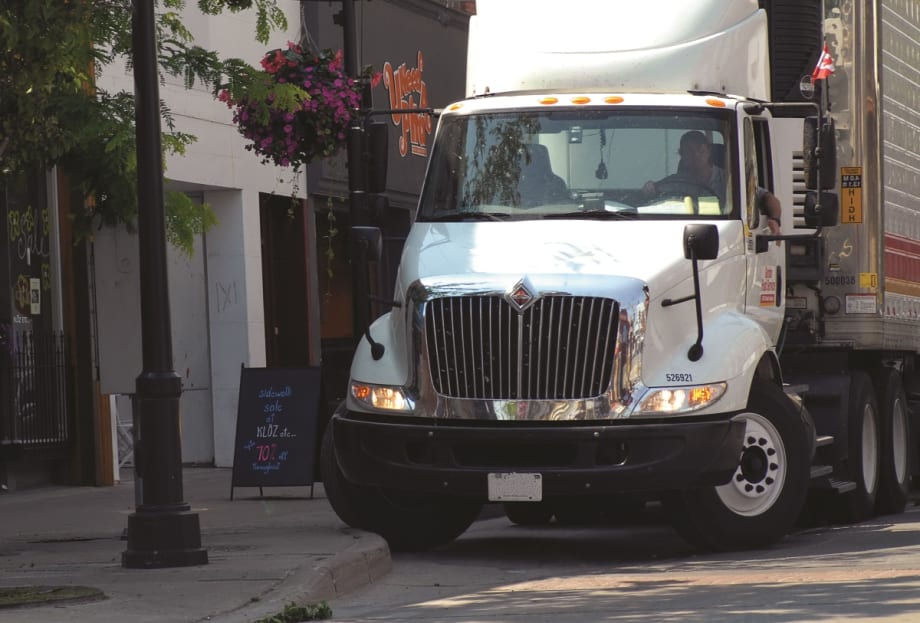
Curb strikes are inevitable in the close confines of a city. Guard against excessive damage with treads and sidewalls designed for the application.
Photo: Jim Park
2 min to read
Round and black is a definition often applied to tires of any stripe, but it does a disservice to the technology and engineering behind optimizing tires for specific applications. Tires designed and built for hard-scrabble regional service are quite different from those that will run 150,000 to 200,000 miles or more on silky-smooth interstate highways.
A regional tire is seen as one used by businesses such as public utilities, government, food distribution, manufacturing, petroleum, and schools operating within a 300-mile radius. These vehicles carry medium to heavy loads, frequently on two-lane roads, highways, and secondary routes. They generally return to home base at night and have an annual mileage of 30,000 to 80,000 miles.
“Tires in this category experience several challenges, including shoulder scrub, start/stop aggression, lateral scrub, and heel/toe wear,” says Paul Tatarchuk, B2B special services coordinator for Michelin North America.
According to Goodyear, the regional haul segment now makes up about 40% of the North American trucking market. That’s driven partly by e-commerce sales, which in the U.S. totaled $453.5 billion in 2017, a 16% jump from the previous year, according to the U.S. Department of Commerce.
The ongoing growth of e-commerce and increasing demand for last-mile delivery services “brings a corresponding increase in the number of distribution hubs,” says Mahesh Kavaturu, Goodyear marketing manager. “As a result, shipping routes are shrinking, and trucks are traveling shorter distances.”
That has put pressure on tire makers to build tires especially suited to that application. Fleets will probably see lower overall tire costs if they make that distinction in their tire spec.
Subscribe to Our Newsletter
More Equipment

How Volvo Updated Its D13 for EPA 2027 [Watch]
Volvo’s updated D13 promises lower emissions without sacrificing performance or fuel economy. Take a closer look at what changed inside the engine in this HDT Spotlight video.
Read More →
Michelin Tire Improves Efficiency and Durability for Regional Fleets
The Michelin X Multi Energy D2 is a regional haul drive tire engineered to help fleets improve fuel efficiency, durability and traction in demanding stop-and-go operations.
Read More →
ZF Expands Commercial Vehicle Push in North America
ZF is expanding its North American commercial-vehicle presence with new transmission applications, electrification, trailer technology and autonomous-driving systems.
Read More →
Tesla Wants a Self-Driving Semi. Are Cameras Enough?
Could Tesla’s camera-only autonomous driving technology work on an 80,000-pound Semi? In this commentary, HDT's Deborah Lockridge takes a look at Tesla, Cybercab, and how autonomous trucks see the road.
Read More →
Kodiak: Driverless Long-Haul Truck Launch on Track for 2026
Kodiak AI says its driverless long-haul safety case is 93% complete and it remains on track to begin commercial operations by year-end 2026.
Read More →
What DOT’s Automated Vehicle Strategy Means for Trucking
The U.S. Department of Transportation issued a new automated-vehicle strategy that outlines plans for driverless-truck regulations, cross-state freight corridors, and federal safety standards.
Read More →
East Coast Port Launches $45M Electric Truck Push
The Port Authority of New York and New Jersey announced millions in incentives for zero-emission drayage trucks, yard tractors, and new charging hubs near the port.
Read More →
PlusAI Going Public to Fund Autonomous Truck Launch
A SPAC deal could provide PlusAI with up to $300 million as it works toward a 2027 commercial launch of factory-built autonomous trucks.
Read More →
NHTSA Moves to Rewrite Truck Fuel-Economy Rules
The National Highway Traffic Safety Administration says it lacks authority to regulate medium- and heavy-duty truck engines separately from complete vehicles, but the existing standards have not yet been eliminated.
Read More →
Detroit Opens Orders for EPA 2027 Engines
Detroit isn’t starting from scratch to meet EPA 2027 diesel emissions standards. Its Gen 6 DD13 and DD15 engines keep much of today’s platform while updating the fuel and aftertreatment systems.
Read More →