





"I liken trucks to cell towers. Everyone wants great cell service but no one wants to look at at a cell tower in their back yard."
Q&A: Swift's New Driver Engagement VP
Swift Transportation's new vice president of driver engagement talks about how the truckload giant plans to make sure its drivers are truly its "driving force."
June 15, 2017
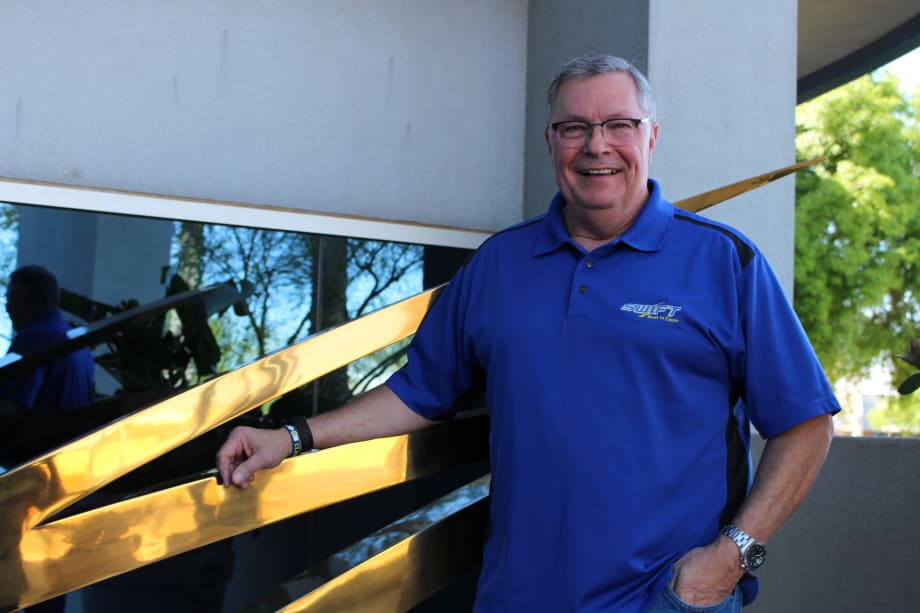
Scott Barker has moved from vice president of safety, driver recruiting, and driver development at Swift to a new post dedicated to driver engagement. Photo: Swift
8 min to read
Scott Barker has moved from vice president of safety, driver recruiting, and driver development at Swift to a new post dedicated to driver engagement.Photo: Swift
Swift Transportation recently created a new position – vice president of driver engagement – and named Scott Barker to the role. With nearly 40 years of experience ranging from spotting yard tractors and being a UPS delivery driver to safety, training and development, Barker is practically giddy about the chance to really make a difference for Swift's 20,000 drivers.
HDT talked to Barker about the new role. This interview has been lightly edited for length and clarity.
HDT: What led to the creation of this new role?
Barker: We have been talking about this for about a year, and in that process we just believe that we needed somebody whose sole focus was on the driver, and the relationship of the driver with the driver support team. It was important to us that we build that position and fill it with somebody who had a relationship with a lot of the drivers already and could either learn or already know about how the driver support teams work.
HDT: So how DO driver support teams work? What is that?
Barker: [Swift founder] Jerry Moyes used to say there are really only two types of people at swift — drivers and those who support drivers. So by definition our driver support teams are all the back office employees, the functions in the shops, and anybody whose job is to help support drivers, whether it’s driver payroll or driver training or driver recruiting teams or HR, any of the teams that do not actually drive the truck are by definition driver support.
HDT: So that’s a lot of people. How many drivers does Swift have?
Barker: We have around 20,000 drivers.
HDT: How do you have a relationship with that many people?
Barker: That’s a great question. I would be remiss if I said I have a true relationship with every driver, but for the last couple of years in my prior role we began sending a weekly video message, 3 to 4 minutes, to the drivers in the cab via the Qualcomm, and just having a conversation, albeit one sided. We would talk about changes in regulations, changes in the organization, general safety best practices — most of it was safety focused. We would talk about driver health, we would talk about virtually anything. And the drivers came to know me and believe it or not, trust me, because as they have told me time and time again, they can sense that we care about them. I say ‘we,’ it mostly was myself and Victor Malchesky, our director of safety. So whenever I was at a terminal, anywhere I would run into drivers, it was almost impossible for me to walk through the driver lounge or anywhere drivers were and not have people stop me and say, ‘Hey, you’re the guy from the video, you’re Scott Barker.’ It humanizes us and the whole safety process with the drivers.
HDT: What are some of the things you’re going to be doing in this job?
Barker: Oh my goodness, there are so many things! I’m so excited about this I can hardly stand it. Right now I’m in Edwardsville, Kansas, at our terminal here. Since I accepted this job, I’ve been in Memphis, Salt Lake, and now here. I’m making the rounds to some of the larger operations, working with driver support teams in each of those locations and talking to as many drivers as I can.
Everything we’re doing from my perspective, is focused on the driver. We’re rebranding that group as Swift’s Driving Force, and the messaging around that is all about how valuable the driver is, not just to Swift and their own families but to the entire U.S. economy and the world economy and everyone who lives within those.
I liken trucks to cell towers. Everyone wants great cell service but no one wants to look at at a cell tower in their back yard. Everyone wants their shelves stocked but they don’t want to be close to a truck on a highway. So our drivers get the feeling sometimes that they’re not appreciated, they’re not wanted, their work is not meaningful. And my goal, our goal, dadgummit, is to finally change the perception of the driver, that this is not only worthwhile work, it’s much bigger than the cab of that truck.
HDT: So how are you working with the driver support teams to help accomplish that?
Barker: I’m trying to understand how we can improve systems that in some cases are pinch points for drivers, that become points of contention with drivers on the road, and work with the people who are in the support teams to make sure they understand the focus on the driver and this concept of our drivers being the driving force. If you take away the driving force of this organization, then there’s really no need for anyone else in the organization. We all depend on the work of the driver and their service to our customers to provide opportunities for us to be there. So I’m working with them on their thinking and looking for opportunities to improve our support of the drivers.
HDT: What kinds of things do you have in mind?
Barker: Honestly, I’m still getting my head around what driver engagement really means and what it looks like and feels like and what it should smell like and taste like. Understanding how to bring it all together in an organization this size is a part of the challenge I’m facing.
Driver engagement to me, if you take a truck, here’s there’s massive powerplant up front that’s creating an enormous amount of power, but it is virtually worthless if you can’t transmit that power to the drive axle, to the wheels that will start the truck in motion, through the transmission of the truck. And inside the transmission are all these gears of all different sizes and if they aren’t engaging, if they don’t mesh at the right time and in the right way, you have degradation in the ability to maximize the power of that truck. In our world if you apply that to people, the more we can engage the drivers, the more they will be satisfied and even happy with their work — don’t get me wrong, many many of them are already — but the more we can do that, the more power we can deliver — improved excellence in service, improved safety results, improved retention rates and all those things we want. And in the process we’re delivering a better life to our driving force.
HDT: What are some of the things you’re hearing from drivers so far?
Barker: Drivers are just like us. They just have a different set of job responsibilities. Their lifestyle is difficult. They need the same things we need. They need a livable wage, and we try to provide that through being an organization of our size we can deliver miles. Drivers need to feel valued and appreciated. And those two words are often used interchangeably, but they are different. Valued is a personal state, a deep abiding sense that I have worth. Appreciation on the other hand is how we recognize drivers for the work that they do. We help improve their value state by asking for them to share their opinions and thoughts with us and then acting on those opinions and thoughts and responding to that feedback.
They want information — we all want to know what’s going on in our world and in our industry. Some are very proactive and go out on the web and gather it themselves, and others don’t. So we provide a variety of web portals internally for drivers to gather information. Driver leaders have weekly webinar type calls with smaller groups of drivers, mostly audio conference calls where they have open dialog about their team’s results and how they measure up and answer questions from drivers.
I started a blog; I’m one of these guys, I go to my grandkids if i have a technology question. But it’s so much fun because in my travels, I’m reminded every day that everyone has a story, and I’m capturing a bunch of that and recognizing drivers and others on my blog and it’s focused toward them. Sometimes I have educational material, maybe a driver comes in with a great tip that will help all drivers. So it’s a combination of education and recognition and sharing. I’m having fun and it’s being well received and well read.
The one thing that’s really difficult — the drivers need social interaction. Drivers who are a remote workforce and out by themselves a lot, we have to develop more and better ways for them to feel like a part of a social network, part of a team. So we participate in all the social networks. We’re building a new technology for the trucks where all their work flow will be on a tablet that will allow them to have face to face capabilities with their team leaders or other drivers via Skype technology.
We’re trying a lot of different things, but it’s all really focused on the same thing, which is that driving force.
HDT: Will any of this cross over to Knight, with the merger?
Barker: We’re going to continue focusing on what we’re doing on our driving force initiative and all the things that we’re doing. The plan for the merger is to continue to operate the way we have and they will operate the way they have. I am certain once the merger is complete, there will be an opportunity for learning, for best practice sharing.
HDT: Anything else you’d like to share?
Barker: If I could sum it up in one short statement, this whole concept of Swift’s driving force and this position for me has allowed me to be focused on a few things. I’m focused on the fact that the driver is a key asset of Swift — I'm not dehumanizing them, they’re not an asset like a truck, but they are the most valuable asset we have. I’m focused on us having extraordinary communication with our drivers, to and from. I’m focused on helping to enhance drivers’ self perception and understanding how truly valuable they are to us and the economy as a whole, and focused on helping us to continue to improve our driver support and deliver best in class driver support to our driving force.
Subscribe to Our Newsletter
More Drivers

Truck Drivers Need More Than Another Alert
Fleets have more visibility into truck health, safety events, and driver activity than ever. The next challenge is turning all that information into useful guidance for the person who has to decide what to do next.
Read More →
FMCSA Removes 110 Truck Driver Training Schools from Certified ELDT List
Federal regulators also are targeting more than 160 additional training providers and launching a nationwide audit of third-party CDL skills testers as part of a broader crackdown on trucking fraud.
Read More →
Hours of Service Pilot Programs: FMCSA Readies for 2027 Rollout
Two pilot programs could eventually reshape hours-of-service rules, giving truck drivers options to pause their 14-hour clock or use longer split sleeper rest periods.
Read More →
Medical Cards, English Proficiency Reshape Roadcheck Violations
Medical-card violations jumped to the top of the driver out-of-service list during CVSA’s 2026 International Roadcheck, while English-language proficiency violations appeared among the leading violations for the first time.
Read More →
Driver Trust Can Make or Break the Success of Fleet Safety Technology
New Teletrac Navman research suggests that onboarding, transparency about driver data, and positive feedback can play a significant role in how commercial drivers respond to safety and coaching technology.
Read More →
EEOC Sues KLLM Over Alleged Sex Discrimination in Driver Training
KLLM is facing a federal sex-discrimination lawsuit over policies the EEOC alleges put female truck driver trainees at a disadvantage.
Read More →
FMCSA Moves to Codify English Language Requirements for Commercial Drivers
By changing regulations on English-language proficiency requirements for commercial drivers, rather than relying on a guidance memo, the FMCSA said future administrations won't be able to walk back the Trump administration's stricter enforcement with just a memo.
Read More →
Drivers Put Western Star Trucks to the Test at Star Nation Experience
Watch to get an inside look at the Western Star trucks, technology, and community behind the Star Nation Experience 2026!
Read More →
Trump Administration Looks to Put More Veterans Behind the Wheel
The Freedom Haulers program pulls together existing and expanded programs at several federal agencies to recruit veterans to drive commercial heavy-duty trucks and cut the red tape for them to get a CDL, training, and employment.
Read More →
Putting Mack’s Command Steer to the Test
A test drive of Mack’s Command Steer active steering system evaluates how it can make truck driving easier and less tiring.
Read More →