





Related: Alabama Trucking Chair Weathers Tough Times, Poised for the Future
Q&A: Fenn Church on ELDs, Infrastructure, and Trucking in Alabama
Mandatory ELDs may level the playing field, but it's still a battle to get some customers to understand the constraints that the hours of service rules play. That's just one challenge facing Fenn Church, president of Church Transportation, as he leads the Alabama Trucking Association this year.
August 20, 2018
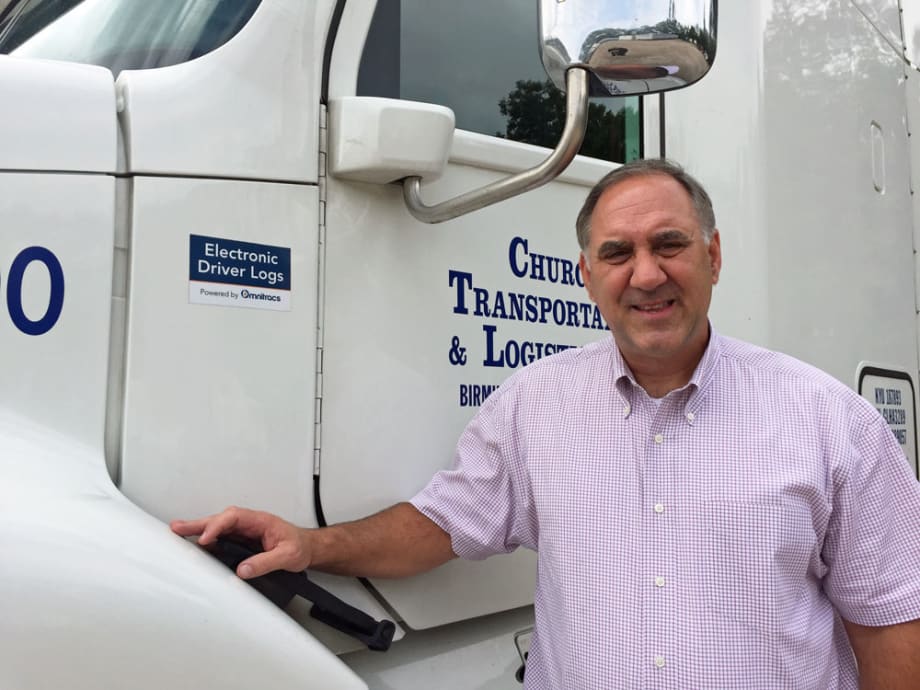
Fenn Church is the Alabama Trucking Association's chairman for fiscal year 2018-’19 and began his term in July.
Photo by Deborah Lockridge
7 min to read
When I first met Fenn Church a few years ago on the way back from the American Trucking Associations’ Management Conference & Exhibition, he spoke passionately about the need for mandatory electronic logs and the dangers of excessive speed. Now that the ELD mandate is in place at the federal level, as the new chairman of the Alabama Trucking Association, he’s turning his attention to issues such as infrastructure funding and growing the next generation of trucking leaders in the state, while battling with customers who just don’t “get” how electronic logs affect delivery schedules.
Church is the founder and president of Church Transportation & Logistics in Birmingham, Alabama. I recently spoke to him about his goals as state trucking association president as well as current industry issues. (The following interview is edited for clarity and length.)
HDT: You’ve long been an advocate for electronic logs, adopting them in 2010. What are your views on how the ELD mandate has rolled out?
Church: It is the right thing to do, and I don’t know how any trucking company, be it privately or publicly owned, [can not have them]. We get to see that we’re operating within legal hours. I don’t want the liability of operating outside of that, and I’m thankful that our federal government saw that and finally put it in place in December. It made our whole playing field much more even. We were losing drivers, and they were going to somebody else to run paper logs and still cheating the system.
HDT: I’ve heard anecdotally that many owner-operators and even some fleets are increasing speed to make up for lost productivity with ELDs. I know you’re also an advocate of speed limiters. What are your thoughts here?
Church: We’ve been at 62 mph for 14 years now and I’m not changing that. I just think it’s a safe speed. I showed you a study where trucks set at 68 or 70 mph vs. our 62, at the end of the day both are going to average about 50.5 mph. Because they run up into traffic and have to start and stop more than a truck going the slower speed to stay steady. I like our safety record with the mph we have.
HDT: Another change in regulations that’s been happening is the greenhouse gas/fuel economy standards. There have recently been some efforts to roll back the glider kit provisions of those rules, which restrict glider kit production. I know you have used a fair number of glider kits in your fleet, being able to gain fuel economy with aerodynamic gliders using pre-2000s-emissions engines.
Church: The manufacturers were putting more restrictions on glider kit production at the end of last year; we took the last 10 at the end of last year that we’re going to put in service and we still have three to build. But I think it’s gone. It was great when it lasted, but there comes a time when the supply of older engines is being depleted and I think we’re at that point. Not only that, but the [cost of] internal engine parts [to rebuild them] have increased some too. We had a reliable truck that was getting better fuel mileage, but it’s time to move on.
The other thing right now we’ve got 25 new trucks on order that’ll be coming in starting in October through March, and they’re equipped with all the new safety devices, the Bndix Wingman,, the adaptive cruise, the lane departure, and that’s technology that is finally moved from the automotive world into Class 8 trucks and it’s relatively inexpensive. For $4,000-$5,000, if it prevents one accident, it’s more than paid for itself. So we’re going to move on. We’ve done all the gliders we’re going to do.
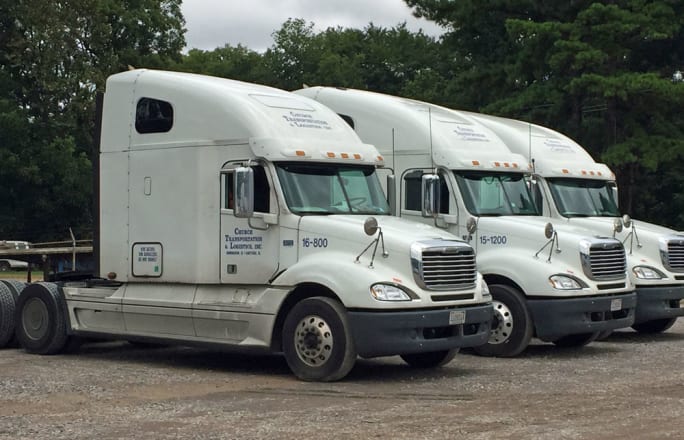
Church Trucking is adding new trucks to the fleet – Navistar Internationals to join the previous Freightliners.
Photo by Deborah Lockridge
HDT: Are those new trucks for replacement or expansion?
Church: A little bit of both. We’ve been slowly expanding, but what’s dictating that is the driver pool. At one time we were up to about 80 trucks, then we pulled back to around 50 at one time and we’re back up to about 65 right now.
HDT: What are your priorities/focus as chairman of the Alabama Trucking Association?
Church: My goals this year, number one is we want to start a Leadership Advancement program much like American Trucking Associations’ LEAD program [which develops young trucking leaders] to identify and train the future leaders of Alabama’s trucking industry. I want to start with 10 individuals in the trucking industry, they’re coming up through family businesses, or some have started their own trucking business. I want to take these 10 guys an introduce them to the DOT, to state legislators, and train them and let them know just how important government decisions in our state are going to impact our industry.
HDT: What are some of the state government decisions most pressing for Alabama’s trucking industry?
Church: We have a lot of people in Alabama operating trucks up and down our interstate that don’t belong to our association, including a lot of big construction companies. And we’re all in a battle for, we all support raising the fuel tax to help with our crumbing infrastructure within the state. So I think we need these big construction companies as members of the association, and I’m willing to join the Asphalt and Road Builder’s Association so we can get this fuel tax passed. I really want to focus on helping our legislature get this fuel tax passed this spring. We haven’t done anything with in in Alabama since 1992. And everybody I’ve talked to, I ask, what kind of mileage did your car get in 1992 and what kind of mileage does your car get today? You probably went from about 12 mpg to 20-24 today. The same thing with trucks. In 1992 you were lucky if you got 5 mph. Today, 9 to 10 mpg is not normal, but it’s not unheard of. We have trucks hitting above 9 weekly. So it’s a diminishing tax.
Then you’ve got electric vehicles. You’ve got companies like Volvo, they’re not even going to built an internal combustion engine for a car after 2021. What’s going to happen to the fuel tax then? I see hybrids all over town. I also see a surprising number of Teslas. None of these vehicles are contributing to the fuel tax that keeps up our infrastructure. We’ve got to figure out a different way. Plus the cost of asphalt and concrete has increased dramatically from 1992. We’re fighting a losing battle.
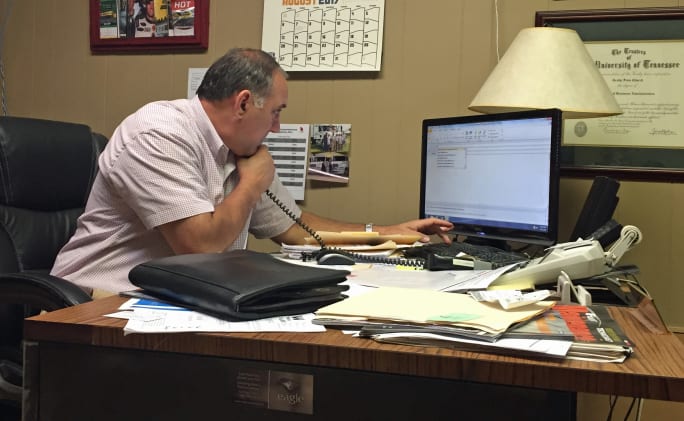
After many years in the LTL and Truckload segments, Fenn Church started his own trucking company in 2000, and Church Transportation & Logistics began operations with one truck, one trailer, and one associate.
Photo by Deborah Lockridge
HDT: What other challenges and opportunities do you see currently, for your company or for the industry?
Church: This is without a doubt the best year we’ve ever had as my company and as an industry, and I’ve had my own company for 18 years, and this is the best year we’ve seen in rates. And the electronic logs have played a part in that. When you’ve got a guy running 750-800 miles a night, he was doing the work of two trucks. Now it’s taking more trucks to do it. Plus the generational changes. Even people my age have been spoiled with Amazon and having stuff delivered in one or two days. E-commerce has changed distribution patterns. People want stuff as quick as they can get it.
We’re under more stress right now [schedule-wise]. It used to be, as long as we get it there before noon we’re fine. But more and more people are wanting us there at a certain time, at 6 or 7 or 8 a.m., and what plays into that is what time we get loaded and get away from the shipper. Plus the other fact is with electronic logs, if the driver’s delayed somewhere getting loaded, he’s burning up his hours. It’s a disturbing trend… we’re seeing penalties from SuperValu; we’ve got one from CVS right now, and a few others. Huge delivery fines if we don’t make it [on time]. I’ve seen deductions as high as $400, $500 for missing an appointment. So you’ve still got these big retailers that are trying to put pressure. Because they’ve been used to somebody doing a paper log book, but you can’t skirt the issue anymore. You’ve got to work within the legal hours of service.
They’re telling me they don’t care, we signed the rate confirmation, even though there were 10 phone calls that the driver didn’t have enough hours, I’m filing a lawsuit against their customer when they short pay us. A lot of times I get a judgment. But there’s a lot of times I can’t collect. That is one way I’m fighting. And we’re trying to stay away from some of these grocery and retail accounts that are really pushing this.
Subscribe to Our Newsletter
More Fleet Management

Sponsored•September 16, 2026
Color Match Smarter: Tools That Restore & Perform
For fleet managers and collision repair professionals keeping heavy-duty trucks on the road, getting the color right the first time isn't just about appearance — it's about efficiency, turnaround time, and bottom-line results. Discover how today's digital color tools are transforming the repair process from guesswork to precision.
Read More →
FMCSA Pauses Biennial-Update Enforcement Amid Motus Transition
Carriers whose updates were due on or after June 1 have more time, while FMCSA works to stabilize its new registration system and warns of phishing sites impersonating its new carrier registration system, Motus.
Read More →
Sponsored•September 14, 2026
2026 Blueprint for Countering Smarter Supply Chain Theft
Cargo theft is no longer just the cost of doing business. It's a multi-billion-dollar criminal enterprise exploiting vulnerabilities across your fleet, drivers, and supply chain.
Read More →


Sponsored•September 1, 2026
How Telematics Improves Visibility, Control, and Performance in Refrigerated Fleets
Explore how telematics help refrigerated fleets improve visibility, uptime, efficiency, compliance, and cargo protection across connected cold chain operations.
Read More →
What the U.S.-Canada Trade War Means for Trucking
Escalating U.S.-Canada tariffs could disrupt cross-border freight, reduce truck volumes, raise costs, and create new uncertainty for carriers on both sides of the border.
Read More →
What Are Trucking’s Top Concerns for 2026?
The American Transportation Research Institute wants to know what's worrying trucking fleet managers, drivers, and other stakeholders in its annual Industry Issues survey.
Read More →
American Trucking Associations Looks for a New Leader
ATA President and CEO Chris Spear abruptly left his job at the association on August 21, at a pivotal time for the trucking industry.
Read More →
Public Wi-Fi Cybersecurity Risks: How Truck Drivers and Fleets Can Protect Their Data
Public Wi-Fi can expose truck drivers and fleets to credential theft, malware, and other cyber threats. Here’s how to reduce the risk on the road.
Read More →
For Nicky Cupp, Fleet Innovation Starts With Frustration
HDT Truck Fleet Innovator Nicky Cupp turns everyday pain points at Fraley & Schilling into opportunities for better technology and smarter processes.
Read More →
Adam Buttgenbach’s Approach to Electric Trucks: Start With Where They Fit
HDT Truck Fleet Innovator Adam Buttgenbach helped PepsiCo build one of North America’s largest EV fleets by focusing on where electric trucks make operational sense.
Read More →