




Piggyback Pointers: Spec'ing For Intermodal
For much of the history of trailer-on-flatcar operations, semitrailers had to be beefed up to take the beating of rail service

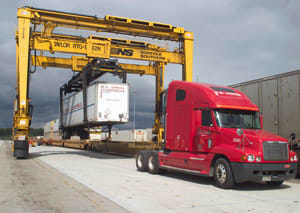
For much of the history of trailer-on-flatcar operations, semitrailers had to be beefed up to take the beating of rail service.
Railcars got slammed together during switching moves en route, and slack action of coupler draft gear among cars delivered more shock as trains started, stopped and changed speeds. Trailer kingpins, upper coupler assemblies, frames and bodies had to be extra heavy duty to survive, and this added weight that cut into payload capacity.
But that changed as railroads began running dedicated trains from one intermodal yard to another, which eliminated switching, and started using long articulated cars that reduced the number of coupling points and slack action.
Also, railroads are keeping their promises to take good care of trailers, say some long-haul trucking companies who are major users of rail service. Circus-style drive-on, drive-off ramps were done away with in the 1980s. Trailers now are loaded and unloaded by huge intermodal cranes that are fast but capable of doing serious damage. However, operators of those machines have evidently been instructed to handle trailers gingerly so damage to vehicles and their cargoes is minimal.
Marten Transport, Mondovi, Wis., and U.S. Xpress Enterprises, Chattanooga, Tenn., say their trailers are used for both road and piggyback rail service with relatively slight modifications and rigid operational caveats. Executives of both carriers spoke about their experience during a conference call hosted by Stifel Nicolaus to talk about equipment advances.
Marten's experience
Marten President and CEO Randy Marten said they've developed a special spec for their piggyback operations. The lifting points at rub rails between landing gear and tandems are reinforced with aluminum angle stock and extra upright posts. Refrigerated trailers have larger 75-gallon fuel tanks versus regular 50-gallon tanks so reefer units will keep running on long, untended runs to California, Dave Meyer, director of maintenance, added later.
"Overall, we work very hard at Marten to make sure that each trailer gets a steady diet of intermodal," said Marten, who added that his company ships 350 to 400 trailers per day by rail. "Some of them might do two intermodal moves a month, and maybe not do another one for eight months. We keep that movement going around so as to reduce trailer wear and tear. Overall, however, we're very satisfied with not only the service, but also with the care that the rails have proved they can actually show our trailers and equipment."
Yes, he admits, trailers get scuffed up and they get bent up, but Marten says it's not as much as some carriers might have experienced. "We're using our own drayage service and our people to pick up the trailers and deliver them, so we know what they look like on both ends. We have to have them back because we're still only running with a 1.75 ratio of trailers to tractors today."
U.S. Xpress
Max Fuller, chairman of U.S. Xpress, said his company's experience was slightly different. "We went into rail intermodal kind of overnight without planning to do so, partially because of the congestion that was going on in southern California in 2004 and 2005," he explains. "Instead of having a backlog, we chose to put loads on the rail to make sure we serviced our customers, whereas other carriers were turning down freight instead."
U.S. Xpress went to the railroads to see what it could do while using its standard trailer. "We told them, 'If you will lift our trailers and add a neoprene rubber pad to your lift so you're not chewing up the aluminum side rails, then we can do this.'"
Fuller recalls getting four or five different manufacturers involved in the process, including the trailer manufacturer, the suspension manufacturer, and the manufacturer that builds the lifts for the railroads. Over about a six-week period, the collaborative effort came up with a process so they could take trailers that were not equipped to go on the rail and lift them and put them on the rail without excessive damage.
That doesn't mean there's no damage, of course.
"The experience has been that close to 5 percent of our trailer fleet has some form of damage due to being hauled on the rail," Fuller says. The most common problem is damage that occurs during the lifting process when the "arms" of the crane come down the side or clip the top rail. A few have been dropped.
"For the most part, trailers live harder in that environment, but at the same time you can do it without a lot of specialty equipment."
Then again, most of U.S. Xpress's trailers are extra stout to begin with. "We use what we call carpet-spec trailers, which have cross members every 12 inches. We've got roof bows at 16 inches and then we use a thicker wall, primarily for carpet, so the structure of our trailer is a lot more solid than the average trailer." About 25,000 of the fleet's 27,000 trailers are carpet spec, so they could go quickly into rail service with only the precautions he outlined.
Watch the suspensions
Both executives noted that axles of air-ride suspensions have to be secured to keep them from pulling down on shock absorbers.
"If it is air ride and it doesn't have something that limits the travel as the trailer's picked up, you probably need to put a chain or something to eliminate that travel so you're not creating other problems," Fuller said.
At Marten, they've added strapping to their air-ride suspensions to not allow the shocks to be the buffer when the trailer's picked up and put in the air.
From the December 2009 issue of Heavy Duty Trucking.
More Equipment

How Volvo Updated Its D13 for EPA 2027 [Watch]
Volvo’s updated D13 promises lower emissions without sacrificing performance or fuel economy. Take a closer look at what changed inside the engine in this HDT Spotlight video.
Read More →
Michelin Tire Improves Efficiency and Durability for Regional Fleets
The Michelin X Multi Energy D2 is a regional haul drive tire engineered to help fleets improve fuel efficiency, durability and traction in demanding stop-and-go operations.
Read More →
ZF Expands Commercial Vehicle Push in North America
ZF is expanding its North American commercial-vehicle presence with new transmission applications, electrification, trailer technology and autonomous-driving systems.
Read More →
Tesla Wants a Self-Driving Semi. Are Cameras Enough?
Could Tesla’s camera-only autonomous driving technology work on an 80,000-pound Semi? In this commentary, HDT's Deborah Lockridge takes a look at Tesla, Cybercab, and how autonomous trucks see the road.
Read More →
Kodiak: Driverless Long-Haul Truck Launch on Track for 2026
Kodiak AI says its driverless long-haul safety case is 93% complete and it remains on track to begin commercial operations by year-end 2026.
Read More →
What DOT’s Automated Vehicle Strategy Means for Trucking
The U.S. Department of Transportation issued a new automated-vehicle strategy that outlines plans for driverless-truck regulations, cross-state freight corridors, and federal safety standards.
Read More →
East Coast Port Launches $45M Electric Truck Push
The Port Authority of New York and New Jersey announced millions in incentives for zero-emission drayage trucks, yard tractors, and new charging hubs near the port.
Read More →
PlusAI Going Public to Fund Autonomous Truck Launch
A SPAC deal could provide PlusAI with up to $300 million as it works toward a 2027 commercial launch of factory-built autonomous trucks.
Read More →
NHTSA Moves to Rewrite Truck Fuel-Economy Rules
The National Highway Traffic Safety Administration says it lacks authority to regulate medium- and heavy-duty truck engines separately from complete vehicles, but the existing standards have not yet been eliminated.
Read More →
Detroit Opens Orders for EPA 2027 Engines
Detroit isn’t starting from scratch to meet EPA 2027 diesel emissions standards. Its Gen 6 DD13 and DD15 engines keep much of today’s platform while updating the fuel and aftertreatment systems.
Read More →