




More from Avery Vise:
Pent-up Demand Bolsters Industrial Freight Volumes
Industrial production and manufacturing output are strong. FTR's Avery Vise explores what this could mean for industrial freight volumes.
by Avery Vise, FTR
April 26, 2022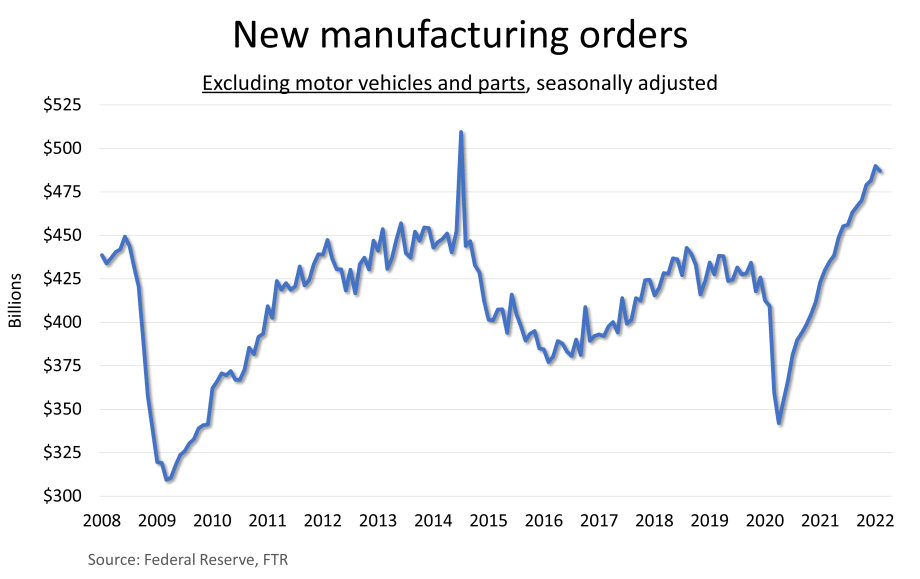
Manufacturing output excluding motor vehicles and parts was 4.6% ahead of February 2020, seasonally adjusted, but new orders for manufactured goods in the latest month were 19% ahead of February 2020.
Source: FTR
3 min to read
Over the past several months, FTR’s Hotline articles for HDT have mostly addressed the consumer sector, including the freight risks associated with inflation and inventories. While we have reasons to be concerned about the potential for weaker consumer spending, we have yet to see data indicating that spending truly is falling.
Some analysts have interpreted the cooling of spot market metrics for dry van and refrigerated as a sign that consumer spending is down. However, that cooling appears to be linked mostly to a recovery in capacity among larger truckload carriers, which is serving to shift volumes back to the contract market and away from the spot market.
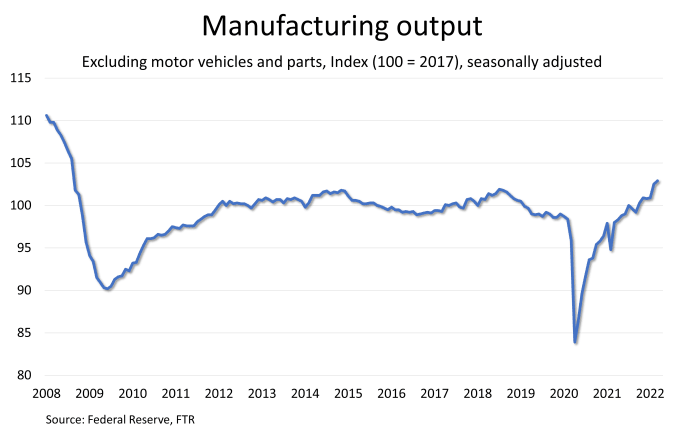
Manufacturing output is the strongest since August 2008.
Source: FTR
Freight associated with the industrial sector is not without risks, but industrial activity appears to have a much higher floor than the consumer sector. Industrial production and manufacturing output are strong. In March, the Federal Reserve’s industrial production index was at its highest level ever, and that data dates to 1919. Manufacturing output is the strongest since August 2008.
Of course, strong production is no guarantee of continued strength. After all, August 2008 was the month before the financial collapse that led to the worst period of the Great Recession. Manufacturing output plunged nearly 16% until it bottomed out in June 2009.
Unlike the situation in 2008, however, the manufacturing sector faces huge pent-up demand due to supply chain and labor challenges. If you have tried to buy new trucks over the past year or so you probably found that it takes far longer than usual. Everyone knows about the global semiconductor shortage that is significantly curtailing production of cars, light trucks, SUVs, and, of course, heavy-duty and medium-duty trucks.
Despite some recent improvements, retail inventories of motor vehicles and parts are still more than 27% below pre-pandemic levels even though vehicle and parts retail sales are running about 29% ahead of pre-pandemic levels. Even if sales fall off, auto makers still will need to push production as much as the semiconductor supply will allow for at least the rest of this year and probably longer.
Although the supply chain issues for vehicle production might be easier to isolate than in the rest of manufacturing, the entire sector is experiencing the same basic problem: Higher demand than production can satisfy. Manufacturing output excluding motor vehicles and parts was 4.6% ahead of February 2020, seasonally adjusted, but new orders for manufactured goods in the latest month were 19% ahead of February 2020.
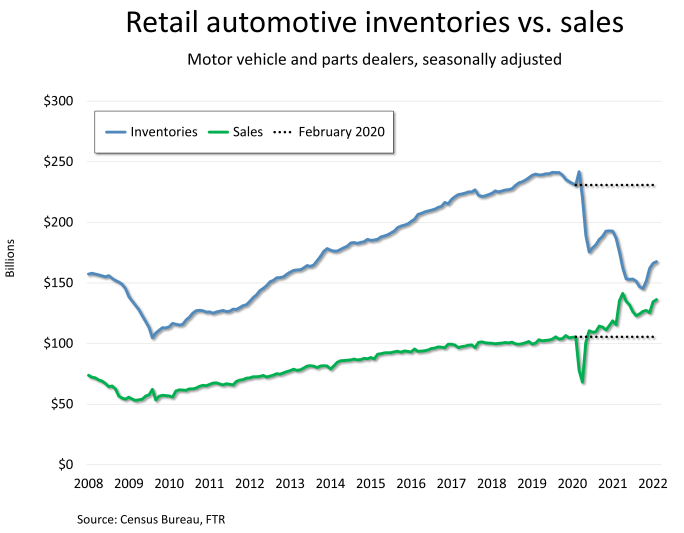
Auto makers will need to push production as much as the semiconductor supply will allow for at least the rest of this year and probably longer.
Source: FTR
Some of that manufacturing demand obviously would disappear if the broader economy stalls, but a significant of that production would be needed to replace worn-out or obsolete equipment. The broader manufacturing sector is not unlike commercial vehicles. Demand for additional trucks and trailers might fade, but the industry still needs to replace older equipment.
For more information, visit www.FTRintel.com/HDT or call FTR at 888-988-1699. This article appears in the May 2022 issue of Heavy Duty Trucking.
Subscribe to Our Newsletter
More Fleet Management

Why Private Fleets Are Taking More Freight
Private fleets are putting their own trucks on demanding customers and high-cost lanes as companies seek greater control over service, costs, and capacity.
Read More →
Sponsored•September 16, 2026
Color Match Smarter: Tools That Restore & Perform
For fleet managers and collision repair professionals keeping heavy-duty trucks on the road, getting the color right the first time isn't just about appearance — it's about efficiency, turnaround time, and bottom-line results. Discover how today's digital color tools are transforming the repair process from guesswork to precision.
Read More →
FMCSA Pauses Biennial-Update Enforcement Amid Motus Transition
Carriers whose updates were due on or after June 1 have more time, while FMCSA works to stabilize its new registration system and warns of phishing sites impersonating its new carrier registration system, Motus.
Read More →


Sponsored•September 14, 2026
2026 Blueprint for Countering Smarter Supply Chain Theft
Cargo theft is no longer just the cost of doing business. It's a multi-billion-dollar criminal enterprise exploiting vulnerabilities across your fleet, drivers, and supply chain.
Read More →
Sponsored•September 1, 2026
How Telematics Improves Visibility, Control, and Performance in Refrigerated Fleets
Explore how telematics help refrigerated fleets improve visibility, uptime, efficiency, compliance, and cargo protection across connected cold chain operations.
Read More →
What the U.S.-Canada Trade War Means for Trucking
Escalating U.S.-Canada tariffs could disrupt cross-border freight, reduce truck volumes, raise costs, and create new uncertainty for carriers on both sides of the border.
Read More →
What Are Trucking’s Top Concerns for 2026?
The American Transportation Research Institute wants to know what's worrying trucking fleet managers, drivers, and other stakeholders in its annual Industry Issues survey.
Read More →
American Trucking Associations Looks for a New Leader
ATA President and CEO Chris Spear abruptly left his job at the association on August 21, at a pivotal time for the trucking industry.
Read More →
Public Wi-Fi Cybersecurity Risks: How Truck Drivers and Fleets Can Protect Their Data
Public Wi-Fi can expose truck drivers and fleets to credential theft, malware, and other cyber threats. Here’s how to reduce the risk on the road.
Read More →
For Nicky Cupp, Fleet Innovation Starts With Frustration
HDT Truck Fleet Innovator Nicky Cupp turns everyday pain points at Fraley & Schilling into opportunities for better technology and smarter processes.
Read More →