




Panel: Electronic Logging Technology Addresses Fleet Priorities
According to Allan Lowry, director of safety at Central Refrigerated Service, there are three main priorities for a fleet: safety, service and retention
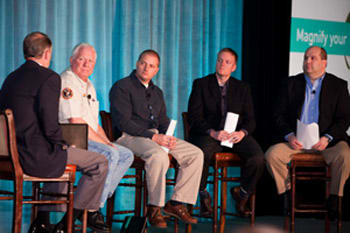
From right: Allan Lowry of Central Refrigerated Service; Dustin England of C.R. England; John Pope of Cargo Transporters; and Kirby Sollom of Schneider National. (Photo courtesy of McGuire Photography)
According to Allan Lowry, director of safety at Central Refrigerated Service, there are three main priorities for a fleet: safety, service and retention.
Electronic logging technology addresses every one of those priorities, Lowry said during a panel session at Qualcomm Enterprise Services' recent user conference in Coronado, Calif.
Lowry joined in on the discussion with some other fleets and a company driver to talk about their use of electronic on-board recorders. The general census was: so far, so good.
Safety
Lowry said the use of EOBRs in Central Refrigerated's fleet has made it much easier to look at every violation, identify risky drivers and take the appropriate actions, such as training drivers. The technology also helps log auditors because the log is much more legible. Central Refrigerated had the technology fully implemented by February 2009.
C.R. England rolled out the technology starting in January 2009, and was fully implemented by the end of 2009. For Dustin England, director of safety at C.R. England, electronic logging meant virtually no more missing logs or falsifications by the drivers. Prior to deploying the technology, the company would be missing between 8 to 10 percent of its driver logs. "We've eliminated that issue," he said.
"As a safety person, it helps you sleep a little better at night," he added.
England said the carrier has also seen a 79 percent reduction in its driver out of service rate since the transition.
Cargo Transporters, which has about 400 power units, took the leap in late October 2008, with the whole fleet outfitted with electronic logging by the end of 2008. According to John Pope, chairman of Cargo Transporters, they have not had a driver placed out of service since October 2008. When the carrier was using paper logs, Cargo Transporters had about 102 violations on its books. In 2009, the number was down to six violations.
"It's been a dramatic change for us," Pope said.
Service
The panelists also indicated that the use of electronic logging has improved their fleet's service. One reason for this, Lowry said, is that drivers are getting better at trip planning.
According to Kirby Sollom, a driver for Schneider National, electronic logging self-educates drivers on legal hours of service. This raises their performance, he said. With a text-to-speech capability, drivers can find out how many hours they have left with the push of a button. "It literally forces that driver to say, 'Where am I?'" he said.
Retention
One of the most common fears the panelists had when they were first considering the technology was that their drivers were going to be resistant. According to Sollom, drivers were a little skeptical at first, but after a day or two, "the comfortability factor just zeroed out."
Sollom said that many of the drivers he trained on the system were worried that they would make less money or be less productive on electronic logs. But drivers found that their productivity levels either stayed the same or improved. In fact, Sollom gained about four to six hours per week using electronic logging.
"There are a lot of benefits that individual drivers don't see up front," Sollom said.
For drivers, it means less paperwork, less addition, and more trust between the driver and dispatch. "It leveled the playing field," Lowry said.
"It takes the pen away; it takes the guessing away," Sollom said. "Once the myths are drained out, the drivers really do like it."
The Bottom Line
In addition to safety, service and retention, the switch to electronic logs also helped these fleets improve their bottom line.
Central Refrigerated ended up saving $50,000 a year from the reductions in processing costs. The carrier also got the amount of revenue going to safety down to 4.5 percent.
Cargo Transporters was able to cut expenses in mailing and scanning. The company was also able to eliminate a person in that department because of the reduction in paperwork.
More Fleet Management

Why Private Fleets Are Taking More Freight
Private fleets are putting their own trucks on demanding customers and high-cost lanes as companies seek greater control over service, costs, and capacity.
Read More →
Color Match Smarter: Tools That Restore & Perform
For fleet managers and collision repair professionals keeping heavy-duty trucks on the road, getting the color right the first time isn't just about appearance — it's about efficiency, turnaround time, and bottom-line results. Discover how today's digital color tools are transforming the repair process from guesswork to precision.
Read More →
FMCSA Pauses Biennial-Update Enforcement Amid Motus Transition
Carriers whose updates were due on or after June 1 have more time, while FMCSA works to stabilize its new registration system and warns of phishing sites impersonating its new carrier registration system, Motus.
Read More →


2026 Blueprint for Countering Smarter Supply Chain Theft
Cargo theft is no longer just the cost of doing business. It's a multi-billion-dollar criminal enterprise exploiting vulnerabilities across your fleet, drivers, and supply chain.
Read More →
How Telematics Improves Visibility, Control, and Performance in Refrigerated Fleets
Explore how telematics help refrigerated fleets improve visibility, uptime, efficiency, compliance, and cargo protection across connected cold chain operations.
Read More →
What the U.S.-Canada Trade War Means for Trucking
Escalating U.S.-Canada tariffs could disrupt cross-border freight, reduce truck volumes, raise costs, and create new uncertainty for carriers on both sides of the border.
Read More →
What Are Trucking’s Top Concerns for 2026?
The American Transportation Research Institute wants to know what's worrying trucking fleet managers, drivers, and other stakeholders in its annual Industry Issues survey.
Read More →
American Trucking Associations Looks for a New Leader
ATA President and CEO Chris Spear abruptly left his job at the association on August 21, at a pivotal time for the trucking industry.
Read More →
Public Wi-Fi Cybersecurity Risks: How Truck Drivers and Fleets Can Protect Their Data
Public Wi-Fi can expose truck drivers and fleets to credential theft, malware, and other cyber threats. Here’s how to reduce the risk on the road.
Read More →
For Nicky Cupp, Fleet Innovation Starts With Frustration
HDT Truck Fleet Innovator Nicky Cupp turns everyday pain points at Fraley & Schilling into opportunities for better technology and smarter processes.
Read More →