




More Than a Logo: What HDT’s Rebrand Means for Heavy-Duty Trucking Fleets
Editor and Associate Publisher Deborah Lockridge explains in this editorial why Heavy Duty Trucking has a new logo and how it reflects how trucking, and HDT, are evolving.


We’ve spent a lot of time this year taking a good look at the industry and ourselves and how we can help you be more successful.
HDT Graphic
Changing a longtime logo is not for the faint of heart. Just ask Cracker Barrel.
In fact, the marketing world has dozens of cautionary tales about famous logo redesigns that flopped. Tropicana’s 2009 new look resembled a generic store brand and was quickly scrapped. Gap’s 2010 logo redesign lasted a week. Pepsi’s 2008 new logo, which was supposed to look like a cheeky smile, was recently retired in favor of the signature red-white-and-blue waves.
Heavy Duty Trucking’s logo isn’t as iconic as these consumer brands, and it’s gone through several iterations since the magazine first appeared under that name in the 1960s.
This month, we announced a bold new logo that we feel honors our 100-plus-year legacy but also moves us into the future. We're refreshing the design of everything from our print magazine to our videos to our award logos.
This new forward-leaning Heavy Duty Trucking logo signals movement and momentum. It’s modern but also has a bit of a retro feel that gives a nod to the nostalgia of old-school trucking.
We’ve gone back to the full name, Heavy Duty Trucking, from the “HDT” we’ve used since 2011. Heavy-duty trucking is our focus, and we wanted that to be quite clear. Fleets using Class 7/8 trucks, heavy-duty trucking fleets, face challenges that can be quite different from those faced by, say, a work truck fleet or a last-mile delivery fleet.
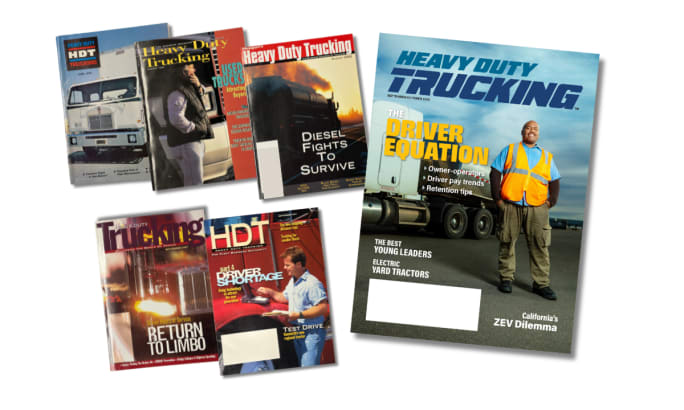
Heavy Duty Trucking's logo has changed several times over the years since it first appeared under this name in the 1960s.
HDT Graphic
Why Heavy Duty Trucking's Changes are More Than a New Look
But the changes go deeper than a new logo and refreshed look.
At Heavy Duty Trucking, we’ve spent a lot of time this year taking a good look at the industry and at ourselves and how we’re serving our audience — you — to help you be more successful, to operate your fleet safely and profitably.
When I started covering trucking in 1990, CDLs were new, electronic engine controls were emerging, and cabovers still roamed the highways. Satellite communication was cutting-edge technology.
When we last redesigned our logo in 2011, the industry was wrestling with CSA 2010, EPA-mandated aftertreatment systems, and the first wave of e-logs.
Today, the industry is shifting again, with a younger generation of leaders, rapidly changing technology, and new ways of consuming information.
But we’re not just looking back — we’re moving forward.
Telling Trucking's Story, Past and Future
Heavy Duty Trucking has been telling the trucking industry’s story for more than a century. I’ve been doing it for 35 years. While much has changed in trucking and in journalism, what hasn’t changed is our commitment to provide the context, analysis, and insights you depend on.
We’re embracing new tools, but our focus is still the people who keep the country moving. We’re committed to delivering human-created content with personality, insight, and analysis.
Our audience isn’t just about the number of site visitors or newsletter opens. It’s about connecting with YOU, one human connecting with another human.
That’s why you won’t find AI-written content at Heavy Duty Trucking. And on the rare occasions we do use AI-generated content, such as images, we will be transparent about it.
We’re exploring new ways to deliver our content, so you can get that information wherever you are, however you prefer it, in a trucking industry that’s changing faster than ever.
“Driven by our Legacy, Designed for What’s Next.” Yes, it’s a marketing slogan, but it’s also a good description of not just our new logo, but of our renewed commitment to you.
More Fleet Management

Color Match Smarter: Tools That Restore & Perform
For fleet managers and collision repair professionals keeping heavy-duty trucks on the road, getting the color right the first time isn't just about appearance — it's about efficiency, turnaround time, and bottom-line results. Discover how today's digital color tools are transforming the repair process from guesswork to precision.
Read More →
FMCSA Pauses Biennial-Update Enforcement Amid Motus Transition
Carriers whose updates were due on or after June 1 have more time, while FMCSA works to stabilize its new registration system and warns of phishing sites impersonating its new carrier registration system, Motus.
Read More →
2026 Blueprint for Countering Smarter Supply Chain Theft
Cargo theft is no longer just the cost of doing business. It's a multi-billion-dollar criminal enterprise exploiting vulnerabilities across your fleet, drivers, and supply chain.
Read More →


How Telematics Improves Visibility, Control, and Performance in Refrigerated Fleets
Explore how telematics help refrigerated fleets improve visibility, uptime, efficiency, compliance, and cargo protection across connected cold chain operations.
Read More →
What the U.S.-Canada Trade War Means for Trucking
Escalating U.S.-Canada tariffs could disrupt cross-border freight, reduce truck volumes, raise costs, and create new uncertainty for carriers on both sides of the border.
Read More →
What Are Trucking’s Top Concerns for 2026?
The American Transportation Research Institute wants to know what's worrying trucking fleet managers, drivers, and other stakeholders in its annual Industry Issues survey.
Read More →
American Trucking Associations Looks for a New Leader
ATA President and CEO Chris Spear abruptly left his job at the association on August 21, at a pivotal time for the trucking industry.
Read More →
Public Wi-Fi Cybersecurity Risks: How Truck Drivers and Fleets Can Protect Their Data
Public Wi-Fi can expose truck drivers and fleets to credential theft, malware, and other cyber threats. Here’s how to reduce the risk on the road.
Read More →
For Nicky Cupp, Fleet Innovation Starts With Frustration
HDT Truck Fleet Innovator Nicky Cupp turns everyday pain points at Fraley & Schilling into opportunities for better technology and smarter processes.
Read More →
Adam Buttgenbach’s Approach to Electric Trucks: Start With Where They Fit
HDT Truck Fleet Innovator Adam Buttgenbach helped PepsiCo build one of North America’s largest EV fleets by focusing on where electric trucks make operational sense.
Read More →