




LNG: Kwik-Trip Inc. runs both LNG and CNG
Says the butcher: “We eat what we sell.” Says Kwik-Trip: “We burn what we sell.” That’s natural gas, sold in liquefied and compressed form at 15 of the 430 retail filling stations the company operates in Wisconsin, Minnesota and Iowa.

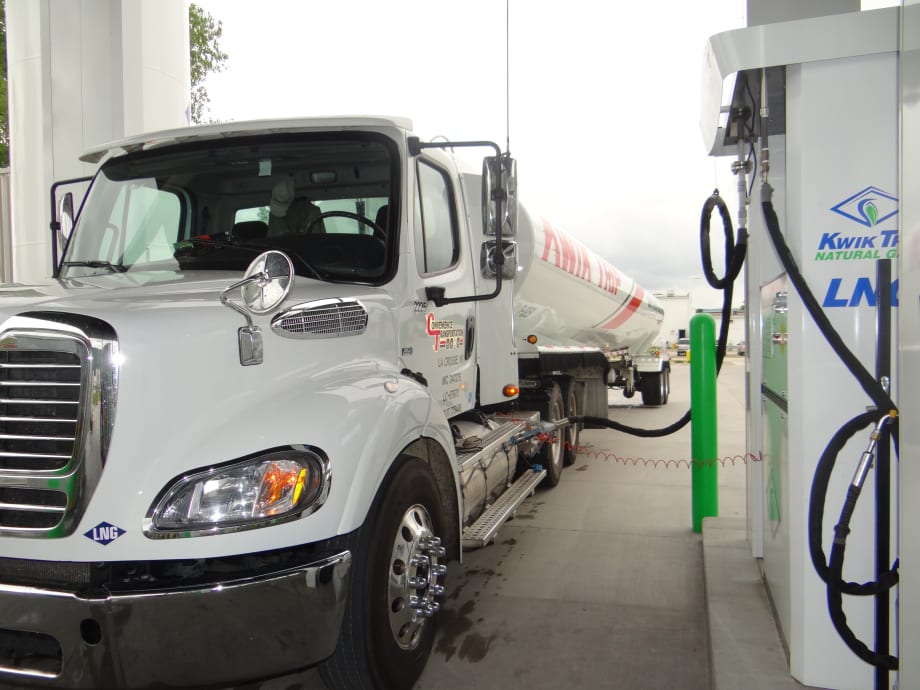
Kwik-Trip’s LNG and CNG trucks use its public filling stations, including this one in La Crosse, Wis. Managers are trying out both gas types so they can give realistic advice to customers.
Says the butcher: “We eat what we sell.” Says Kwik-Trip: “We burn what we sell.” That’s natural gas, sold in liquefied and compressed form at 15 of the 430 retail filling stations the company operates in Wisconsin, Minnesota and Iowa. Currently, 34 of the firm’s own trucks and tractors use LNG and CNG because managers wanted experience with both types.
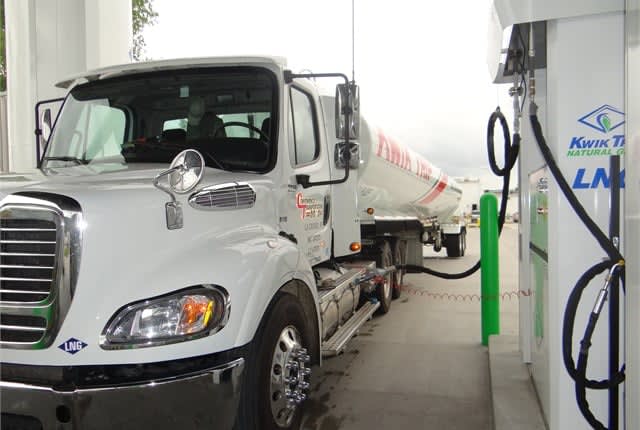
Kwik-Trip’s LNG and CNG trucks use its public filling stations, including this one in La Crosse, Wis. Managers are trying out both gas types so they can give realistic advice to customers.
“We wanted to look at them both, to learn the advantages and disadvantages, to learn how to spec them, so that as we talk to fleet customers we can speak to our experiences,” says Joel Hirschboeck, superintendent of alternative fuels at the company’s headquarters in La Crosse, Wis. Its vehicles have Cummins Westport 8.9- and 11.9-liter gas engines, which can burn either CNG or LNG.
Which is better – LNG or CNG? “It’s what fits your application,” he says. “LNG’s biggest advantage is more energy in a smaller container. Of course, infrastructure is important, and CNG is less costly for that.”
An LNG truck or tractor has a range of approximately 600 miles with a 119-diesel-gallon-equivalent tank. A CNG truck uses two 45-DGE tanks with a 450-mile range. More bottles would give more range for a CNG vehicle, but they also would add weight and cost.
“We don’t need the longer range, so we will go toward CNG and refuel en route on the longer runs,” Hirschboeck says.
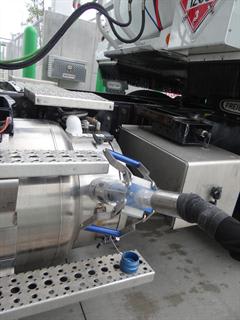
Kwik-Trip sells about 1,000 gallons of natural gas a day, including to the public, and the fleet’s trucks use the same public facilities.
The shortest-range tractors in the fleet are a pair of yard “goats,” but they run on LNG “because at the time we ordered, there wasn’t a good CNG solution for fuel storage – the chassis were too small to mount the tanks. But now they do have CNG capability.” The yard tractors are from Capacity and Autocar, and have Cummins ISL G engines.
“We’ve had good success with that engine, and use it in straight trucks, too,” he says. “It works well with diminishing loads. We have a couple of demo units with the ISX12 G, one 350 horsepower and one 400, and we’re seeing good success, too.” The 12Gs are in tractors that gross up to 80,000 pounds.
The company does a lot of driver training, with two to three hours up front plus ongoing training. Drivers need to learn more about the system itself, plus how to manage low-end torque, and the fact that your foot on the floor at higher speeds doesn’t give any more horsepower.
“Natural gas gives pretty close to diesel performance in our application and the way we’ve got our trucks set up, including governing at 60 mph,” he says.
Tractors are a little bit of everything, including Peterbilt 384, Kenworth T440, Freightliner M2-112 and Volvo VNM.
“We wanted to individually understand the product lines and also the corporate support structures,” Hirschboeck says. “We’re working with the different dealerships and OEMs to understand where their service and support are on natural gas vehicles. They’ve been good with all of ‘em, especially at the local dealer level with shop support, and they’ve all got trained technicians.”
Vehicle price premiums range from $30,000 to $60,000 each, depending on the tank package, Hirschboeck says. “We had Agility (the fuel system supplier) come out and install the vehicle tank systems on site, and we now can install the systems on our own. We have 15 natural gas stations, and the cost for each was $750,000 to $1.5 million,” with LNG equipment being more expensive.
Natural gas fuel is half the price of diesel, so the break-even point for vehicles is 200,000 miles.
Kwik-Trip sells about 1,000 gallons of natural gas a day, including to the public, and the fleet’s trucks use the same public facilities.
They pump at 10 to 12 gallons per minute; most have two dispensers with four nozzles, standard and transit (for buses).
“We run 24/7, so LNG boil-off from truck tanks (when they warm) is not a problem. We can hold LNG for seven days. But we can turn any venting from on-site storage tanks into CNG, automatically – they’re set up for that.
“It’s a very safe fuel,” Hirschboeck says. “All trucks have safety measures, with positive nozzle locks so there’s no leakage while fueling, like you can have with gasoline and diesel.”
More Fuel Smarts

Geotab Links Fleet Card to Vehicle Data
The new card combines fuel discounts with telematics-based purchase controls. Geotab’s analysis also points to potential savings from choosing lower-priced fuel stops.
Read More →
Fleet Economics Shape Electric Truck Outlook
ACT Research expects costs, charging infrastructure, and technology improvements to drive zero-emission commercial vehicle adoption as federal regulations and incentives retreat.
Read More →
Wex Adds Cardless Fuel Payments for Over-the-Road Customers
A new fuel card feature for Wex customers offers convenience and security.
Read More →

New California Law Could Shed Light on Electric Truck Prices
Why do battery-electric Class 8 trucks remain so expensive? A California bill signed by Gov. Gavin Newsom would give fleets and state agencies more visibility into what manufacturers charge.
Read More →
How Volvo Updated Its D13 for EPA 2027 [Watch]
Volvo’s updated D13 promises lower emissions without sacrificing performance or fuel economy. Take a closer look at what changed inside the engine in this HDT Spotlight video.
Read More →
Diesel Price Spike Shortens Payback for Natural Gas Trucks, Report Says
Energy Vision estimates fleets could recover the higher purchase price of an RNG-fueled Class 8 tractor in 1.3 to 2.8 years under current fuel-price scenarios.
Read More →
Calstart Becomes Catalyst Mobility, Reflecting Broader Focus
Calstart is now Catalyst Mobility, reflecting the nonprofit’s growing national role in clean transportation, including zero-emission trucks, infrastructure and incentive programs.
Read More →
Record Diesel Prices Squeeze Trucking Fleets
Average U.S. diesel prices have climbed to nearly $6 a gallon, surpassing the 2022 record as tight refinery capacity and Middle East disruptions keep fuel costs elevated.
Read More →
How Fuel Delivery Shapes Engine Performance
Fuel delivery depends on more than what happens at the injector. For fleet, maintenance and technical professionals, looking at the full path from pump to injector can provide useful context for understanding engine performance.
Read More →
East Coast Port Launches $45M Electric Truck Push
The Port Authority of New York and New Jersey announced millions in incentives for zero-emission drayage trucks, yard tractors, and new charging hubs near the port.
Read More →