




Lawfare: Nuclear Verdicts and the War on Trucking
Nuclear verdicts are on the rise. And they’re only getting worse. Why has trucking found itself in the crosshairs? And what can the industry do about it? Part one in a series.


Key to preventing and fighting nuclear verdicts in trucking is understanding how plaintiff attorneys work.
Image: HDT Graphic
HAVE YOU BEEN INJURED BY A BIG TRUCK?
CALL THE LAW FIRM OF SQUISHY, SQUALLAS AND SPASSOID TODAY TO GET YOUR BIG CASH SETTLEMENT!
WE FIGHT FOR YOU!
Mmmm hmmm.
We’ve all seen the billboards and the TV commercials. Not to mention the radio ads and banner ads on social media platforms.
And if you’re in the trucking industry, this isn’t news. Plaintiff attorneys have been coming at trucking fleets for years now. And in the process these lawyers have been steadily driving up so-called nuclear verdicts against carriers.
What is news is this: The problem is getting exponentially worse.
Nuclear verdict settlements are skyrocketing at an alarming rate. And in recent months, plaintiff attorneys have moved beyond targeting fleets and are starting to go after OEMs and suppliers.
In September, Wabash National was hit with a $462 million verdict in the wake of accident that killed two men when the car they were in went underneath a trailer in St. Louis and the rear underride guard failed.
The same month, Daimler Truck North America was slammed with a $160 million verdict in an Alabama rollover accident that left a man paralyzed.
Both companies are appealing those verdicts.
A quick internet search reveals a depressing litany of jury awards against fleets in excess of $10 million, the amount that the American Transportation Research Institute defines as a “nuclear verdict.”
And these verdicts do far more damage to trucking than gutting individual carriers. They are driving up insurance costs across the industry and forcing some fleets to leave the industry altogether.
It’s no surprise, then, to learn that nuclear verdicts have become a top concern for fleet executives in recent industry surveys.
In an effort to help fleets better understand and protect themselves from nuclear verdicts, HDT invited attorney Jennifer Akre of the Tyson & Mendes law firm to speak at Heavy Duty Trucking Exchange in September.
Tyson and Mendes specializes in representing trucking fleets in high-risk litigation cases. Akre has defended companies of all sizes in the transportation and logistics industry.
It All Started with a Hot Cup of Coffee
In many ways, the current plague of nuclear verdicts dates back to a February morning in 1992 when Stella May Liebeck ordered a cup of coffee at McDonald’s in Albuquerque, New Mexico, and spilled its contents on her lap.
Liebeck received third-degree burns in her pelvic region and spent eight days in the hospital recovering from the incident. This was followed by skin grafts and two additional years of medical care.
She initially tried to settle with McDonald’s for $20,000 to cover her medical expenses. But the giant restaurant chain refused. So Liebeck’s attorney filed suit accusing McDonald’s of gross negligence.
In court, her attorneys then argued that McDonald’s coffee was defective and far more likely to cause serious injury than coffee served at other fast-food restaurants.
The jury agreed and awarded Liebeck $2.7 million in damages.
Since then, things have only gotten worse, Akre noted. The average jury verdict rose nearly 1,000% from 2010 to 2018. And starting in 2019, the country saw another 300% spike in verdicts in excess of $20 million.
“And there are ripple effects to these verdicts,” she told HDTX attendees. “Huge verdicts change the way that we have to insure our companies. You have to pass those costs on to your customers, and everybody wants to know why prices are rising.
"So, this is a problem that we have to solve.”
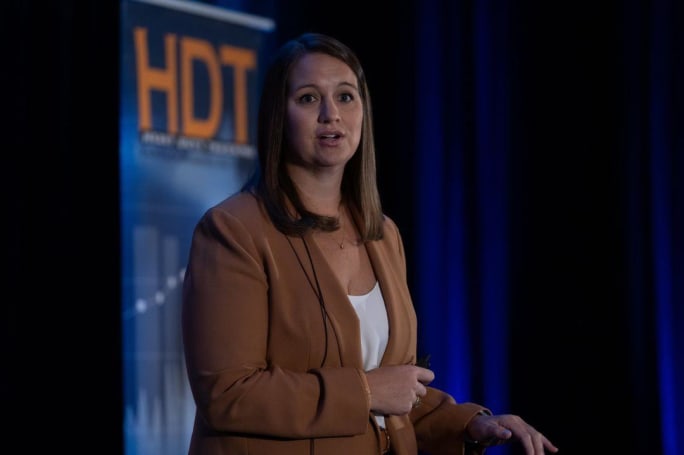
Defense attorney Jennifer Akre speaks at HDTX in 2024.
Photo: Ross Stewart Photography
Akre said her law firm and other concerned parties are working with state legislators all over the country to pass common-sense legislation that will better control those economic damages.
But, she noted, those efforts are far removed from a conference room in Scottsdale, Arizona. Which is why she advises trucking fleets to do everything in their power long before an accident occurs to drive down those damages in the courtroom.
“It’s our hope that that by doing so, we can drive down those non-economic damages over time.”
What About Your Trucking Company Can Plaintiff Attorneys Use to Inflame Juries?
Another problem Akre pointed out is that plaintiff attorneys fought for, and got, substantial changes in how they can advertise their services to the public. Until a few years ago, attorneys were not allowed to post settlement amounts in advertising. Today, virtually every advertisement features an eye-popping dollar amount that grabs the public’s attention.
Combine that with the reality that the public is scared of and mistrusts big trucks, and you’ve got a recipe for disaster.
“These lawyers know that all they have to do is go down to the courthouse, say a few things and tick a jury off,” Akre explained.
“And a trucking company is an easy target. We used to be able to settle cases for 40% to 50% of what we believed the actual verdict value was. But now? They can get a huge number. So why would they settle for anything less?”
In fact, jury verdict figures and settlement numbers are getting closer together.
“That means that we, as defense lawyers, have to be a lot more creative about how we settle cases,” she said. “We have to carefully evaluate cases early so that we can try to win back some of the power we’ve lost over time in the courtroom.”
But, Akre explained, the main issue defense lawyers have to contend with in a courtroom today is good, old-fashioned outrage.
“Why are there so many nuclear verdicts today?” she asked. “Well, it’s not because of bad judges, or bad laws, or bad lawyers or bad juries. The answer is anger. The plaintiff lawyers are ticking off juries.”
The lawyers do this, Akre explained, by going through every aspect of a fleet’s operations. They dig in deep and look at a fleet’s shops, safety meetings, training meetings, hiring processes, warehouses and corporate offices to find anything they can use to anger a jury.
That means a fleet can end up getting hit with a nuclear verdict because a plaintiff attorney outraged a jury over an incident that wasn’t directly related to the accident that brought the lawsuit in the first place.
“When I come in to defend a fleet, it’s my job to identify things that happened before the accident that might tick a jury off when we go to trial,” she said. “I have to look at things that happened a year, or even two years before the accident.
"I’m looking for potential anger points – what we call aggravating factors. And then I sit down with the defendant and outline what I’ve learned: Things that, as soon as a plaintiff attorney learns about, he or she is going to start using in depositions and building a case that will make a jury angry in order to get a nuclear verdict.”
More Fleet Management

Color Match Smarter: Tools That Restore & Perform
For fleet managers and collision repair professionals keeping heavy-duty trucks on the road, getting the color right the first time isn't just about appearance — it's about efficiency, turnaround time, and bottom-line results. Discover how today's digital color tools are transforming the repair process from guesswork to precision.
Read More →
FMCSA Pauses Biennial-Update Enforcement Amid Motus Transition
Carriers whose updates were due on or after June 1 have more time, while FMCSA works to stabilize its new registration system and warns of phishing sites impersonating its new carrier registration system, Motus.
Read More →
2026 Blueprint for Countering Smarter Supply Chain Theft
Cargo theft is no longer just the cost of doing business. It's a multi-billion-dollar criminal enterprise exploiting vulnerabilities across your fleet, drivers, and supply chain.
Read More →


How Telematics Improves Visibility, Control, and Performance in Refrigerated Fleets
Explore how telematics help refrigerated fleets improve visibility, uptime, efficiency, compliance, and cargo protection across connected cold chain operations.
Read More →
What the U.S.-Canada Trade War Means for Trucking
Escalating U.S.-Canada tariffs could disrupt cross-border freight, reduce truck volumes, raise costs, and create new uncertainty for carriers on both sides of the border.
Read More →
What Are Trucking’s Top Concerns for 2026?
The American Transportation Research Institute wants to know what's worrying trucking fleet managers, drivers, and other stakeholders in its annual Industry Issues survey.
Read More →
American Trucking Associations Looks for a New Leader
ATA President and CEO Chris Spear abruptly left his job at the association on August 21, at a pivotal time for the trucking industry.
Read More →
Public Wi-Fi Cybersecurity Risks: How Truck Drivers and Fleets Can Protect Their Data
Public Wi-Fi can expose truck drivers and fleets to credential theft, malware, and other cyber threats. Here’s how to reduce the risk on the road.
Read More →
For Nicky Cupp, Fleet Innovation Starts With Frustration
HDT Truck Fleet Innovator Nicky Cupp turns everyday pain points at Fraley & Schilling into opportunities for better technology and smarter processes.
Read More →
Adam Buttgenbach’s Approach to Electric Trucks: Start With Where They Fit
HDT Truck Fleet Innovator Adam Buttgenbach helped PepsiCo build one of North America’s largest EV fleets by focusing on where electric trucks make operational sense.
Read More →