




Knorr-Bremse Leaders Talk About the Path to Future Trucks
Where does Knorr-Bremse, the parent company of Bendix, fit in on the path to future trucks, as trends drive further toward advanced safety systems, electrified vehicles, and autonomous technology?
by John G. Smith, Today's Trucking
December 16, 2020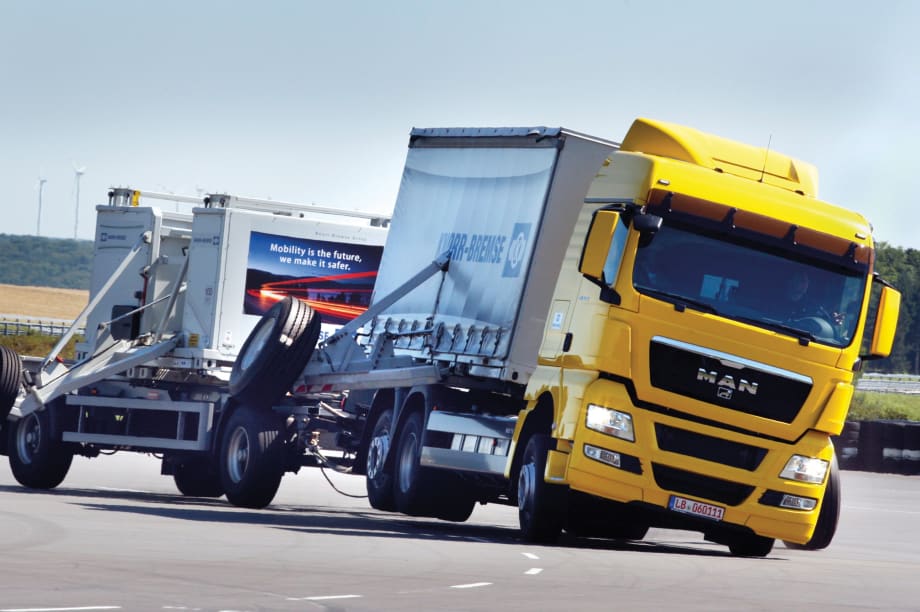
Advanced driver assistance systems are all about vehicle motion control, whether in the U.S., China, or Europe. And that takes brakes, steering, electronics and more all working together.
Photo: Knorr-Bremse AG
5 min to read
While trucks are often thought of in terms of steel, iron, aluminum and fiberglass, the underlying electronics are powering their future – as the industry drives further in the direction of advanced safety systems, electrified vehicles, and autonomous technology.
It’s a global business, too. As advanced as equipment is becoming in North America, Chinese and European markets are on similar journeys of their own.
Those trends are increasingly evident in the global nature of the truck makers and component suppliers. Take Knorr-Bremse, for instance. You may know the name as the parent company of Bendix. Bendix Commercial Vehicle Systems LLC had been operating as a joint venture between Honeywell and Knorr-Bremse AG since 1993, and the German company took full control in 2002.
While other parts of the world are seeing some of the same commercial-vehicle trends, they’re influenced by different forces.
In North America, today’s evolving safety systems are largely driven by a desire to make driving jobs more comfortable, helping to address the challenge of hiring and retaining truck drivers, Hawthorne says. “You’re trying to ensure you can compete for that talent,” explains Bendix President and CEO Michael Hawthorne.
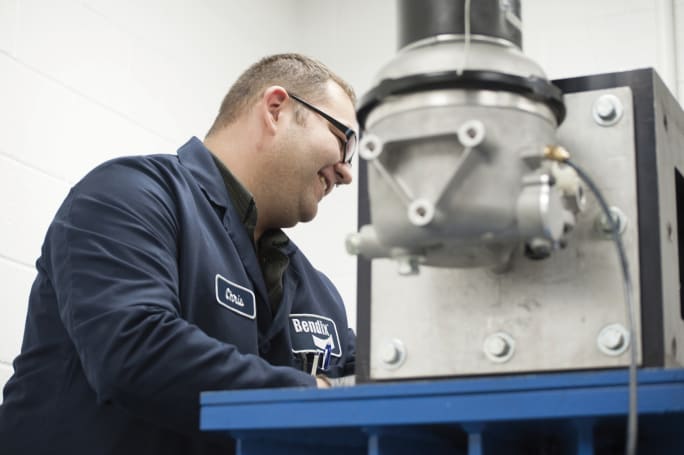
Bendix production facility in Elyria, Ohio.
Photo: Knorr-Bremse AG
In China and Europe, there are more regulatory forces at play.
China, for instance, is regulating pedestrian automatic emergency braking systems and mandating electronic stability controls for trucks that haul dangerous goods. Its latest Five-Year Plan even includes commitments to develop highly autonomous vehicles.
European trucks and buses will soon need systems to eliminate blind spots that might otherwise hide cyclists and pedestrians, adding to mandates for emergency braking systems. And Peter Laier, the member of Knorr-Bremse’s executive board responsible for Commercial Vehicle Systems operations (including Bendix), believes systems to help with steering will not be far behind.
Steering to the Future
Knorr-Bremse has assembled many of the pieces to make a new generation of steering controls a reality. It recently acquired R.H. Sheppard, a well-known maker of steering gear, from Wabco Holdings. But that $149.5 million deal wasn’t the only one. It’s also picked up J.M. Engineered Products’ ProSteering Business, Japan’s Hitachi CVS Steering, and tedrive Steering, and expanded a joint venture with Dongfeng Motor in China.
What’s emerging are systems that can help keep trucks in their lanes, compensating for issues such as the crown on a road or cross winds, as well as tracking between the lines.
“Truck motion control is really the product,” says Hawthorne.
In the process, advanced braking systems and the steering controls combine to support the development of highly autonomous vehicles.

Knorr-Bremse's Peter Laier, chief of the Commercial Vehicle Systems operations that include Bendix CVS.
Photo: Knorr-Bremse AG
The journey to autonomous vehicles is not about building trucks that can travel from L.A. to New York under autonomous controls, Laier says. He sees them making more sense in confined settings such as harbors and logistics centers.
“I think we have two countries in the world where it will come first – that’s the U.S. and China,” he adds. In the U.S., the interest comes through the business case and the shortage of drivers. In China, the targets are set by the state.
Lower Emissions and E-Mobility
Advances for future trucks are not limited to steering and braking and autonomous technology, of course. Global markets are placing an increasing focus on e-mobility, whether it comes in the form of a battery-electric vehicle or hydrogen fuel cells.
In Europe, the interest is largely driven by emissions-related regulations. The European Commission wants to reduce greenhouse gas emissions by 55% by 2030 compared to 1990 levels.
In North America, the strongest push to electric trucks has been more regional. Every new truck sold in California will need to be a zero-emission vehicle as early as 2045, and the shift from diesel to zero-emission offerings is scheduled to begin in 2024.
“That’s ambitious, and I want to see how hard they hold that line,” Hawthorne says of the timelines, referring to some of the underlying challenges that still need to be addressed.
One California fleet recently noted that just five of its 125 depots had access to the infrastructure needed to charge electric trucks, he says, referring as well to sagging and aging powerlines that contributed to recent wildfires. “You just can’t get access to the electricity.”
But there’s no question that electric trucks will play a part in the future. Knorr-Bremse’s eCubator development arm was established specifically to adapt products for e-mobility needs, as well as to identify growth opportunities in the field.
Laier says he expects a mixture of powertrains to come, with manufacturers offering a combination of highly efficient diesel engines, battery-electric systems, or hydrogen fuel cells depending on the application.
The business cases vary from one operation to the next, and some are undeniably closer to electrification options than others. Package delivery is one example of one application well-suited to e-mobility.
“You don’t have to do it because you’re a good steward of the earth. You do it because it’s good business,” Hawthorne says.
Decisions will even need to be anchored in brakes, he says, referring to other questions that need to be answered: Will they be driven electrically, or rely on compressed air?
Evolving Brakes
That isn’t the only way brakes themselves continue to evolve. Although North America continues to lag behind the European adoption of disc brakes, they are becoming more popular on this side of the Atlantic.
The main barrier for disc brakes is the customer experience, Hawthorne says. “There’s a familiarity with drums. It’s a historically understood product.” Disc brakes cost more than drums, as well.
But there’s no denying the benefits. Discs aren’t prone to fading like drum brakes. The servicing is easier, too, Laier says. It explains why adoption rates exceeded expectations last year and this year.
Knorr-Bremse’s corporate strategies are supporting growth in this area as well. A wheel-end manufacturing facility in Kentucky is being expanded to meet the higher demand.
There’s no stopping the journey to the future, even if that future involves new and better ways of stopping.
John G. Smith is the editorial director of Newcom Media's trucking and supply chain publications – including Today's Trucking, trucknews.com, and others. A version of this article first appeared on trucknews.com and was used with permission from Newcom Media as part of a cooperative editorial agreement.
Subscribe to Our Newsletter
More Equipment

How Volvo Updated Its D13 for EPA 2027 [Watch]
Volvo’s updated D13 promises lower emissions without sacrificing performance or fuel economy. Take a closer look at what changed inside the engine in this HDT Spotlight video.
Read More →
Michelin Tire Improves Efficiency and Durability for Regional Fleets
The Michelin X Multi Energy D2 is a regional haul drive tire engineered to help fleets improve fuel efficiency, durability and traction in demanding stop-and-go operations.
Read More →
ZF Expands Commercial Vehicle Push in North America
ZF is expanding its North American commercial-vehicle presence with new transmission applications, electrification, trailer technology and autonomous-driving systems.
Read More →
Tesla Wants a Self-Driving Semi. Are Cameras Enough?
Could Tesla’s camera-only autonomous driving technology work on an 80,000-pound Semi? In this commentary, HDT's Deborah Lockridge takes a look at Tesla, Cybercab, and how autonomous trucks see the road.
Read More →
Kodiak: Driverless Long-Haul Truck Launch on Track for 2026
Kodiak AI says its driverless long-haul safety case is 93% complete and it remains on track to begin commercial operations by year-end 2026.
Read More →
What DOT’s Automated Vehicle Strategy Means for Trucking
The U.S. Department of Transportation issued a new automated-vehicle strategy that outlines plans for driverless-truck regulations, cross-state freight corridors, and federal safety standards.
Read More →
East Coast Port Launches $45M Electric Truck Push
The Port Authority of New York and New Jersey announced millions in incentives for zero-emission drayage trucks, yard tractors, and new charging hubs near the port.
Read More →
PlusAI Going Public to Fund Autonomous Truck Launch
A SPAC deal could provide PlusAI with up to $300 million as it works toward a 2027 commercial launch of factory-built autonomous trucks.
Read More →
NHTSA Moves to Rewrite Truck Fuel-Economy Rules
The National Highway Traffic Safety Administration says it lacks authority to regulate medium- and heavy-duty truck engines separately from complete vehicles, but the existing standards have not yet been eliminated.
Read More →
Detroit Opens Orders for EPA 2027 Engines
Detroit isn’t starting from scratch to meet EPA 2027 diesel emissions standards. Its Gen 6 DD13 and DD15 engines keep much of today’s platform while updating the fuel and aftertreatment systems.
Read More →