




IT and MPG
In the abstract, reducing fuel cost represents a pretty straightforward undertaking: Get as many miles as possible out of every gallon of fuel, pay as little as possible for those gallons, and reduce the number of miles each truck travels to get the job done

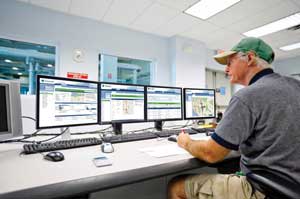
Driver and vehicle performance data gathered by IT solutions is often presented in dashboard-style format, allowing fleet managers to quickly spot problem areas.
In the abstract, reducing fuel cost represents a pretty straightforward undertaking: Get as many miles as possible out of every gallon of fuel, pay as little as possible for those gallons, and reduce the number of miles each truck travels to get the job done.
Information technology can help manage all three goals.
"No matter how you slice it, reducing fuel costs comes down to two things: increasing mpg and reducing the number of miles you drive," says Chris Ransom, director of sales for NetworkFleet, San Diego.
We discussed routing and route optimization in our March issue. Adam Kahn, director of product marketing for Qualcomm Enterprise Solutions, noted then that back-office routing and dispatch systems combine the right freight with the right truck based on destination, delivery windows, driver profiles and other factors.
However, establishing the most efficient route in and of itself is not enough to ensure that truck is operated in the most fuel-efficient manner or that the fuel purchased along that route is the cheapest available. A number of technology vendors offer solutions to help fleets manage both of these.
Improving mpg
Ransom says he sees three components to increasing fleet fuel efficiency: reducing idling, improving driver behavior and maintaining vehicle health. To help fleets identify areas where they can improve, NetworkFleet collects GPS from its onboard device and collects operational data directly from the truck's electronic control module. It sends that information via a cellular network to the company's servers, where customers can access the data online. They also can receive email reports on a periodic basis.
Other companies offer similar services.
Steve Katz, director of sales for Blue Tree Systems, Roanoke, Va., says coaching driver behavior can result in a 30% to 35% improvement in fuel economy. Blue Tree's R:Com fleet management system links map location data to all events such as excessive idling, harsh acceleration or braking, speeding, driving without use of cruise control and over-revving, and other events to produce color-coded driver and vehicle reports to highlight areas for improvement. The system allows profiling vehicle characteristics such as rpm bands, over-speeding, fuel consumption targets and other areas. The system can summarize driver performance based on groups (by terminal, equipment driven, etc.) and also can produce individual driver scorecards.
Christian Schenk, vice president of market development and product marketing for Xata Corp., says managing driver behavior by monitoring speeding, progressive shifting and idle time are considered "table stakes" for these packages, and most customers expect those capabilities as a minimum. The Xata Turnpike product puts a dollar value on a fleet's drivers based on their performance, allowing fleet managers to direct their efforts toward those drivers needing the most help.
Brad Pinchuk, president of Hirschbach Motor Lines, East Dubuque, Ill., says his fleet monitors the driver behavior aspects of fuel economy by getting daily downloads from their tractors' ECMs via mobile communications devices. That data is then integrated into its enterprise software, which generates reports that highlight fuel efficiency, speeding, shift-ranges and other factors.
The company runs 500 trucks pulling temperature-controlled trailers. Pinchuk says they have improved their fuel economy by about 15% as a result of the various strategies they have implemented.
Although fleets typically see the most improvement through managing driver behavior, vehicle health is also an important aspect. "When a vehicle has a 'check engine soon' light on, it's averaging 2 to 6 mpg less than normal," says NetworkFleet's Ransom.
Analytics
Monitoring vehicle fuel efficiency and driver behavior is a good start on improving a fleet's fuel usage, but often the data collected can present an incomplete picture. That's where operational analytics comes in. PeopleNet's Vusion division and other vendors offer products that can reach across the various systems within a fleet such as dispatch, enterprise management, maintenance management, mobile communications, fuel tax auditing systems and fuel card programs to bring data together for analysis.
According to Thomas Fansler, Vusion president, the system combines data from these various sources to compile a more complete picture of vehicle and driver performance. Instead of just looking at fuel-use data from the engine's ECM, for instance, it also looks at fuel card information, fuel tax data, equipment specifications and aftermarket products such as APUs and GPS data to produce a truer picture of vehicle performance. "A lot of fleets go astray in managing mpg," he says.
Fansler says that for trucks running engines with 2007 emissions standards, fuel-use figures from the ECMs tended to be overstated and may give misleading results due to calibration inequities (although engine makers we contacted did not concur). Fleets also need to consider load and geographical characteristics, tires, fuel-tank size, APU use and other data.
Oftentimes, once these other factors have been taken into consideration, fleets find that the trucks they thought were the "dogs" of the fleet are actually performing better than they thought, while the trucks that appeared to be the top performers are lagging behind. Knowing that information can be vital for a fleet looking to increase its fuel efficiency, Fansler says. Looking at a hypothetical 900-truck fleet, for example, a difference between 6.51 mpg and 6.35 mpg for two different truck model and engine pairings can mean a savings of $1.6 million per year in fuel costs if the fleet specs the better-performing truck.
"Fleets are always looking for more granular information from their systems," NetworkFleet's Ransom adds. "For example, a fleet operator may want to know idle time, but only when the PTO is not in use. That gives them a better picture of the idling that they want to control."
Theft and fraud
As fuel prices rise, so do incidents of fuel theft or fraud. A number of solutions exist to help fleets fight such theft. Vusion's Fansler says that by combining data from a number of sources, fleets can know a truck's tank level at key off, tank level at key on and compare that to any fuel card charges to help spot fuel theft or fraud.
Blue Tree Systems' R:Com Fuel Auditor module performs the same kind of function. "It takes the fuel burned by the engine and compares it against the fuel purchased during the same time," Katz says. "The deltas jump out."
"If there is a difference of a few gallons, that's probably not significant," he notes. Each fleet can decide what is significant so they can make sure the fuel that is purchased is fuel burned in the engine. When a fleet does spot a significant variance, the system has a one-click drill-down - a mouse click on that item brings up a map that shows where that fuel was purchased and how much.
NetworkFleet offers similar fuel fraud protection through its association with Wright Express, a fuel card provider. "We can track fuel fraud through the information we provide," Ransom says. Because the system monitors GPS location of the vehicle, "we can see if a fuel card was used in a place where the vehicle was not. If that happens, the fuel card is in some other vehicle."
NexTraq, Atlanta, which offers dispatch and vehicle tracking products, also uses GPS and fuel card data to monitor possible fuel fraud. "If a fuel card shows fuel was purchased at a fuel stop at the same time the GPS shows your truck at a customer's location, there is probably some fuel slippage going on," says Mark Roberts, chief marketing officer.
For fleets operating remote fueling locations, oil-field work for instance, telematics helps control fuel loss there as well.
More Fleet Management

Geotab Links Fleet Card to Vehicle Data
The new card combines fuel discounts with telematics-based purchase controls. Geotab’s analysis also points to potential savings from choosing lower-priced fuel stops.
Read More →
How MFA Helps Protect Trucking Fleets
Multi-factor authentication adds protection when passwords are stolen. Here’s how it works and where fleets should start.
Read More →
How Better Freight Data Helps Trucking Teams Get Ahead of Disruption
Trucking and logistics teams have plenty of data. The problem is getting the right information in front of the right people soon enough to act. Better-connected data can help teams spot trouble earlier and make smarter decisions before small problems become big ones.
Read More →

Trimble: Taking Artificial Intelligence in Trucking Beyond Faster Tasks
At Insight 2026, Trimble executives argued that fleets may need to redesign workflows to get more from AI as it introduced new products and enhancements. AI’s value will depend on how fleets combine automation with their people's knowledge.
Read More →
Build a bulletproof fleet: Uniting ELDs and dash cams for total compliance
An ELD can prove compliance, but it cannot always prove what happened on the road. Discover how uniting accurate ELD data with AI-powered dash cam video can help your fleet strengthen compliance, defend against liability, protect drivers and reduce operational costs.
Read More →
Nominations Open for HDT Emerging Leaders
Heavy Duty Trucking is looking for accomplished trucking fleet professionals under 40 who are making an impact and helping lead the industry forward.
Read More →
Why Private Fleets Are Taking More Freight
Private fleets are putting their own trucks on demanding customers and high-cost lanes as companies seek greater control over service, costs, and capacity.
Read More →
Color Match Smarter: Tools That Restore & Perform
For fleet managers and collision repair professionals keeping heavy-duty trucks on the road, getting the color right the first time isn't just about appearance — it's about efficiency, turnaround time, and bottom-line results. Discover how today's digital color tools are transforming the repair process from guesswork to precision.
Read More →
FMCSA Pauses Biennial-Update Enforcement Amid Motus Transition
Carriers whose updates were due on or after June 1 have more time, while FMCSA works to stabilize its new registration system and warns of phishing sites impersonating its new carrier registration system, Motus.
Read More →
2026 Blueprint for Countering Smarter Supply Chain Theft
Cargo theft is no longer just the cost of doing business. It's a multi-billion-dollar criminal enterprise exploiting vulnerabilities across your fleet, drivers, and supply chain.
Read More →