




Inflation Reduction Act Will Spark Greater, Faster Switch to Electric Trucks
The Inflation Reduction Act contains key provisions that promote the adoption of electric-powered medium- and heavy-duty commercial trucks.

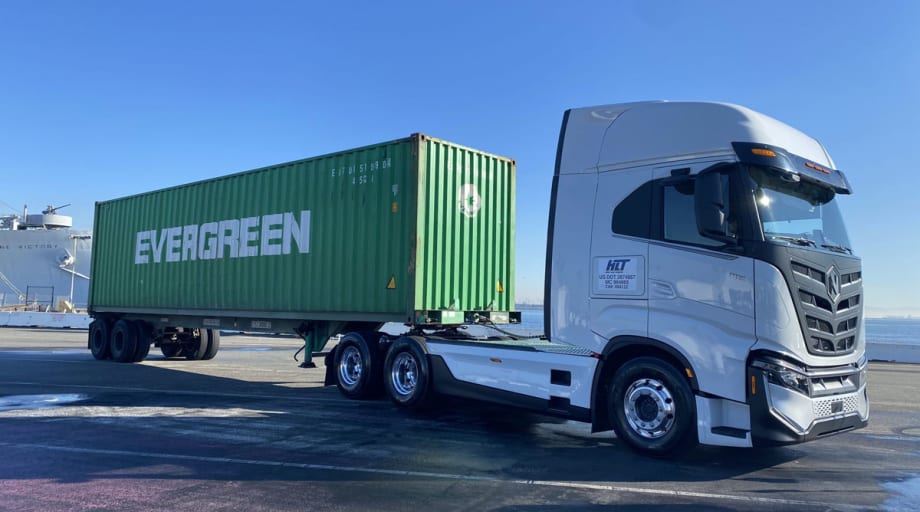
The Inflation Reduction Act includes some provisions specifically meant to foster electric vehicle adoption by truck fleets.
Photo: Nikola
Colossal in scope and dollars, the Inflation Reduction Act (IRA), signed into law by President Biden on Aug. 16, rings up the biggest investment in battling climate change in U.S. history. The legislation will raise $738 billion and authorize $391 billion in spending to increase energy efficiency and reduce the impact of climate change.
When it comes to pushing development and adoption of zero-emission vehicles (ZEVs), the IRA contains several provisions crafted to promote the adoption and deployment of clean transportation technologies, which includes alternative fuels, that build on existing programs and various incentives for switching to clean transportation technology.
As for trucking, some of those provisions are specifically meant to foster electric vehicle take-up by truck fleets, including a new tax credit program and a grant and rebate program to replace certain commercial vehicles with new “clean” heavy-duty vehicles.
New Tax Credits Seen as Boost for Electric Trucks
Speaking jointly at a recent green transportation summit, the founding member companies of Partners for a Zero Emission Vehicle Future (PZEVF), Daimler Truck, Navistar, Paccar, and Volvo Group, applauded the Inflation Reduction Act for its tax credits to offset the purchase cost of medium- and heavy-duty ZEVs and installation of charging infrastructure.
"In the early stages of the industry's transition to zero emissions, grants and incentives are essential to help operators and owners offset initial higher purchase costs and encourage deployment of these vehicles on our nation's roads," said Alec Cervenka, Kenworth Zero Emissions Sales Manager, who represented Paccar on the panel. "Down the road, as volumes increase and the industry brings to bear economies of scale, we eventually expect ZEV technology to provide a total cost of ownership on par or better than the current diesel truck."
The IRA also “provides unprecedented support for the domestic EV battery-manufacturing sector and supply chain and represents a historic down payment on the transition to a clean transportation system for our nation,” said Jes Olson, vice president of policy for CALSTART, a California-based national nonprofit that promotes clean transportation solutions.
“Tax policy support for the EV battery market has been a top priority for CALSTART’s U.S. Electric Vehicle Battery Initiative (USEVBI) and we believe this bill will have a transformational impact, incentivizing manufacturing opportunities and the thousands of new jobs that will result from these investments,” Olson added.
How the Bill Will Drive EVs Forward
A summary of the bill’s incentives for clean transportation prepared by the Congressional Research Service, a public policy research institute of the U.S. Congress, lays out the key provisions that are intended to drive electric truck adoption forward. “The IRA modifies the existing tax credit for new PEVs, resulting in a modified tax credit for certain clean vehicles,” stated the author, CRS analyst Melissa N. Diaz. “The IRA also creates a new tax credit for previously owned ‘clean vehicles’ and commercial ‘clean vehicles.’”
Per the CRS summary, edited for clarity, here are the key IRA provisions aimed at trucking:
Qualified Commercial Clean Vehicles. Section 13403 introduces a new tax credit offering a separate option from the Section 13401 credit (a double benefit is disallowed) for commercial “clean vehicles” (e.g., Plug-in Electric Vehicles (PEVs and Fuel Cell Electric Vehicles (FCEVs). Commercial vehicles may be eligible for the unmodified tax credit for PEVs or the previous tax credit for FCVs. The basis for the credit amount differs from that for Section 13401 credit: either 15% of the vehicle cost (30% for non-gasoline or non-diesel vehicles) or the incremental cost relative to a comparable vehicle. The maximum amount is $7,500 for GVWRs less than 14,000 pounds, or $40,000 otherwise (e.g., heavy-duty municipal vehicles).
Alternative Fuel Refueling Credit. Section 13404 extends and modifies the tax credit for alternative fuel refueling property. Qualifying property is expanded to include charging stations for 2- and 3-wheeled vehicles (for use on public roads) and bidirectional charging equipment (i.e., vehicle-to-grid or V2G). Starting in 2023, qualifying property will be limited to that placed in service within low-income or non-urban census tracts. For business property, the credit amount decreases to 6% (from 30%) with a maximum amount of $100,000 (previously $30,000). Business property meeting prevailing wage and registered apprenticeship requirements may be eligible for a credit amount of 30% ($100,000 maximum).
Funding for Vehicle Fleets. In addition to tax credits, the IRA supports fleet acquisition of clean and zero-emission vehicles (e.g., PEVs, FCVs). Section 70002 appropriates $3 billion to the United States Postal Service (USPS) to acquire zero-emission delivery vehicles and requisite infrastructure at USPS facilities. Section 60101 appropriates $1 billion to the Environmental Protection Agency to implement a grant and rebate program for clean heavy-duty vehicles, with $400 million set aside for projects to replace vehicles serving communities located in an air quality nonattainment area for any air pollutant.
EPA Administrator Michael S. Regan said in a statement that sums up the bill’s push for zero-emission vehicles that the Inflation Reduction Act is “a game-changer for the American people… We will use these unprecedented resources to reduce harmful air pollution in places where people live, work, play, and go to school… We will aggressively combat damaging climate pollution.”
More Fuel Smarts

How Volvo Updated Its D13 for EPA 2027 [Watch]
Volvo’s updated D13 promises lower emissions without sacrificing performance or fuel economy. Take a closer look at what changed inside the engine in this HDT Spotlight video.
Read More →
Diesel Price Spike Shortens Payback for Natural Gas Trucks, Report Says
Energy Vision estimates fleets could recover the higher purchase price of an RNG-fueled Class 8 tractor in 1.3 to 2.8 years under current fuel-price scenarios.
Read More →
Calstart Becomes Catalyst Mobility, Reflecting Broader Focus
Calstart is now Catalyst Mobility, reflecting the nonprofit’s growing national role in clean transportation, including zero-emission trucks, infrastructure and incentive programs.
Read More →

Record Diesel Prices Squeeze Trucking Fleets
Average U.S. diesel prices have climbed to nearly $6 a gallon, surpassing the 2022 record as tight refinery capacity and Middle East disruptions keep fuel costs elevated.
Read More →
How Fuel Delivery Shapes Engine Performance
Fuel delivery depends on more than what happens at the injector. For fleet, maintenance and technical professionals, looking at the full path from pump to injector can provide useful context for understanding engine performance.
Read More →
East Coast Port Launches $45M Electric Truck Push
The Port Authority of New York and New Jersey announced millions in incentives for zero-emission drayage trucks, yard tractors, and new charging hubs near the port.
Read More →
California Bill Could Shed Light on Electric Truck Prices
Why do battery-electric Class 8 trucks remain so expensive? A California bill headed to Gov. Gavin Newsom would give fleets and state agencies more visibility into what manufacturers charge.
Read More →
Detroit Opens Orders for EPA 2027 Engines
Detroit isn’t starting from scratch to meet EPA 2027 diesel emissions standards. Its Gen 6 DD13 and DD15 engines keep much of today’s platform while updating the fuel and aftertreatment systems.
Read More →
Zero-Emission Truck Corridor Planned for West Coast
California, Oregon, Washington, British Columbia and Baja California are coordinating plans for truck charging and hydrogen fueling from Canada to Mexico.
Read More →
A Closer Look at Kenworth’s Electric T880E Vocational Truck [Video]
Learn more about Kenworth's T880E battery-electric vocational truck at the Paccar Technical Center, including its range, applications, upfitting considerations, and PTO options, in this HDT Spotlight video.
Read More →