




“Like most transportation companies, we have access to tons of data that is not being analyzed in an interactive manner."
How ‘Intelligent’ is Your Business?
Where are you on the ladder of business intelligence? Using big data can help you understand potentially thousands of variables to help you boost competitiveness and profitability.
by TMW Systems
February 9, 2017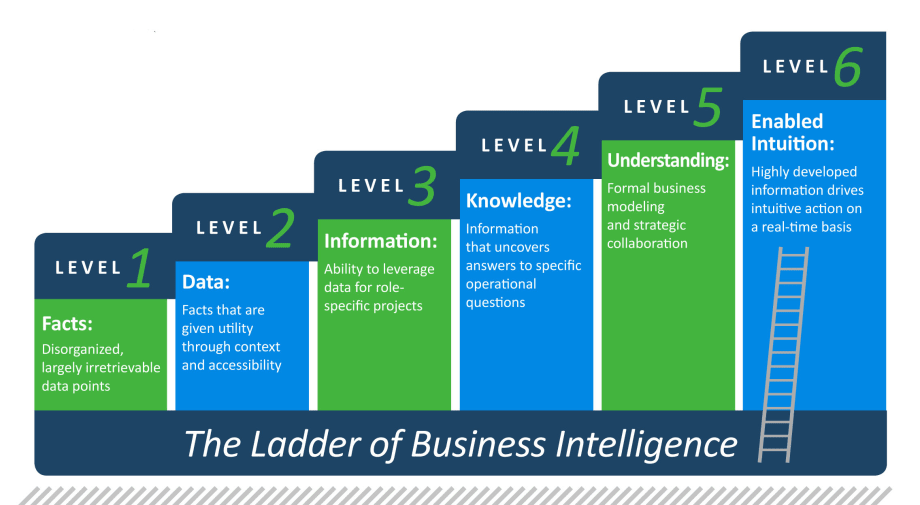
Graphic courtesy TMW
8 min to read
Are you investing in “BI?” You undoubtedly recognize the acronym for “Business Intelligence” and, like most transportation professionals, agree it is a crucial strategic tool for any asset-, non-asset-based or blended operation.
But how you and your industry peers define and leverage BI might vary dramatically. For some, it represents little more than visual replications of an established set of KPIs. For many, BI remains largely a backend process through which data is aggregated and retrieved for reporting purposes. For a growing number of transportation enterprises, however, business intelligence represents an exciting new pathway to increased understanding of potentially thousands of variables that help determine an organization’s competitiveness and profitability.
Even the industry’s BI thought leaders would likely agree they are still in the very early stages of a journey that could ultimately revolutionize their businesses. In a sense, therefore, the progress made in this journey by any fleet, 3PL or broker can determine how “intelligent” they really are in an age of ever-rising data volume, variety and velocity.
“Like most transportation companies, we have access to tons of data that is not being analyzed in an interactive manner,” says Kent Parkinson, chief information officer for Royal Trucking, West Point, Mississippi. “But we’re now on a path to move beyond spreadsheets as we apply modern tools that will help provide a much deeper understanding of our business.”
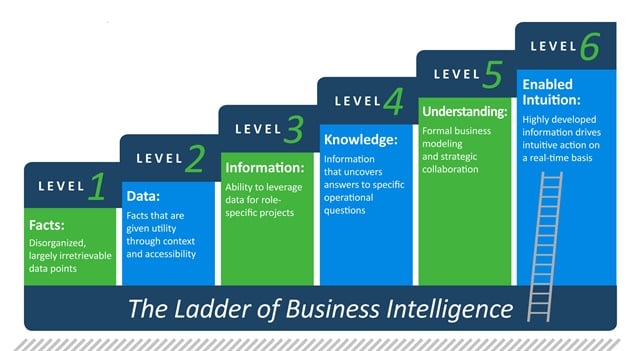
Royal, like thousands of carriers, is still comparatively early in its BI journey, perhaps just two or three steps into what author and consultant James E. Cates calls the “Ladder of Business Intelligence.” Cates’ BI maturity model comprises six levels of organizational resources and fluency in managing information:
Level 1 - Facts: Disorganized, largely irretrievable data points
Level 2 - Data: Facts that are given utility through context and accessibility
Level 3 - Information: Ability to leverage data for role-specific projects
Level 4 - Knowledge: Information that uncovers answers to specific operational questions
Level 5 - Understanding: Formal business modeling and strategic collaboration
Level 6 - Enabled Intuition: Highly developed information drives intuitive action on a real-time basis
Graphic courtesy TMW
A Windshield View
Make no mistake, everyone knows they need BI; the market is too dynamic for successful players not to understand the importance of gaining deeper insight into the many complex operational factors that contribute to growth and profitability.
But while a majority of transportation businesses are leveraging what they consider to be some form of business intelligence, they might not yet recognize how far they can stretch their capabilities.
“There’s a tremendous gap between the first few steps in that ladder and the ability to consistently and proactively use information to move your business forward,” explains Brian Larwig, vice president and general manager, optimization, for TMW Systems. “In the earlier stages, you’re essentially using data to identify a specific past performance measure. As your capabilities mature, however, you can answer a much more important question: Why did you perform at that level? And next, you can determine which specific changes you can make to improve your performance.”
As transportation businesses ascend this ladder, they increase their ability to leverage data on the leading edge of their operations rather than as a backend reporting tool. Or, as Larwig describes it, they can spend more time “managing through the windshield” rather than from the rearview mirror.
Better to Best
To illustrate the difference, consider the following challenge: Conventional reporting might tell you that you had excess capacity in Dallas during the previous week. A more mature BI platform can help you identify this issue earlier in the planning lifecycle, perhaps in time to solicit additional loads. Today’s most advanced BI tools, by contrast, can enable users not only to pursue that additional freight, but also determine which prospective customers might offer the highest yielding opportunities, not only out of Dallas but also in the context of any subsequent loads for each truck. The dollars-and-cents benefits, not to mention network balance implications, can be huge.
While many transportation businesses eventually will attain this level of intelligent foresight, BI’s more conventional, near-term benefits are already driving ROI for many carriers and 3PLs. For Lawrence Transportation Services, Rochester, Minnesota, investing in BI is considered as important as insuring its assets.
“The costs of not knowing how our business is operating, at a finite level of detail, is just far too risky,” says Walter A. Grigg III, the company’s vice president of business intelligence. Beyond tracking an expanded array of operational details, including empty miles, fuel expenses, hours of service, and idle time, Lawrence is identifying and monitoring goals for improvement and, equally important, using its increased visibility “to make sure we don’t fall back into our previous errors,” Grigg adds.
Similar successes can be found in asset and non-asset based businesses across North America. Private carrier Deseret Transportation Services, Salt Lake City, Utah, is now using an advanced BI platform to dramatically improve management reporting, identify actionable information, and extend this intelligence deeper within its organization, according to fleet manager Steve Roberts. The company already has established an extensive set of BI dashboards that monitor billing status (completed loads that have not been billed, old loads not completed, and projected vs. actual revenue for current month); on-time delivery (last quarter, past five weeks, actual and projected performance for current week); internal and external freight costs by operating group; loaded, empty and brokered miles; average miles per gallon by dispatch group; and more.
“Each of these businesses is on its own journey of understanding how to more quickly and effectively respond to the unexpected changes in demand and other factors that confront every carrier or non-asset based provider,” says Tim Leonard, executive vice president, technology, TMW Systems. “We are in an age that demands instant intelligence.”
The massive volume, variety and velocity of data flowing through ERP, TMS, WMS, CRM, mobile communications and other solutions has overwhelmed the capabilities of traditional data warehouses and other similar BI tools, according to Leonard. Those batch-processing solutions are only capable of reporting “what happened” rather than “what can happen.”
Royal Trucking is using its cloud-based BI solution to methodically turn its attention from the past to the future. “We’ve been able to look at longer term trends and drill down to identify any changes that might have impacted our performance at a given point,” Parkinson explains. “Now we want to address these trends on a predictive basis. Given our mix today and the trends we’ve identified from the past, how will a change such as the addition of a new lane or capacity affect our bottom line?”
This progress toward a “windshield view” is important not only to Parkinson and his I.T. team, but also to Royal’s upper management and owner. “The thing they like best is that we’re going to the source of truth,” he says. “Any authorized user of our system can run the analytics and discover what’s actually happening.”
Going Beyond
Leonard foresees modern BI transforming dozens of value areas within fleets of virtually all sizes and types, with the rate of adoption accelerating as businesses demonstrate the ROI of harnessing Big Data. As transportation businesses progress through the journey of developing an information-infused operational culture, he expects them to overcome several common challenges:
Optimizing freight movements and routing. The increased use of satellite navigation, on-vehicle sensors and other technologies will feed ever-growing volumes of data that can be leveraged to provide instantaneous snapshots of load and network status. How are the driver and vehicle performing? Will current and projected traffic patterns impact on-time delivery and/or driver availability? All of this enhanced intelligence can be used to optimize fleets on a near-continuous basis.
Predictive modeling for inventory logistics. Shippers can dynamically refresh inventory projections and product availability based on real-time information regarding in-transit stock. This enables shippers, in partnership with BI-savvy carriers and 3PLs, to reduce inventories while enhancing service levels.
Reduce fuel consumption. Fleets can leverage Big Data to monitor driver behavior that contributes to excessive fuel consumption. They also can apply predictive modeling to match the most versatile, durable and fuel-efficient assets to a given set of lanes and load profiles.
Reduce maintenance costs and downtime. Advanced BI can provide crucial visibility into the complex world of vehicle maintenance. Fleets will gain an enhanced understanding of operating conditions, component wear rates and patterns, impact of varying PM schedules, warranty analytics, spare parts inventory costs, and other factors affecting productivity and profitability.
Network and capacity optimization. Applying a predictive approach to demand based on continuous, real-time analysis of data from multiple systems will enable fleets to optimize capacity planning for improved yield and ROI.
Optimizing pricing strategies. Complex analytical models can be developed based on daily published rates, historical data, competitor behavior, seasonality considerations, and overall market opportunity data to sharpen pricing strategies by customer and lane.
“Each of these is a comparatively near-term opportunity for a business that is serious about leveraging business intelligence for a sustained competitive advantage,” says TMW’s Larwig. “The technology largely exists. The path forward involves gaining buy-in across the organization to put your data to work in a far more strategic way.”
Achieving that buy-in and leading the organization along the path – or up Cates’ “ladder” – to a mature BI platform is a role that can be played by a transportation-focused technology provider, Larwig adds. “This doesn’t need to be a huge investment carrying a lot of risk,” he says. “Solutions exist that can help guide an organization along the journey toward data mastery. The possibilities can be overwhelming, but a technology provider can help you prioritize and pursue business and market insights that will have the greatest effect on your bottom line.”
From TMW's new Outbound customer magazine; used with permission. This article was chosen by HDT's editors to provide useful information to our readers. For more information: www.tmwsystems.com/big-data
Subscribe to Our Newsletter
More Fleet Management

Sponsored•September 16, 2026
Color Match Smarter: Tools That Restore & Perform
For fleet managers and collision repair professionals keeping heavy-duty trucks on the road, getting the color right the first time isn't just about appearance — it's about efficiency, turnaround time, and bottom-line results. Discover how today's digital color tools are transforming the repair process from guesswork to precision.
Read More →
FMCSA Pauses Biennial-Update Enforcement Amid Motus Transition
Carriers whose updates were due on or after June 1 have more time, while FMCSA works to stabilize its new registration system and warns of phishing sites impersonating its new carrier registration system, Motus.
Read More →
Sponsored•September 14, 2026
2026 Blueprint for Countering Smarter Supply Chain Theft
Cargo theft is no longer just the cost of doing business. It's a multi-billion-dollar criminal enterprise exploiting vulnerabilities across your fleet, drivers, and supply chain.
Read More →


Sponsored•September 1, 2026
How Telematics Improves Visibility, Control, and Performance in Refrigerated Fleets
Explore how telematics help refrigerated fleets improve visibility, uptime, efficiency, compliance, and cargo protection across connected cold chain operations.
Read More →
What the U.S.-Canada Trade War Means for Trucking
Escalating U.S.-Canada tariffs could disrupt cross-border freight, reduce truck volumes, raise costs, and create new uncertainty for carriers on both sides of the border.
Read More →
What Are Trucking’s Top Concerns for 2026?
The American Transportation Research Institute wants to know what's worrying trucking fleet managers, drivers, and other stakeholders in its annual Industry Issues survey.
Read More →
American Trucking Associations Looks for a New Leader
ATA President and CEO Chris Spear abruptly left his job at the association on August 21, at a pivotal time for the trucking industry.
Read More →
Public Wi-Fi Cybersecurity Risks: How Truck Drivers and Fleets Can Protect Their Data
Public Wi-Fi can expose truck drivers and fleets to credential theft, malware, and other cyber threats. Here’s how to reduce the risk on the road.
Read More →
For Nicky Cupp, Fleet Innovation Starts With Frustration
HDT Truck Fleet Innovator Nicky Cupp turns everyday pain points at Fraley & Schilling into opportunities for better technology and smarter processes.
Read More →
Adam Buttgenbach’s Approach to Electric Trucks: Start With Where They Fit
HDT Truck Fleet Innovator Adam Buttgenbach helped PepsiCo build one of North America’s largest EV fleets by focusing on where electric trucks make operational sense.
Read More →