





Related: Who Balances Trailer Wheels?
How Important are Balance and Alignment?
Fleets seem to run hot and cold on alignment and balance. Some swear by them, while others see them as unnecessary expenses.
October 28, 2015
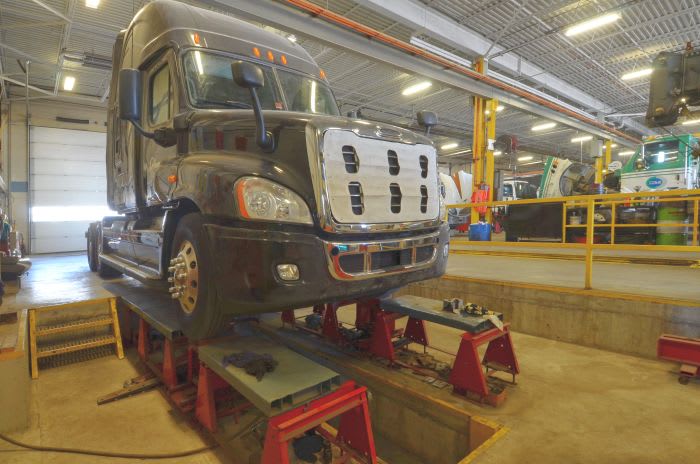
Alignment is best used as a repair tool, not a diagnostic tool. The tires themselves will tell you when an alignment is needed. Photos: Jim Park
5 min to read
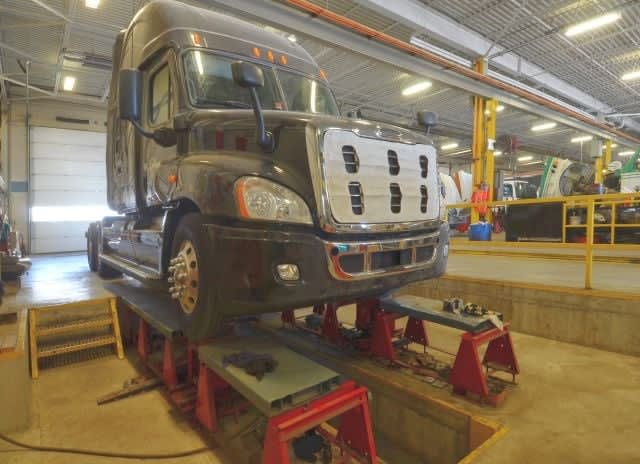
Alignment is best used as a repair tool, not a diagnostic tool. The tires themselves will tell you when an alignment is needed.Photos: Jim Park
Fleets seem to run hot and cold on alignment and balance. Some swear by them, while others see them as unnecessary expenses. Discussions with fleet maintenance managers suggest that many who do balance tires balance only steer tires, and then only once when new. Fleets that do not balance believe that today’s top radial tires are manufactured to high enough standards that they should not need to be balanced if they are mounted and installed properly.
As for alignment, the most common refrain we hear is from fleets is to align the truck before putting it into service as part of the pre-delivery inspection, and then align only as needed throughout its life.
Combined, the prevailing thinking would seem to suggest fleets are willing to perform these services only if there’s an obvious need, like premature tire wear or driver complaints about ride and handling.
Two views on balancing
Lloyd Hair, maintenance director at Pennsylvania-based heavy-hauler Keen Transport, routinely balances steer tires and will do so again if he gets driver complaints about ride or handling. He does not balance drive or trailer tires.
“I’ll use as much as 16 ounces of weight to balance a tire,” he says. “If it needs more than that, I’ll deflate the tire, break the bead and rotate the tire 180 degrees on the rim and try it again. That more often than not does the trick. If that doesn’t work, I send the tire back to the manufacturer.”
When he gets a driver complaint about vibration, he doesn’t automatically pull the wheels off and balance them. He investigates the complaint.
“If the tires are wearing properly and they aren’t damaged, a vibration is usually a sign that something else is wrong,” he says. “If you assume it’s the tire and put a weight on it or use some balancing compound, you might be masking a driveline problem, such as a failing U-joint.”
Fred Staugh, vice president of maintenance at Iowa-based CRST, does not balance his tires. He spends a little more time ensuring they are mounted properly. Staugh believes that unless there’s a defect in the tire, if the tire and wheel assembly is round and running true, it won’t need balancing.
“When I say round, I’m talking 60- or 90-thousandths of an inch of tolerance on radial and lateral runout as measured with a dial indicator,” he says. “If you have that inspection process down and you use those guidelines, there’s no reason on Earth to balance a steer tire.”
Staugh believes you can eliminate the need to balance tires just by installing them properly and then checking them for runout and a heavy spot while on the vehicle. He says rims should be inspected with a runout gauge before the tire is mounted, and they should be within the manufacturer’s tolerance. The mounted tire should be checked for concentric mounting by verifying the gap between the rim flange and the bead seating ring is the same all around the tire and on both sides of the tire.
“Even if you know you’re putting a round tire on a round wheel, you still have to check after it’s installed for its high spot,” cautions Staugh. “With the high spot marked, place it at the 12 o’clock position on the hub where gravity will pull the wheel down onto the hub pilots, creating a natural low spot. The two will cancel each other out. It doesn’t get any better than that.”
Guidelines for these inspection and mounting procedures can be found in the ATA’s Technology & Maintenance Council Recommended Practice library. Look for RP 214D.
Align when needed
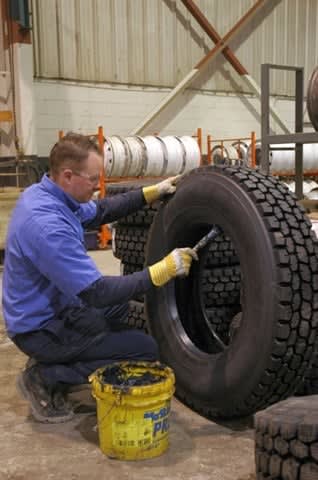
Bead lubricant will help the tire seat properly. Use the bead seating rings as guidelines to ensure the tire is concentrically mounted.
Your tires will tell you whether or not the vehicle is going straight down the road. Staugh says tires should be examined at every preventive maintenance interval for telltale signs of alignment-related wear, such as feathering, or excess wear on opposite shoulders of the steer tires.
“You can’t shove a tire down the road at any kind of an angle other than straight ahead and not get some kind of wear pattern that will indicate the truck is not going straight down the road,” he says.
Hair, too, is constantly on the lookout for wear patterns that suggest a vehicle-related problem, such as alignment.
“I align when new and usually again at between 250,000-300,000 miles,” he says. “I will always pull a truck in for an alignment when I see sign of unusual wear as well.”
Both Hair and Staugh agree that thrust angle is more often the culprit with alignment than front-end problems.
Both also regularly check their trailers for alignment. It’s a simple check: measuring from the kingpin to the front axle, and then from the front axle to the rear. It only takes a few minutes to check and it can save many 32nds of an inch of trailer rubber.
Fuel economy
Balance and alignment have long been touted as tire saving measures, although maybe a little tough to quantify — but how about fuel savings? TMC’s S.11 Energy Conservation Study Group recently updated RP 1111, Relationships Between Truck/Trailer Components and Fuel Economy. It says that “tire balance across 18 tires on a tractor-trailer combination has been documented to save as much as 2.2% SAE J1326/RP 1102 Type II fuel testing at two different facilities.”
Getting all your tires headed in the same direction isn’t going to hurt fuel economy either. But there’s also tire life improvements to be had, and since the most fuel efficient part of a tire’s life cycle is the latter half, when not try to extend that life as long as possible? It won’t bankrupt you to throw some balancing compound into a few sets of trailer tires to see what sort of life increase or better fuel mileage you get.
Subscribe to Our Newsletter
More Maintenance

Sponsored•September 16, 2026
Color Match Smarter: Tools That Restore & Perform
For fleet managers and collision repair professionals keeping heavy-duty trucks on the road, getting the color right the first time isn't just about appearance — it's about efficiency, turnaround time, and bottom-line results. Discover how today's digital color tools are transforming the repair process from guesswork to precision.
Read More →
Wrong Repair Prompts Recall of Freightliner, Western Star 4x2 Trucks
DTNA is recalling more than 2,400 trucks that received an incompatible software fix instead of the hardware repair required to address brake valve corrosion.
Read More →
Truck Drivers Need More Than Another Alert
Fleets have more visibility into truck health, safety events, and driver activity than ever. The next challenge is turning all that information into useful guidance for the person who has to decide what to do next.
Read More →
The Maintenance Checks Trucking Fleets Should Prioritize Before Fall Freight Picks Up
Making it through August isn’t the same as being ready for the next several months of operation. Find out what systems may have suffered from summer heat and need to be checked out before fall.
Read More →
What Three Fleets Are Doing Differently When Buying Truck Parts in 2026
With freight improving but costs still climbing, fleet maintenance executives explain how they're balancing price, quality, and supplier relationships.
Read More →
Paccar Recalls 2027 Trucks Built This Summer for Possible Electrical Problem
The nearly 6,000 Kenworth and Peterbilt trucks in the recall could potentially lose engine power, among other things.
Read More →
Will API PC-12 Oil Change Trucking Fleet Maintenance?
The new API PC-12 heavy-duty engine oil category reflects the changing demands of modern diesel engines. But fleets like Foodliner are looking to getting their own data before making decisions on adopting the new oils and questions such as extending oil drain intervals.
Read More →
Brake Safety Week to Focus on Drums and Rotors
Commercial vehicle inspectors are focusing on truck brakes during CVSA's Brake Safety Week, August 23-29.
Read More →Possible Battery-Cable Fires Prompt Recall of 15,000+ International MV and HV Trucks
On the recalled vehicles, manufacturing variations can cause the battery interconnect cable to contact the auxiliary stud and hold down the bracket.
Read More →
Rush, MCT Team Up to Grow Refrigeration Service Network
The joint venture will operate MCT's network of Carrier Transicold dealerships and mobile service locations, with the companies promising greater service capacity and uptime for refrigerated fleets.
Read More →