





Related: Taking Tires for a Test Drive
How Fleets Can Get the Most From A National Tire Account
New options and greatly expanded services mean more choices for trucking fleets. Here’s how to fine-tune your fleet's tire management services.
January 18, 2018
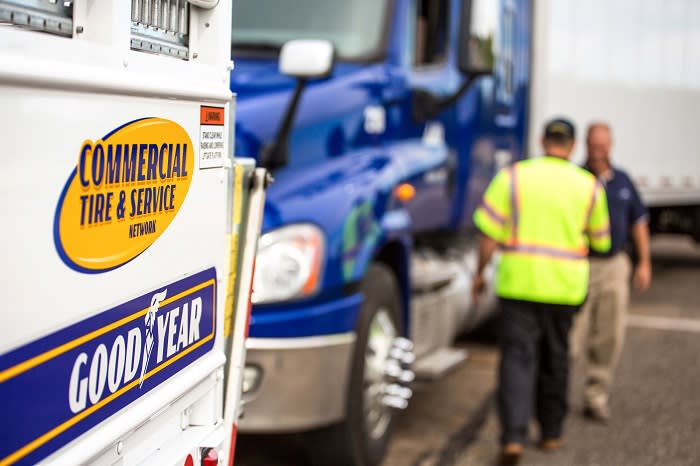
National tire management programs initially began as roadside assistance services, but now include complete tire life cycle management and data analysis options as well. Photo: Goodyear
5 min to read
National tire management programs initially began as roadside assistance services, but now include complete tire life cycle management and data analysis options as well.Photo: Goodyear
Tires are tough to manage, even in ideal conditions. Start adding hundreds of tractors and trailers, spread them across the vast expanse of North America, and a tough problem can become an impossible one almost immediately. National tire accounts, offered by major tire manufacturers nationwide, evolved decades ago to help long-haul fleets deal with their most pressing problem: failures and roadside service in areas far away from home.
Tire management has steadily become more sophisticated, and tire management programs have evolved as well. Today, fleets can choose a host of management options, from simple roadside service packages to comprehensive, on-site cradle-to-crave management programs.
Rich Cottrell, general manager, fleet solutions, Goodyear, says fleet feedback through the years has led to a continuous improvement effort for its national tire program, with an emphasis on understanding emerging needs while optimizing tire performance and lowering operating costs. But he says, that experience has also taught Goodyear that not every fleet is a good candidate for large, national programs. “We’ve learned that offering alternatives is important as well,” he says. “This is why we also offer our Preferred Fleet program, which is geared toward small and mid-size fleets. Fleets have different needs and we strive to meet them ‘where they are.’”
Fleet managers already have plenty do, says Tom Fanning, Continental Tire’s vice president of sales and marketing for commercial vehicle tires in North America. And a national tire program gives them a break from worrying about tires, which can be a demanding job for a full-time employee. Among the benefits he points to are a single point of contact at a tire OE for all a fleet’s tire needs, as well as expert help in selecting replacement tires and retreads.
“A good tire program eliminates the day-to-day tire decisions and guesswork, since approved tires and prices have already been established at a corporate level,” Fanning says. “Moreover, fleets benefit from paying a single price nationwide, plus convenient one-source billing with financial statements and reporting available 24/7. For fleets in our National Account tire program, our manufacturer’s representatives help select the best tires for the fleet’s individual needs. They also perform fleet checks with our digital tire inspection tool, ContiTrack2, to help fleet managers get the most out of their tires.”
A national tire program is simply a part of long-term vehicle optimization, says Shane Messner, national account business manager for Michelin Americas Truck Tires. He notes that buying a new vehicle, whether it’s a truck or trailer, is an investment that should be evaluated with the entire life cycle in consideration. That decision includes a determination of tire specifications along with a well-thought-out plan for fitting vehicles with tires and retreads that deliver the lowest cost of ownership over the life cycle.
“A good tire account partner should work with your fleet to build a life cycle analysis tool that takes into consideration trade lifecycle (miles or years), tire runout mileage for both new tires and retreads, fuel savings (new/retread), product acquisition cost (new/retread), and trade tread depth,” Messner says. “Altogether, specifying the correct products over the life cycle of a vehicle will optimize a tire program and deliver cost savings for the fleet.”
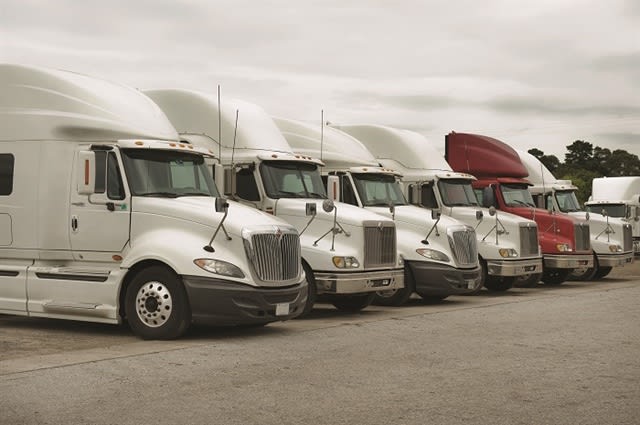
Negotiating up front and putting restrictions in place to ensure adherence to your tire program nationwide are critical for success.Photo: Michelin
What to ask
Given the wide range of fleet applications today, most national tire programs now offer an a la carte menu of services and features, as opposed to blanket plans that offer a whole hosts of items. In either case, he says, there are key questions that any potential tire partner should answer before you make a final decision, including:
Does the manufacturer have enough dealer coverage and consistent product and service offers at all of my locations?
Do they offer multiple brand and price point offers?
Does the program allow the fleet to order, view invoices, and pay online via a secure website portal?
What types of warranty and product performance guarantees are available?
What ability does the program have to respond to, track, and report emergency roadside service events? What is your network’s average ERS roll time?
What type of preventive maintenance offers does your program have to keep my vehicles in service and maximize my tire program investment?
Getting a program that best fits specific applications and needs requires some work, agrees Bruce Stockton, president of Stockton Solutions, who has worked on both the tire maker and the fleet side of the business. He advises fleets interested in a national tire account to focus on evening out costs and support capabilities across their operational geography. But he also cautions fleets that tire companies can only dictate so much to their franchised dealers, and some dealers will not commit to national account pricing for service, such as labor rates. As a result, he says, be prepared to negotiate to get a better deal.
“Another common misconception, especially among medium to small fleets, is that they think having a national tire account gives them the same pricing on product and service as the large fleets,” he says. “That is not the case. Bear in mind that even some large fleets haven’t negotiated what they could have regarding pricing for both product and services.”
To be prepared when meeting with potential tire partners, Stockton says, understand your fleet’s current costs and usage levels and be prepared to ask some questions:
Will the tire company provide some sort of credit for specifying their tires on new trucks and trailers?
Are tires adjustable (warranted) across the network? How will that work for my fleet?
Are my prices for tires and services the same across the network, or will there be surprises from the dealers when I get my bill?
If I deal directly with the dealer and not on a national account, will I be able to negotiate lower prices for services and still get my tire prices on a national account summary?
Once you have satisfactory answers to those questions and enter into an agreement, following up is key, Stockton adds. “Ultimately, the success of your program will be dependent upon regularly checking and verifying the data being collected, holding tire dealers and your own shops accountable, and setting controls in place that don’t allow drivers, or other outside influences, to waiver from the program.”
Return investment varies from fleet to fleet, as well, Cottrell adds, with some fleets only seeing incremental program improvements, while others see dramatic gains with simple coverage tweaks. But if implemented correctly, tire programs can help with cost control, maintenance and driver retention — key competitive elements in fleet management today.
Subscribe to Our Newsletter
More Equipment

How Volvo Updated Its D13 for EPA 2027 [Watch]
Volvo’s updated D13 promises lower emissions without sacrificing performance or fuel economy. Take a closer look at what changed inside the engine in this HDT Spotlight video.
Read More →
Michelin Tire Improves Efficiency and Durability for Regional Fleets
The Michelin X Multi Energy D2 is a regional haul drive tire engineered to help fleets improve fuel efficiency, durability and traction in demanding stop-and-go operations.
Read More →
ZF Expands Commercial Vehicle Push in North America
ZF is expanding its North American commercial-vehicle presence with new transmission applications, electrification, trailer technology and autonomous-driving systems.
Read More →
Tesla Wants a Self-Driving Semi. Are Cameras Enough?
Could Tesla’s camera-only autonomous driving technology work on an 80,000-pound Semi? In this commentary, HDT's Deborah Lockridge takes a look at Tesla, Cybercab, and how autonomous trucks see the road.
Read More →
Kodiak: Driverless Long-Haul Truck Launch on Track for 2026
Kodiak AI says its driverless long-haul safety case is 93% complete and it remains on track to begin commercial operations by year-end 2026.
Read More →
What DOT’s Automated Vehicle Strategy Means for Trucking
The U.S. Department of Transportation issued a new automated-vehicle strategy that outlines plans for driverless-truck regulations, cross-state freight corridors, and federal safety standards.
Read More →
East Coast Port Launches $45M Electric Truck Push
The Port Authority of New York and New Jersey announced millions in incentives for zero-emission drayage trucks, yard tractors, and new charging hubs near the port.
Read More →
PlusAI Going Public to Fund Autonomous Truck Launch
A SPAC deal could provide PlusAI with up to $300 million as it works toward a 2027 commercial launch of factory-built autonomous trucks.
Read More →
NHTSA Moves to Rewrite Truck Fuel-Economy Rules
The National Highway Traffic Safety Administration says it lacks authority to regulate medium- and heavy-duty truck engines separately from complete vehicles, but the existing standards have not yet been eliminated.
Read More →
Detroit Opens Orders for EPA 2027 Engines
Detroit isn’t starting from scratch to meet EPA 2027 diesel emissions standards. Its Gen 6 DD13 and DD15 engines keep much of today’s platform while updating the fuel and aftertreatment systems.
Read More →