





Heavy Duty Trucking Logo
MenuMENU
SearchSEARCH

Taking Tires for a Test Drive

If you want to test drive some new tires before you buy — and who wouldn’t — be prepared to invest significant time and energy in the project.

Jim Park
Jim ParkFormer HDT Equipment Editor
Read Jim's Posts
July 24, 2017
Taking Tires for a Test Drive

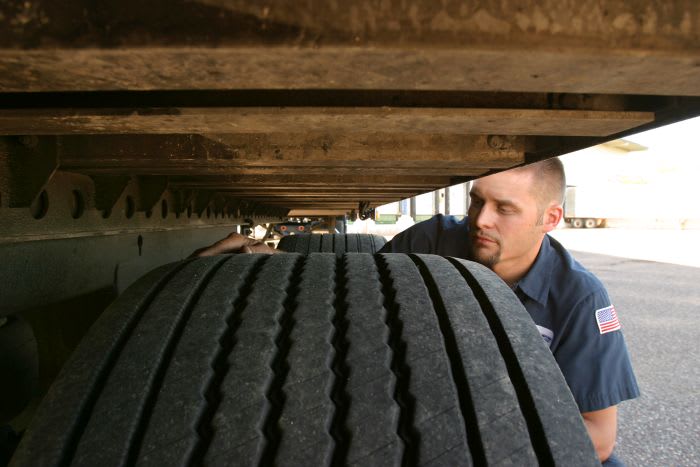
Tread depth measurements and tire condition checks should take place at regular intervals, and all relevant data noted on the evaluation. Photo: Michelin

4 min to read


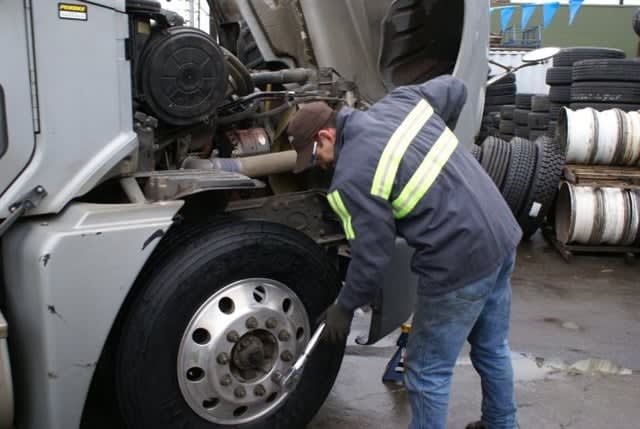
Tires operate in all kinds of conditions. Be sure your testing reflects the environment in which the tires will serve. Photo: Jim Park

If you want to test drive some new tires before you buy — and who wouldn’t — be prepared to invest significant time and energy in the project.

You need patience to produce a successful tire evaluation. Diligent record keeping and careful observation will help, but it can take two years or more to get an accurate picture of how tires will perform in a specific application. 

Ad Loading...

It takes time and miles for tread rubber to scrub away and for any irregular wear problems to appear. All the while, the test tires will be at the mercy of the mechanical condition of the truck, road hazards, ambivalent or unknowing technicians, and the habits of the drivers piloting the test trucks. That’s a lot of variables from which to draw hard conclusions about tire performance.

Peggy Fisher, president of Tire Stamp Inc. and expert-at-large on the ATA’s Technology & Maintenance Council’s S.2 Tire and Wheel Task Force, orchestrated many such tire evaluations during her days as a fleet tire manager with Roadway Express back in the ’80s. She managed nearly 200,000 tires on 30,000 pieces of equipment — and tested many thousands of tires.

“Because tire testing for tread wear and durability can take years, the biggest issue in running these tests is keeping maintenance personnel aware that the test is still ongoing,” she says. “This becomes harder to do the larger the fleet and the more people touching the test tires.”

Fisher points to TMC recommended practice 230B as the ideal template for tire durability and tread wear evaluation. One of the TMC’s longer RP documents at 20 pages, it’s very comprehensive and includes tools for recording data and making evaluations.

Among the recommendations is to use the same make, model and year of truck to ensure consistency at the mechanical level, and of course, to align the truck and inspect the running gear to ensure the truck itself won’t compromise the test.

Ad Loading...

“That is why we specify in RP 230B that fleets use the same model trucks if possible for tire tests,” Fisher says. “Factors such as camber, caster and Ackermann [steering geometry] can be different, and that will affect tire wear.”

Randy McGregor, fleet manager at Transway Inc., a 100-truck general commodities carrier based in Holland, Michigan, and serving the Midwest, always has four types of tires in tests on eight power units. He tries to keep the trucks on similar routes with similar loads, and his tests generally run eight months to a year, or 80,000-90,000 miles.

“We begin the process by selecting a few tires to test,” he says. “We look to our tire suppliers for likely candidates for our needs. And we also try to find out if the tires in question will be available for at least a few more years. There’s no point in testing a tire that’s about to undergo a design change or be discontinued.”

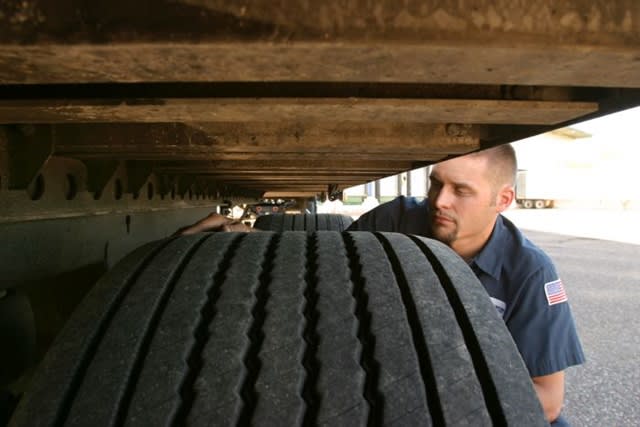
Tread depth measurements and tire condition checks should take place at regular intervals, and all relevant data noted on the evaluation. Photo: Michelin

McGregor says if he’s testing steer tires he’ll align the truck first, but for drive tires he just checks axle parallelism and the condition of the shocks and suspension bushings to minimize wear from mechanical issues. He monitors tread depth and tire condition every 10,000 miles or so, and will switch the tires to different trucks with different drivers at about 50,000 miles.  

“We have a pretty good idea how tires will perform by 50,000 miles, but wear rates can change as the tread thins out,” he notes. “Past test results have shown that conclusions we can draw at 50,000 miles usually hold for the remainder of the tread life, but we don’t stop there. A lot can still happen after that.”

Ad Loading...

He also draws on his drivers’ opinions about the tires in terms of ride and handling, traction, etc. “They are the ones who have to live with them.”

There will be tires that start to show wear more quickly than others, so McGregor tries to find out why. Sometimes it’s the truck and sometimes it’s the tire, he says. “We investigate the problem before assuming it’s the tires by comparing the wear on the test tires to the previous tires that came off the truck,” he explains. “If the previous tire and the test tire show the same wear, the truck is likely the source of wear.  On the other hand, if two tires show the same wear rates and patterns at the same mileage, we usually assume it’s the tires and contact the dealer.”

The important thing is that McGregor says his tire test program does yield meaningful results and has proven reliable over the fullness of time. He’s not testing a thousand tires at a time, just a few dozen. He figures the results even on his small sample size are accurate enough to help him plan future tire purchases.

Alert your technicians to ongoing tests by labeling the tires and the trucks involved in the test so they know there will be some special handling requirements. Photo: Michelin

Testing Tires for Fuel Economy

Testing tires for fuel efficiency, or rolling resistance, in fact, is just as challenging as testing for tread wear and durability, but in different ways. Since two tires for a similar purpose, such as a ribbed drive tire versus a lug drive tire, will not produce dramatically different results, the errors in data collection or test procedures can skew or ruin the test, cautions Chuck Blake, senior technical sales support manager at Detroit Diesel. “A plus-or-minus 2% error in data collection or analysis will skew your results in such a way that a 3%-product could look like a 5%-product or a 1%-product,” he says.

In-service evaluations of tire rolling resistance (fuel efficiency) are difficult to extract precise data from because of the large number of variables, such as weather, driver performance, loads, and operating conditions, unless you plan long-term tests where the variables start to disappear statistically with time. But then you have the same problem as tire performance evaluations: threats to the data from damaged tires, disinterest or forgetfulness, and unforeseen changes to the test protocols.

Shorter-term tests, such as track testing or on-road single-run tests, can give accurate results fairly quickly, but such tests require a high level of sophistication, a highly structured test environment, and very accurate measurements. They also can be discouragingly expensive.

The ATA’s Technology & Maintenance Council offers three Recommended Practices for in-service fuel economy testing, RP 1102, RP 1103 and RP 1109, that can be successfully implemented if the required level of precision is used in the collection of data. Done properly, they can reduce testing costs while providing a high level of reliability and repeatability.

The caveat here is “done properly.” It would be easy for an inexperienced tester or a fleet that cuts a few corners to ruin the data without even realizing it.

A fatal mistake in fuel economy testing is to rely totally on data collected from the truck itself without the appropriate checks and balances. Blake says electronic fuel consumption data from some ECMs can be off by as much as 5%, while speed and odometer measurements can be notoriously imprecise.

“Taking measurements from those sources alone will not get you reliable results,” he stresses. “Sure, it’s quick and easy to do a before-and-after comparison, but the results would be meaningless.”


3 Tips for a Successful Tire Test

Peggy Fisher, president of Tire Stamp Inc. and expert-at-large on the ATA’s Technology & Maintenance Council’s S.2 Tire and Wheel Task Force, recommends the following:

1. Clearly mark the tires and the wheels they are mounted on as test subjects by stenciling “test” on the wheels in red, branding the tires “test,” or using colored sleeves over the valve stems. Fleets also can put a decal on or near the driver’s door of the power unit or the nose of the trailer indicating the vehicle is involved in a test. If testing for durability through several retreads, the tires should be marked with a unique number by branding, applying bar codes or installing RFIDs.

2. Communicate test instructions to all maintenance personnel and drivers who will be touching the test vehicles and tires. These instructions should include mileage interval at which tread depths should be taken, such as at PM intervals. Information to be recorded at each service event should include tread depth, vehicle mileage, wheel position, unique tire number, tire condition, notes on wear, etc.

3. Send periodic updates and reminders to everyone involved that the test is still running, along with test instructions, and the importance of handling and servicing the tires involved correctly. Some software systems can remind technicians when they enter tire service work into the system that the vehicle and its tires are involved in a test and that test instructions should be followed.

Subscribe to Our Newsletter

More Equipment

New truck sales surge.
Equipmentby News/Media ReleaseMarch 4, 2026

FTR Reports Class 8 Truck Orders Surged in February

FTR said preliminary Class 8 truck orders jumped 47% month over month and 159% year over year as improving freight conditions and clearer regulatory outlook boost fleet confidence.

Read More →
2026 Kenworth C580 truck.
Equipmentby News/Media ReleaseMarch 4, 2026

Kenworth Unveils C580 Extreme-Duty Truck at ConExpo

The new extreme-duty vocational truck replaces the long-running C500 and is designed for the most demanding off-highway applications, with production scheduled to begin in 2027.

Read More →
New 2026 Mack Keystone tractor.
Equipmentby News/Media ReleaseMarch 3, 2026

Mack Debuts All-New Keystone Vocational Tractor, Unveils Reimagined Granite at ConExpo 2026

Mack has debuted an all-new Class 8 tractor and an updated Granite model ahead of ConExpo-Con/Agg 2026.

Read More →
Ad Loading...
Photo of truck driver in yellow safety vest walking alongside tractor-trailer
Driversby Deborah LockridgeFebruary 25, 2026

How One Company is Using Smart Suspension Technology to Reduce Driver Injuries and Improve Retention

America’s Service Line adopted Link’s SmartValve and ROI Cabmate systems to address whole-body vibration, repetitive strain, and driver turnover. The trucking fleet is already seeing measurable results.

Read More →
FTR 2026 trailer sales.
Equipmentby News/Media ReleaseFebruary 20, 2026

Trailer Orders Hold Steady in January as Backlogs Rebuild

FTR says net trailer orders are flat month over month at 24,206 units, with 2026 orders still trailing last year.

Read More →
Daimler Gen 6 diesel engines.
Equipmentby Jack RobertsFebruary 19, 2026

Detroit Bets on Evolution, Not Reinvention, for EPA 2027 

Detroit's DD13, DD15, and DD16 engines get a pre-SCR boost, 3% fuel-efficiency gains, and familiar service intervals as Daimler prepares for trucking's next emissions era. 

Read More →
Ad Loading...
Photo of Volvo VNR pulling a trailer into building
Equipmentby News/Media ReleaseFebruary 17, 2026

Volvo Starts Factory Production of All-New VNR Regional Truck

Production begins less than a year after Volvo unveiled its new regional-haul VNR.

Read More →
Aurora Drive autonomous truck.
Equipmentby News/Media ReleaseFebruary 13, 2026

Aurora Adds 1,000-Mile Driverless Run from Fort Worth to Phoenix

Aurora announced it has validated a 1,000-mile driverless lane beyond Hours of Service limits and plans to have more than 200 self-driving trucks on the road by the end of the year.

Read More →
Mercedes-Benz 130 years of trucking.
Equipmentby Jack RobertsFebruary 12, 2026

Mercedes-Benz Celebrates 130 Years of Trucking Heritage

Mercedes‑Benz Trucks Classic showcased “130 Years of Trucks” at the Retro Classics Stuttgart Museum from February 19 to 22, 2026. Check out these photos.

Read More →
Ad Loading...
Phillips Connect TrailerID.
Equipmentby News/Media ReleaseFebruary 11, 2026

Phillips Connect TrailerID Automates Trailer Pairing to Cut Errors and Boost Fleet Visibility

New hardware-and-software solution from Phillips Connect confirms tractor-trailer connections automatically, eliminating manual driver input and improving compliance, dispatch accuracy, security, and billing.

Read More →







