




How Does CVSA's Roadcheck Affect the Spot Market?
The experts at FTR crunch the spot freight numbers to analyze the effect this year's inspection blitz focusing on hours of service affected trucking capacity.
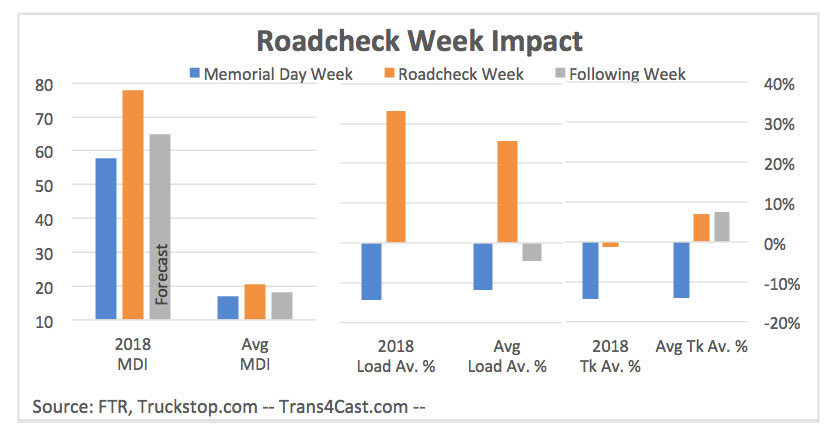
The last time we saw Roadcheck week spot market numbers like this was 2014, when again there was a regulatory impact at play.
Graph courtesy FTR
The spot market was the tightest ever – by far – during week 23 of 2018. The ratio of loads available to trucks available in the Truckstop.com system, called the Market Demand Index (MDI), was 77.7 to 1. The previous high was 61.9 in week 14. To put these numbers in perspective, the five-year average is 23.81 for week 23 and 17.51 for week 14. So the imbalance in the spot market is more than three times the usual imbalance.
Although market conditions are driving the degree of imbalance, there’s something else behind the timing of the peak. Barring extreme situations – usually severe weather events affecting a large swath of the country, such as last year’s hurricanes – the MDI peaks each year either in week 23 or week 22.
The answer is actually quite simple: The Commercial Vehicle Safety Alliance’s International Roadcheck, the annual three-day push during which North American commercial vehicle inspectors conduct intensive 37-step Level 1 inspections on drivers and vehicles. International Roadcheck always is announced in advance, and it always occurs during early June. This year’s International Roadcheck occurred June 5-7 – during week 23.
What does International Roadcheck have to do with the spot market? Many drivers would rather not drive during International Roadcheck, so they take a vacation, disrupting capacity temporarily. The impact of this year’s event might have been larger than usual. Because of the focus on hours-of-service compliance, including the now-mandatory electronic logging devices, non-compliant drivers and carriers likely were especially hesitant to operate June 5-7.
How does all of this play out in spot-market terms? Typically, we can look at load availability to understand how freight demand is performing and truck availability to understand how capacity is performing. However, International Roadcheck is one of the handful of times this dynamic does not hold true. Because so many for-hire and private fleet drivers take time off that week, shippers must turn to the spot market in unusually large numbers to find trucks to move their freight. So we get a double whammy of fewer trucks available and more shippers posting loads at the very same time. Adding to the week-to-week impact is the fact that the International Roadcheck week represents the beginning of the summer peak season while also coming off a holiday-shortened week.
This year, we saw what we expected in terms of an increase in posted loads, which were up 33% from the prior week. Over the past four years, that increase has averaged 32% during International Roadcheck week. The average increase over the past 10 years was 26%. Of course, the spot market generally this year is much hotter than usual, so on an absolute basis we had the biggest weekly gain in volumes for a Roadcheck week – an increase of 662,000 posted loads.
However, the real impact this year came from the truck capacity side. The calendar artificially inflates the weekly capacity change because Memorial Day typically reduces capacity by about 14%, which is exactly what we saw in week 22 of this year. The week after Memorial Day we typically see a small but notable uptick on truck capacity. It’s the beginning of summer, so the overall level of capacity does generally stay lower until after the Fourth of July holiday.
This year, not only was there no truck capacity increase, but capacity actually declined further – something FTR hasn’t seen in its 10 years of tracking the spot market. The only time we can compare this to is 2014, when truck availability was unchanged during Roadcheck week compared to the prior week. As in 2014, we have a strong market, combined with a regulatory change that hurts driver productivity – at that time, it was the hours of service changes with the controversial more restrictive 34-hour restart. Over the last 10 years we have averaged an increase in truck availability of 7%. This year we saw a decline of 1%.
Related: Get Your Brakes Ready for Roadcheck
More Safety & Compliance

From One Generation to the Next: How Mentorship Builds Safer Truck Drivers
After three decades in trucking, Harold Perry shares what he's learned about driver safety, mentorship, and helping the next generation build confidence behind the wheel.
Read More →
FMCSA Pauses Biennial-Update Enforcement Amid Motus Transition
Carriers whose updates were due on or after June 1 have more time, while FMCSA works to stabilize its new registration system and warns of phishing sites impersonating its new carrier registration system, Motus.
Read More →
ZF Expands Commercial Vehicle Push in North America
ZF is expanding its North American commercial-vehicle presence with new transmission applications, electrification, trailer technology and autonomous-driving systems.
Read More →
Truck Drivers Need More Than Another Alert
Fleets have more visibility into truck health, safety events, and driver activity than ever. The next challenge is turning all that information into useful guidance for the person who has to decide what to do next.
Read More →
Tesla Wants a Self-Driving Semi. Are Cameras Enough?
Could Tesla’s camera-only autonomous driving technology work on an 80,000-pound Semi? In this commentary, HDT's Deborah Lockridge takes a look at Tesla, Cybercab, and how autonomous trucks see the road.
Read More →
What DOT’s Automated Vehicle Strategy Means for Trucking
The U.S. Department of Transportation issued a new automated-vehicle strategy that outlines plans for driverless-truck regulations, cross-state freight corridors, and federal safety standards.
Read More →
NYC Expands Speed, Pedestrian Safety Tech Across Fleet
New York City is expanding intelligent speed assistance and pedestrian-alert systems across its municipal fleet, moving the technologies from pilot programs into vehicle procurement and retrofit requirements.
Read More →
FMCSA Removes 110 Truck Driver Training Schools from Certified ELDT List
Federal regulators also are targeting more than 160 additional training providers and launching a nationwide audit of third-party CDL skills testers as part of a broader crackdown on trucking fraud.
Read More →
Beyond DOT Compliance: What Makes a Trucking Fleet Truly Safe?
A trucking fleet can follow every rule and still make unsafe decisions. The real test comes when safety conflicts with freight, productivity, or cost.
Read More →
Hours of Service Pilot Programs: FMCSA Readies for 2027 Rollout
Two pilot programs could eventually reshape hours-of-service rules, giving truck drivers options to pause their 14-hour clock or use longer split sleeper rest periods.
Read More →