




How Did Wild Third-Quarter Swings Affect Fleet Earnings?
How did publicly traded trucking fleets perform financially as the roller-coaster year of 2020 headed back uphill in the third quarter?

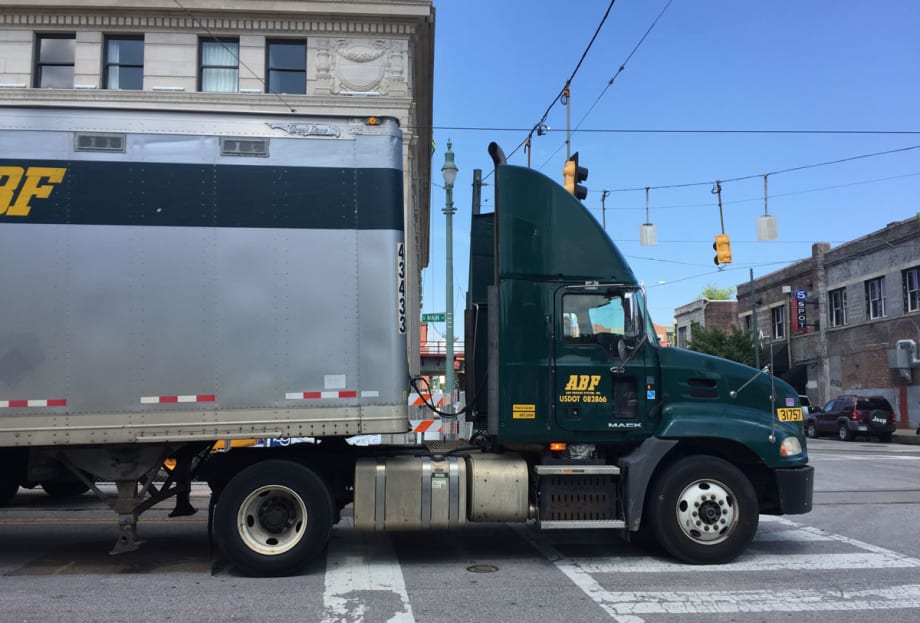
On average, less-than-truckload companies in the third quarter showed impressive margin improvement.
Photo: Deborah Lockridge
The third quarter of 2020 marked a turn in fundamentals for many freight companies. After a second quarter saw real gross domestic product plunge 31.4%, the 33.1% increase in the third quarter resulted in a year-over-year GDP figure closer to 2.6%.
The quarter saw an aggressively rebounding freight volume environment, likely the result of carrier capacity reductions, inventory restocking by retailers, and a surge in necessity shipping of food, beverage and healthcare-related items. Business inventory levels appeared to be coming down at a 6% rate as of the end of the third quarter, but retail inventories were declining at a rate closer to 12%.
Despite some of the most dramatic short-term third-quarter swings in freight demand, financial results for most freight and logistics companies were better than expected. Even with lower revenue, the publicly traded companies we track saw better operating margins, largely the result of lower fuel, labor and purchased transportation costs, and a sharp rebound in volumes caused in part by an inventory build among retailers.

Jeff Kauffman
Photo: Jeff Kauffman
In the pure truckload segment, we saw profits consistently beating expectations for the second consecutive quarter. Average operating profit margins for the companies we’ve tracked in the accompanying table jumped to 10.1%, the highest we have seen since 2018. There was an average 1.3% revenue decline (the average fleet dropped by 9.7%, but drove more miles per truck, and was paid 0.9% more in terms of average revenue per mile). But revenue per mile improved, fleet growth slowed, truck utilization improved meaningfully from last quarter, and empty mile ratios improved by 0.9% to 12.1% — better than we would have expected, given the wild swings in the economy.
In dedicated truckload, although the data is not robust, there are some interesting observations. Median revenue growth was the strongest among trucking segments, at 1.1%, but it continued to slow while other areas improved. Average operating profit margin of 14.1% was only a 0.5% improvement. Fleet growth slowed to 0.2%, so there is still a shift in capacity occurring, but the trend has slowed.
Less-than-truckload showed impressive margin improvement and a meaningful bounce-back in revenues, despite a still-slow industrial marketplace. Average operating margins improved to 13.3%, the result of some dramatic cost-cutting, lower fuel prices, and nearly 13 percentage points improvement in tonnage over the second quarter. Top-line revenues were down an average of 2.4%, an improvement from being down 17.6% in the second quarter. We saw a decline in shipments (3.2%), tonnage (1.7%), and yields (0.9%). However, costs fell more, with labor costs down 2.7% and fuel costs 23.4% lower. A leading indicator, weight per shipment, improved 100 basis points — a positive sign.
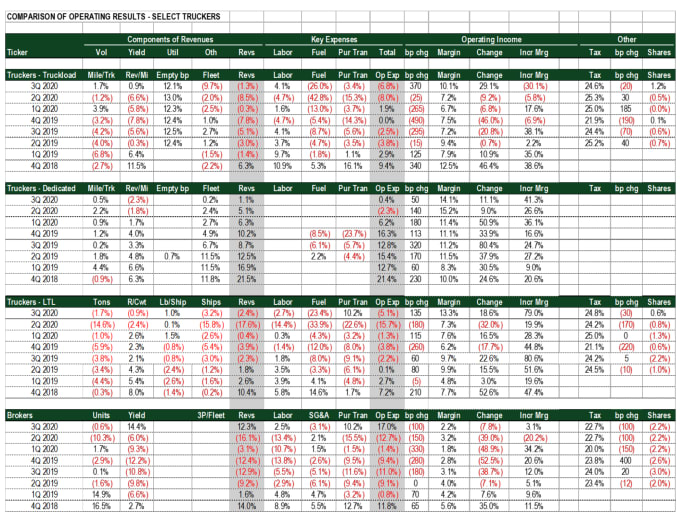
The operating environment for brokers was challenging, given the swings in spot rates and volumes. A 25% increase in trucking spot rates from the previous quarter resulted in a revenue increase of 12.3%, driven by shipment levels only 0.6% lower as shippers scrambled for capacity amongst 25%+ tender rejection rates, implying a 14.4% improvement in yields. To put the difficulty in managing this swing in perspective, revenues were down 16.1% last quarter. Despite the positive news on revenue and yield, spot rates drove the cost of purchased transportation up faster, leading to a 17% increase in operating expenses and a drop in operating margins to 2.2%. However, many brokers expect contractual rates to begin to improve relative to spot market rates in the coming quarters.
Looking ahead, near term, a surge in COVID-19 infections may lead to another round of slowdowns in commerce this winter. What is encouraging heading into the new year is that tighter capacity and rising volumes are driving spot market rates higher. We are hearing via anecdotes that this is leading to stronger contract rates. Another sign of this is the way truck and trailer orders have been racing upward in recent months.
More Fleet Management

Why Private Fleets Are Taking More Freight
Private fleets are putting their own trucks on demanding customers and high-cost lanes as companies seek greater control over service, costs, and capacity.
Read More →
Color Match Smarter: Tools That Restore & Perform
For fleet managers and collision repair professionals keeping heavy-duty trucks on the road, getting the color right the first time isn't just about appearance — it's about efficiency, turnaround time, and bottom-line results. Discover how today's digital color tools are transforming the repair process from guesswork to precision.
Read More →
FMCSA Pauses Biennial-Update Enforcement Amid Motus Transition
Carriers whose updates were due on or after June 1 have more time, while FMCSA works to stabilize its new registration system and warns of phishing sites impersonating its new carrier registration system, Motus.
Read More →


2026 Blueprint for Countering Smarter Supply Chain Theft
Cargo theft is no longer just the cost of doing business. It's a multi-billion-dollar criminal enterprise exploiting vulnerabilities across your fleet, drivers, and supply chain.
Read More →
How Telematics Improves Visibility, Control, and Performance in Refrigerated Fleets
Explore how telematics help refrigerated fleets improve visibility, uptime, efficiency, compliance, and cargo protection across connected cold chain operations.
Read More →
What the U.S.-Canada Trade War Means for Trucking
Escalating U.S.-Canada tariffs could disrupt cross-border freight, reduce truck volumes, raise costs, and create new uncertainty for carriers on both sides of the border.
Read More →
What Are Trucking’s Top Concerns for 2026?
The American Transportation Research Institute wants to know what's worrying trucking fleet managers, drivers, and other stakeholders in its annual Industry Issues survey.
Read More →
American Trucking Associations Looks for a New Leader
ATA President and CEO Chris Spear abruptly left his job at the association on August 21, at a pivotal time for the trucking industry.
Read More →
Public Wi-Fi Cybersecurity Risks: How Truck Drivers and Fleets Can Protect Their Data
Public Wi-Fi can expose truck drivers and fleets to credential theft, malware, and other cyber threats. Here’s how to reduce the risk on the road.
Read More →
For Nicky Cupp, Fleet Innovation Starts With Frustration
HDT Truck Fleet Innovator Nicky Cupp turns everyday pain points at Fraley & Schilling into opportunities for better technology and smarter processes.
Read More →