




How Central Oregon Truck Company Stays on Top of Safety
Best Fleets to Drive For Hall of Famer Central Oregon Truck Company has an extensive new driver orientation program and continues its training through ongoing safety education.

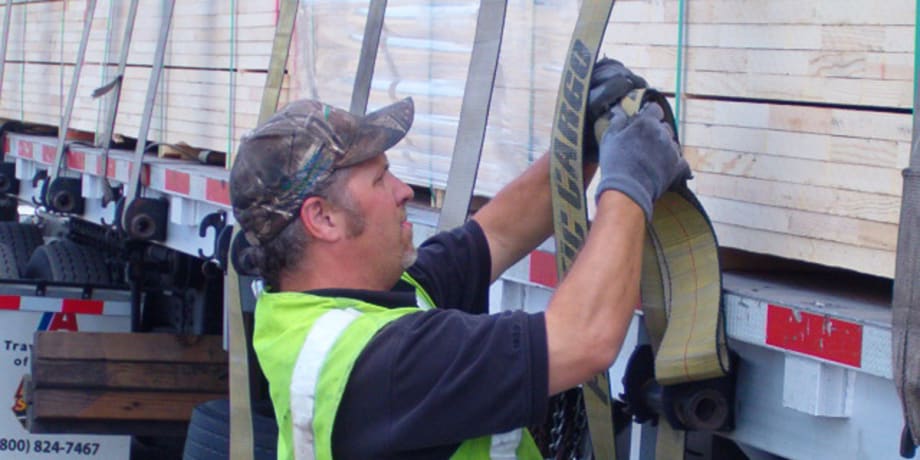
For Central Oregon Truck Company, safety is all-encompassing. It begins with an extensive new driver orientation program and continues through to ongoing safety education and online training through CarriersEdge.
Photo: COTC
For Brad Aimone, director of safety for Central Oregon Truck Company, the numbers are very telling.
“Looking back at 2021, our unsafe driving basic score was 2.5%,” he says. “In 2020, our number was 11.1%. Our phenomenal number today is a credit to our drivers, staff, and the safety tools we now have in place. It showcases where we sit when it comes to safety.”
Part of the Daseke group of flatbed carriers, Redmond, Oregon-based Central Oregon Truck Company operates 400 trucks. It’s always been known as a drivers’ company, co-founded by former truck driver Rick Williams, who now serves as Daseke’s chief operating officer. The company was recently named to the Best Fleets to Drive For Hall of Fame by the Truckload Carriers Association and CarriersEdge, which recognizes fleets that have made the Top 20 for 10 consecutive years, or 7 consecutive years plus a Best Overall award.
For Aimone, safety is all-encompassing. It begins with an extensive new driver orientation program and continues through to ongoing safety education and online training through CarriersEdge. The company also monitors driver performance through SmartDrive inward- and-outward facing cameras, along with notifications from the truck’s ECU.
Since the company is self-insured through Daseke, safety saves in more ways than one. “Everyone is onboard to its importance for our drivers, and to the bottom line,” Aimone says. “We have a 52-page booklet that documents all the safety practices we have in place, and that’s a staple for all the Daseke companies. We strive to develop best practices for all our companies. To ensure compliance, we’ve just starting external audits of our operating companies through a law firm to ensure we are following procedures and Daseke minimum safety standards. Nuclear verdicts are a real thing. We need to make sure we do all we can to protect our drivers, and our companies.”
It Starts With Orientation
Because COTC is a flatbed carrier, driver duties are more hands-on than traditional freight. New hires, who must have at least one year of driving experience, go through four days of orientation.
“What is a bit different about our orientation process is that the leader of orientation will also be the driver’s coach moving forward,” Aimone says. “This establishes a relationship from the beginning. Over the four days, we get the drivers up to speed on our systems and use of the Eleos platform we use in our cabs; go over load securement with hands-on practice; conduct road tests, which includes tire chaining exercises; and have instruction on ‘safety in motion’ – since working in flatbed is physical, we spend time on proper lifting and movement to avoid soft tissue injuries.”
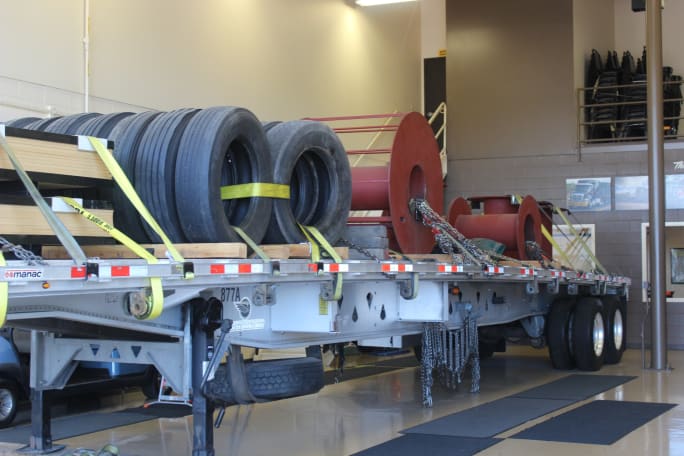
Over a four-day orientation, drivers go over load securement with hands-on practice.
Photo: COTC
When COTC does real-world loading instruction, half the class will be strapping and tying down, while the other half will be on computers completing CarriersEdge modules on hours of service, accident scene reporting, distracted driving, cargo securement, and vehicle inspections.
The CarriersEdge Practical Cargo Securement module was developed as a companion to the book of the same name published by Techni-Com, which Aimone says is considered the gold standard when it comes to securing freight on flatbeds. “We’ve used it for years and have the book at each workstation. It’s great that the CarriersEdge module works directly with the book, so the module reinforces and tests what we study in the book.”
The company’s hands-on training is very thorough. “We have two trailers in our training bay, with students required to use fall protection at all times,” Aimone says. “One mockup is used for tarp training and securing ductile pipe. The other is set with flat steel, and then coiled rebar. We also have multiple steel coil mockups that can be arranged vertically, in-line, and laterally. All students are given the weight of the product to be secured, and are required to demonstrate the ability to correctly secure all the mockups. What’s more, they’re required to demonstrate the construction of bulkheads using dunnage, or grade 70 chains, for flat steel. And they’re required to fully tarp a load within 60 minutes.”
Post orientation, drivers must also complete modules on defensive driving, cargo securement for metal coils, trip planning, parking, and deliveries within 60 days.
After all practical training is completed, “graduation” from orientation is next. “On the fourth day, the drivers meet our executive team for breakfast,” Aimone says. “From top down it shows our sincere interest in welcoming our new drivers and their importance to what we do. It also is an open forum with a Q&A. Nothing is off limits. After that, it’s final steps with HR before the driver is ready to hit the road.”
On the Road
Each month, Aimone assigns drivers a CarriersEdge module to address any trends the company is seeing or to cover seasonal training such as driving in winter conditions. He says this training is very well-received by drivers.
According to Aimone, the way the tests are produced helps drivers retain the information — and they can do the work in their cabs at the time that best fits them. “Drivers must score at least 80% to pass the module, and we can see any areas where a driver might be having trouble,” he says. “When we do, the driver’s coach can work directly with the driver for any extra training."
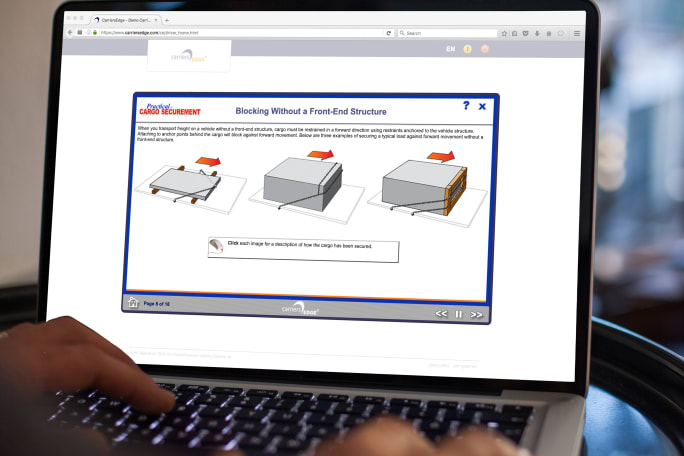
When COTC does real-world loading instruction, half the class will be strapping and tying down, while the other half will be on computers completing CarriersEdge modules on hours of service, accident scene reporting, distracted driving, cargo securement, and vehicle inspections.
Photo: CarriersEdge
Each quarter Aimone puts together a safety podcast for drivers, which is a “wrap-up” on safety related issues. “We talk about our CSA scores and look at any claims or incidents that might have happened during the quarter, and address things we can all work on. Podcasts are a great tool in communicating with our drivers.”
COTC also may assign specific courses to drivers when they notice a trend or to address a specific incident that was flagged by the truck’s ECU.
“We had a case recently where a driver had a close call when a car was passing the truck, and the sudden swerve from our driver set off an alert,” Aimone says. “The cameras we have documented the incident. Again, a teachable moment for us with the driver, and depending upon the circumstance, we’ll assign a refresher course to help instill proper driving techniques.”
Documenting
Keeping drivers abreast of how they’re doing is important,” Aimone says. “We have rolling driver scorecards – giving drivers feedback every four weeks, and then a year-end recap. Safety information is a big part of that. We show the drivers where they stand in claims, the cost of those claims, and give them their camera scores and the number of events.”
There’s a saying, “if it’s not documented, it didn’t happen,” he notes.
“The scorecards play a part in that for driver improvement. But, documentation is also important to protect our company,” Aimone says. “It can come up in a courtroom if you’re being tried for an accident. We can show proof of training delivery.
“We do our absolute best to make sure our drivers are as safe and productive as possible. It’s why we take all the steps we do and work so closely with our drivers. Again, it all comes back to two key words: protect life. It’s something we don’t take lightly.”
Safety is Never Ending
For Aimone, being a safe fleet means never being complacent. “There is new safety technology constantly being developed and we’re always open to new ideas. You can’t stand pat,” he says. “To survive and flourish in this industry, you have to be proactive and always have your drivers’ backs. We do that in many ways, with safety being the most important.”
A shorter version of this article appears in the April 2022 issue of Heavy Duty Trucking.
More Fleet Management

Color Match Smarter: Tools That Restore & Perform
For fleet managers and collision repair professionals keeping heavy-duty trucks on the road, getting the color right the first time isn't just about appearance — it's about efficiency, turnaround time, and bottom-line results. Discover how today's digital color tools are transforming the repair process from guesswork to precision.
Read More →
FMCSA Pauses Biennial-Update Enforcement Amid Motus Transition
Carriers whose updates were due on or after June 1 have more time, while FMCSA works to stabilize its new registration system and warns of phishing sites impersonating its new carrier registration system, Motus.
Read More →
2026 Blueprint for Countering Smarter Supply Chain Theft
Cargo theft is no longer just the cost of doing business. It's a multi-billion-dollar criminal enterprise exploiting vulnerabilities across your fleet, drivers, and supply chain.
Read More →


How Telematics Improves Visibility, Control, and Performance in Refrigerated Fleets
Explore how telematics help refrigerated fleets improve visibility, uptime, efficiency, compliance, and cargo protection across connected cold chain operations.
Read More →
What the U.S.-Canada Trade War Means for Trucking
Escalating U.S.-Canada tariffs could disrupt cross-border freight, reduce truck volumes, raise costs, and create new uncertainty for carriers on both sides of the border.
Read More →
What Are Trucking’s Top Concerns for 2026?
The American Transportation Research Institute wants to know what's worrying trucking fleet managers, drivers, and other stakeholders in its annual Industry Issues survey.
Read More →
American Trucking Associations Looks for a New Leader
ATA President and CEO Chris Spear abruptly left his job at the association on August 21, at a pivotal time for the trucking industry.
Read More →
Public Wi-Fi Cybersecurity Risks: How Truck Drivers and Fleets Can Protect Their Data
Public Wi-Fi can expose truck drivers and fleets to credential theft, malware, and other cyber threats. Here’s how to reduce the risk on the road.
Read More →
For Nicky Cupp, Fleet Innovation Starts With Frustration
HDT Truck Fleet Innovator Nicky Cupp turns everyday pain points at Fraley & Schilling into opportunities for better technology and smarter processes.
Read More →
Adam Buttgenbach’s Approach to Electric Trucks: Start With Where They Fit
HDT Truck Fleet Innovator Adam Buttgenbach helped PepsiCo build one of North America’s largest EV fleets by focusing on where electric trucks make operational sense.
Read More →