





Related: Tanker Association Recognizes Carrier Safety Performance
How Carbon Express Did a 180 on Safety
When Steve Rush was an owner-operator, he would have laughed at the notion that one day he would be running a tanker fleet that would be recognized as the safest carrier by the National Tank Truck Council in the 15 million miles and under category.
October 20, 2016

Controller Sean McAllister and Director of Safety John Bowlby hold the National Tank Truck Council Outstanding Safety Performance Trophy at the entrance to Carbon Express headquarters.
4 min to read

Controller Sean McAllister and Director of Safety John Bowlby hold the National Tank Truck Council Outstanding Safety Performance Trophy at the entrance to Carbon Express headquarters.
When Steve Rush was an owner-operator, he would have laughed at the notion that one day he would be running a tanker fleet that would be recognized as the safest carrier by the National Tank Truck Council in the 15 million miles and under category. A fleet with a safety director who was recognized by both New Jersey and NTTC as safety director of the year. A company whose drivers had been honored three years running as state Truck Driver of the Year.
Rush, president of Wharton, N.J.-based Carbon Express, was a driver for the better part of 19 years. On one of his first jobs, he worked some 20 hours a day hauling U.S. mail, and “had more accidents than you could shake a stick at.” He still had his share of accidents as an owner-operator. And even when he started building his own fleet in 1983, he says, he didn’t really pay attention to hours of service.
Then about 10 years ago, his then-safety director turned down an invitation to be chairman of safety for NTTC — and turned it down because “it would be a lie,” Rush recalls. That was a wakeup call for Rush, and he and Sean McAllister, today the company controller, set out to build a safety culture that would be worthy of the declined honor.
It wasn’t easy. A company that previously had rubber-stamped driver logs now had to get drivers to adhere to hours of service and fill out logs accurately. Two years later, they transitioned to electronic logs.
One of the drivers chosen to be the first to use e-logs “was a great driver who really struggled,” Rush says. Rush expected this driver to be one of the toughest sells for e-logs, but he was wrong. “He was always getting into trouble for his logbooks. Once we put in electronic logs, that went away. His wife told me that we had made her husband the happiest man on earth.”
In addition to the insight and compliance gained with electronic logs, Carbon Express started spec’ing only day cabs to save weight and putting drivers in hotel rooms at night (or changing routes to get them home). As a result, Rush says, the company has learned a great deal about driver fatigue and sleep patterns.
“The things we learn now are just incredible,” he says. “We now have such an understanding of sleep patterns that if we can’t push the load to fit our sleep patterns, then we turn that load down,” Rush says.
Respecting those sleep patterns, using electronic logs, and focusing on low driver turnover helped the company achieve no reportable accidents in its 55-truck fleet in 2015. And today, Steve Rush is an ardent supporter of electronic logs.
“Without question the electronic logs have made us safer,” he says.
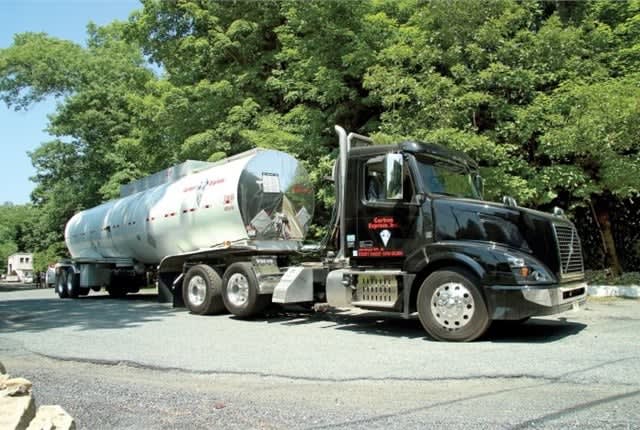
Carbon Express buys Volvo day cabs because of Volvo’s emphasis on safety. Without sleepers, the trucks are lighter and drivers get better sleep in hotel rooms or at home.
A common argument among drivers and owner-operators who oppose electronic logs is that “we want to stop when we’re tired.” But Rush says since they started strictly adhering to HOS rules, his drivers have been able to follow their natural sleep patterns and get enough rest. “My guys find they don’t have that fatigue factor anymore.” Instead of needing to stop driving because they’re tired or sleepy, he says, “they may take that break, get a cup of coffee, walk around and then finish their trip.”
One place Rush thinks the new electronic logging device rules missed the mark is in not requiring them for local drivers who don’t stay out overnight.
“The biggest cheaters are those who run less than 100 miles,” he contends. And as a former cheater himself, he says he should know. In that U.S. mail job, he was home every night. But he would make a four-hour run, take a two-hour break, then do it all over again, all day long.
Not far from Carbon Express on I-287 in Mahwah, N.J., just south of the New York state line, there’s a big problem with trucks lining up and idling on the shoulder at night. While part of the problem is drivers who say they run out of hours and have nowhere to park, Rush believes at least some of them are just waiting there a few hours so they can head into the city early in the morning for deliveries.
He recently was talking to a customer with a small private fleet who was transitioning to e-logs. This customer’s drivers are pushing back because of exactly the scenario Rush painted — instead of following the hours of service rules and shutting down for the mandated 10 hours, the drivers want to be able to simply stop and nap for a few hours and get into Manhattan early to make their delivery. “I told him those days are gone,” Rush says.
Subscribe to Our Newsletter
More Safety & Compliance

FMCSA Pauses Biennial-Update Enforcement Amid Motus Transition
Carriers whose updates were due on or after June 1 have more time, while FMCSA works to stabilize its new registration system and warns of phishing sites impersonating its new carrier registration system, Motus.
Read More →
ZF Expands Commercial Vehicle Push in North America
ZF is expanding its North American commercial-vehicle presence with new transmission applications, electrification, trailer technology and autonomous-driving systems.
Read More →
Truck Drivers Need More Than Another Alert
Fleets have more visibility into truck health, safety events, and driver activity than ever. The next challenge is turning all that information into useful guidance for the person who has to decide what to do next.
Read More →
Tesla Wants a Self-Driving Semi. Are Cameras Enough?
Could Tesla’s camera-only autonomous driving technology work on an 80,000-pound Semi? In this commentary, HDT's Deborah Lockridge takes a look at Tesla, Cybercab, and how autonomous trucks see the road.
Read More →
What DOT’s Automated Vehicle Strategy Means for Trucking
The U.S. Department of Transportation issued a new automated-vehicle strategy that outlines plans for driverless-truck regulations, cross-state freight corridors, and federal safety standards.
Read More →
NYC Expands Speed, Pedestrian Safety Tech Across Fleet
New York City is expanding intelligent speed assistance and pedestrian-alert systems across its municipal fleet, moving the technologies from pilot programs into vehicle procurement and retrofit requirements.
Read More →
FMCSA Removes 110 Truck Driver Training Schools from Certified ELDT List
Federal regulators also are targeting more than 160 additional training providers and launching a nationwide audit of third-party CDL skills testers as part of a broader crackdown on trucking fraud.
Read More →
Beyond DOT Compliance: What Makes a Trucking Fleet Truly Safe?
A trucking fleet can follow every rule and still make unsafe decisions. The real test comes when safety conflicts with freight, productivity, or cost.
Read More →
Hours of Service Pilot Programs: FMCSA Readies for 2027 Rollout
Two pilot programs could eventually reshape hours-of-service rules, giving truck drivers options to pause their 14-hour clock or use longer split sleeper rest periods.
Read More →
New Guide Offers Pet Safety Tips for Truck Drivers
Hundreds of thousands of pets travel in truck cabs. A new safety guide from Volvo Trucks and the Center for Pet Safety offers practical advice for truck drivers who bring dogs and cats along for the ride.
Read More →