




How Allison is Advancing Propulsion, Transmission Developments
HDT's David Cullen provides an inside look at Allison's new engineering and testing facilities and how they're helping truck makers and suppliers more efficiently develop new propulsion systems, including electric vehicles.

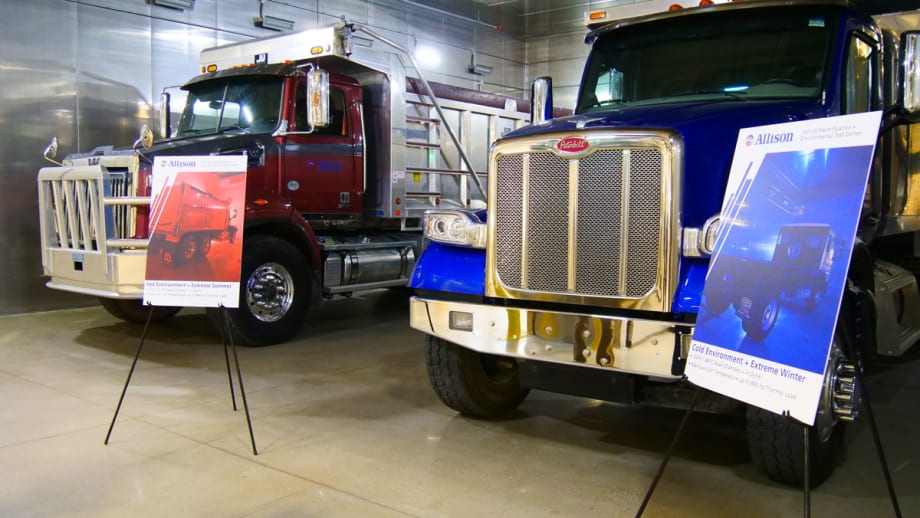
Running hot or cold: Environmental test chamber within Allison’s VE+ET Center can dial up a dizzying range of weather conditions.
Photo: Allison Transmission
Propulsion. It’s the watchword at Allison Transmission, in more ways than one. Long known for its commercial-grade, fully automatic transmissions for medium- and heavy-duty vehicles, the 107-year-old company is expanding its engineering and manufacturing scope to offer a range of conventional, electric hybrid, and fully electric “vehicle propulsion solutions,” including its line of e-Gen Power series of electric axles.
Reflecting its commitment to fostering advanced propulsion and transmission developments, the company has invested some $335 million in expanding and upgrading its engineering facilities. Part of that investment went to building the new-from-the ground-up Allison Transmission Innovation Center, which opened its doors earlier this year on Allison’s expansive Indianapolis headquarters and manufacturing campus.
The 96,000-square-foot facility houses enhanced product and technology development and validation capabilities designed to support customers, industry partners, and outside suppliers. Some 300 employees, consolidated from engineering teams based at multiple locations, now staff the Allison Transmission Innovation Center.
Getting New Vehicle Tech to Market Faster
Configured to help speed the development of innovative solutions — and get them to market faster — the center’s interior design boasts collaborative amenities such as conference rooms fitted with special glass that cannot be looked through while the room is occupied. Highlights of a building tour taken by HDT included touring a lobby museum showing key Allison transmissions over the years, interactive displays on company history, a corporate timeline designed by employees, and a close-up look at the in-house 3D-printing lab.
The center is both the launchpad and mission control for innovative ideas. Engineers at the facility can model concepts with physical and virtual simulations. Then those can be modeled via the center’s 3D printing capability. From there, new products can be produced within Allison’s on-site manufacturing footprint and put through its paces on the company’s test and demonstration tracks. What’s more, these manufactured products can be validated at the Allison Vehicle Electrification and Environmental Test Center (VE+ET), also located on the Indy campus.
VE+ET is a technological tour de force in itself. Opened in 2020, it was recently significantly expanded to keep up with these galloping times for commercial vehicle technology.
“The Innovation Center, along with the recently expanded Vehicle Electrification and Environmental Test Center, will be centers of excellence for the development of enhanced conventional and fully electric vehicle technology,” said Dave Graziosi, chairman and CEO of Allison Transmission.
Bringing Environmental Testing Inside
The VE+ET offers a wide range of repeatable, reliable and “seasonally independent” testing for vehicle electrification and other vehicle-related testing. Allison said the 60,000-square-foot facility is the only one of its kind in the Midwest, as it offers “a truly unique set of capabilities.”
It houses a hot soak chamber, a cold soak chamber, and two chassis-dyno-equipped environmental chambers capable of simulating a broad range of duty cycles. Environmental conditions that can be dialed up range from negative 54 degrees to 125 degrees and altitudes up to 18,000 feet. Various grades and other on-road conditions also can be simulated within the facility. For example, a recently added thermal capability simulates solar radiant heat to support HVAC testing.
The two testing chambers can accommodate most commercial on-highway and off-highway as well as wheeled defense vehicle applications, in addition to automotive passenger vehicles. Likewise, testing can be done for a wide range of propulsion systems, including conventional powertrains and alternative fuel, electric hybrid, fully electric, and hydrogen fuel cell vehicles.
Testing Batteries for Larger Electric Vehicles
Seeing demand increase for testing and validating larger battery-electric vehicles, Allison extended the test center’s battery-emulation capability to accommodate above 500 kilowatts with a maximum of 900 volts DC. This allows for around-the-clock testing without the need to stop and recharge, so more testing can be completed in less time. With an eye to further developments, the VE+ET also provides commercial fast-charging capabilities at 150 kilowatts.
“The services available allow OEMs to push their development dollars further while reducing design and discovery time, simplifying the process to help them get to market faster,” explained David Proctor, general manager of the Allison Vehicle Electrification + Environmental Test Center.
He noted that results from the VE+ET are ideal for developing sophisticated, highly correlated simulations and models so that design decisions happen early in the cycle, before prototype hardware investments. Proctor also pointed out that the VE+ET is secured, operated, and managed independently from Allison Transmission Inc. to keep customer IP, data, and property secure and confidential.
An Inside Look at Allison's Vehicle Electrification + Environmental Test Center
Proctor took HDT through the vast VE+ET facility, in and out of the environmental test chambers, and down below to view the underpinnings that simulate the “shake, rattle, and roll” of riding over rough roads, but without the travel costs and fraught interactions with Mother Nature that must be dealt with out in the real world.
“This facility was designed keeping in mind that customers [previously] had to take vehicles to actual locations to get the right test environments,” Proctor told HDT. “Here, we can control the environment all from inside. We can maintain the heat, the cold, the humidity they want to test in. We can even make it snow.”
He said the VE+ET hosts the largest dynos open to the public. “OEMs on the West Coast have comparable ones, but they are not open to outsiders. Here, we drive the process. The way we work is turnkey. You rent the space from us, you get the cell to test in, including testing engines. We collect the data for you, but we don’t retain it. When the customer is done, we hold the data for 21 days and then we wipe it clean from the cloud.”
Proctor said that about 80% of the VE+ET current business involves testing related to battery-electric vehicles, primarily in Class 4-8.
“This is about control of temperature for charging capabilities and maximum performance range as well as for evaluating onboard battery diagnostics and safety features. This facility is about supporting the beginning stages of development of vehicles.”
More Equipment

How Volvo Updated Its D13 for EPA 2027 [Watch]
Volvo’s updated D13 promises lower emissions without sacrificing performance or fuel economy. Take a closer look at what changed inside the engine in this HDT Spotlight video.
Read More →
Michelin Tire Improves Efficiency and Durability for Regional Fleets
The Michelin X Multi Energy D2 is a regional haul drive tire engineered to help fleets improve fuel efficiency, durability and traction in demanding stop-and-go operations.
Read More →
ZF Expands Commercial Vehicle Push in North America
ZF is expanding its North American commercial-vehicle presence with new transmission applications, electrification, trailer technology and autonomous-driving systems.
Read More →
Tesla Wants a Self-Driving Semi. Are Cameras Enough?
Could Tesla’s camera-only autonomous driving technology work on an 80,000-pound Semi? In this commentary, HDT's Deborah Lockridge takes a look at Tesla, Cybercab, and how autonomous trucks see the road.
Read More →
Kodiak: Driverless Long-Haul Truck Launch on Track for 2026
Kodiak AI says its driverless long-haul safety case is 93% complete and it remains on track to begin commercial operations by year-end 2026.
Read More →
What DOT’s Automated Vehicle Strategy Means for Trucking
The U.S. Department of Transportation issued a new automated-vehicle strategy that outlines plans for driverless-truck regulations, cross-state freight corridors, and federal safety standards.
Read More →
East Coast Port Launches $45M Electric Truck Push
The Port Authority of New York and New Jersey announced millions in incentives for zero-emission drayage trucks, yard tractors, and new charging hubs near the port.
Read More →
PlusAI Going Public to Fund Autonomous Truck Launch
A SPAC deal could provide PlusAI with up to $300 million as it works toward a 2027 commercial launch of factory-built autonomous trucks.
Read More →
NHTSA Moves to Rewrite Truck Fuel-Economy Rules
The National Highway Traffic Safety Administration says it lacks authority to regulate medium- and heavy-duty truck engines separately from complete vehicles, but the existing standards have not yet been eliminated.
Read More →
Detroit Opens Orders for EPA 2027 Engines
Detroit isn’t starting from scratch to meet EPA 2027 diesel emissions standards. Its Gen 6 DD13 and DD15 engines keep much of today’s platform while updating the fuel and aftertreatment systems.
Read More →