




Heavy-Haul Trailers Get Lighter
You don’t think about “lightweight” when talking about lowboys, which are often long and multi-axled. Nevertheless, today’s heavy-haul trailers are not as heavy as their predecessors – but it’s a careful balance.

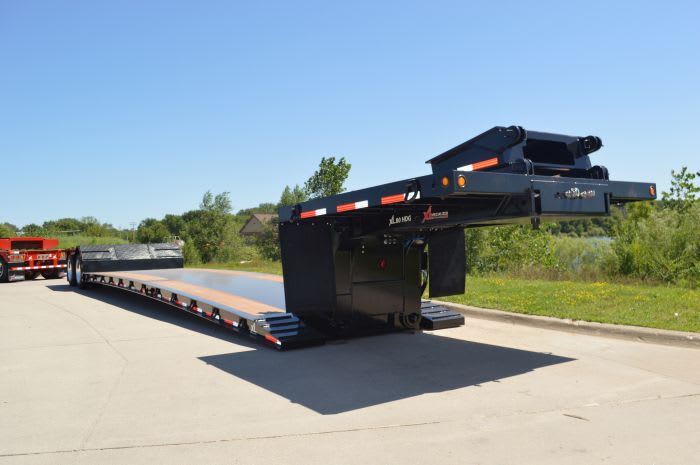
Low deck heights, as on XL Specialized’s XL 80, allow carrying of extra-high loads. The hydraulic mechanism on this trailer’s removable gooseneck is powered by 13-hp Honda engine. In other systems, a tractor’s PTO runs a pump to supply hydraulic pressure. Photo: XL Specialized
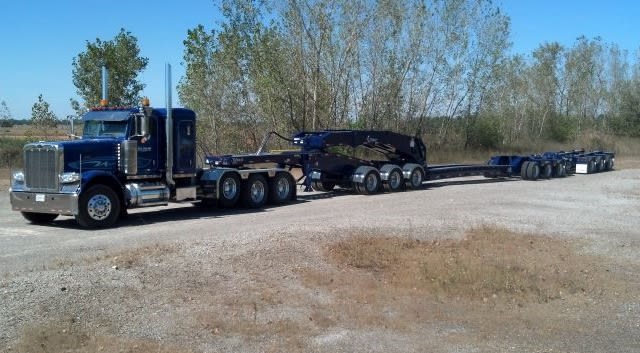
At the request of a customer, Talbert crafted this 75-ton, nine-axle “3+3+3” combination trailer consisting of a three-axle jeep dolly, a three-axle lowboy with a flip gooseneck extension, a nitrogen-assisted “E3Nitro” dampening system, and three removable flip axles.Photo: XL Specialized
It takes heavy to haul heavy. That’s a fact of life in this segment of trucking, where users deal with increasingly massive loads that must be supported and carried economically. You don’t think about “lightweight” when talking about lowboys, which are often long and multi-axled. Operators also use extra-heavy-duty flats and drop decks where low tare weight is also a difficult goal.
Nevertheless, today’s heavy-haul trailers are not as heavy as their predecessors – but it’s a careful balance.
“Loads are getting bigger, wider, heavier, so there comes a point where the word ‘integrity’ comes into play and we don’t want to interfere with that” by trying to cut too much weight, says Troy Geisler, vice president of sales and marketing at Talbert Manufacturing in Rensselaer, Ind. However, modern steels are lighter and stronger than the iron used by Austin Talbert when he founded the firm in 1938 in Chicago.
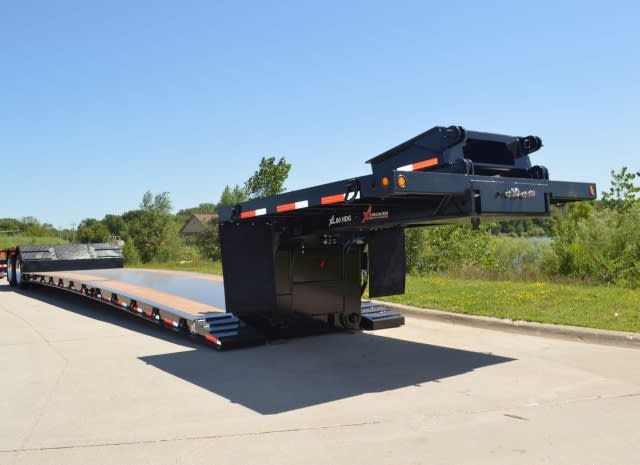
Low deck heights, as on XL Specialized’s XL 80, allow carrying of extra-high loads. The hydraulic mechanism on this trailer’s removable gooseneck is powered by 13-hp Honda engine. In other systems, a tractor’s PTO runs a pump to supply hydraulic pressure. Photo: XL Specialized
“We use mostly T-1 (100,000-pound tensile-strength) steel for our higher-capacity products,” which go to 70 tons and more, Geisler says. “For our SRT 30- to 45-ton double drops, we use 80K steel,” which is more than adequate but less costly.
Is aluminum feasible? “Aluminum’s not as robust. We’re definitely crafting, working on trying to reduce weight. But there comes a point where we have to say, ‘Could we build it? Yes. Could they afford it? No.’”
At Cozad in Stockton, Calif., “We use 100% T-1 steel on our products,” says Curt Weeks, the sales manager. “We’re not the cheapest, but we’re the strongest. T-1 is really strong, and it will hold up to extra loading. I’m not gonna say that our customers overload [go beyond a trailer’s rated capacity], but sometimes it happens.”
XL Specialized of Manchester, Iowa, uses a combination of T-1 and 80K steel in some of its products, but spec’ing is a way to cut poundage, says Rodney Crim, vice president of sales. “We build some of the lightest-weight trailers on the market. You can do it by leaving off non-essential equipment.” Like what? “That’s the ‘secret sauce,’” he answers. “Everybody tries to figure out how to do it.”
Lighter weight “has been a theme since I was in this industry, and that’s 25 years,” says Jay Kulyk, president of Rogers Brothers Corp. in Albion, Pa., now in its 111th year. “It’s a little bit misleading because trailers are getting longer. It used to be that a lowboy would have 20 to 22 feet of deck length; now it’s 26 feet and up to 28 feet. As a consequence, they get heavier. But they are lighter. Now a 55-ton detachable gooseneck trailer weighs 21,000 pounds, depending on options and accessories. Ten years ago, a similar trailer but with a shorter deck length would weigh 3,000 pounds more.
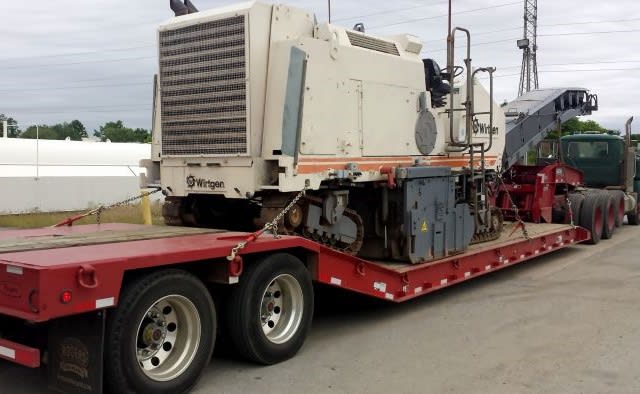
By federal regulation, Grade 70 transport chains must secure any machinery weighing over 4,500 kilograms, or 9,900 pounds, says Kinedyne, a maker of tie-down devices.Photo: Rogers Brothers Corp.
“But we take some conservative steps to lighten the trailer,” he continues. “The lighter the trailer, the more the flex, and the more the flex, the sooner it wears out. And the owner doesn’t get as much return on investment. So we have to make those changes very carefully. Our trailers will last almost indefinitely if they’re cared for. We get calls for parts for trailers from the ’50s. In used-trailer ads, you’ll see some for Rogers trailers from the ’90s and ’80s.”
More Equipment

Electric Yard Tractors Move Beyond Pilots
Operating-cost savings have overtaken sustainability goals as the leading reason surveyed fleets are adopting battery-electric terminal tractors, according to new NACFE research.
Read More →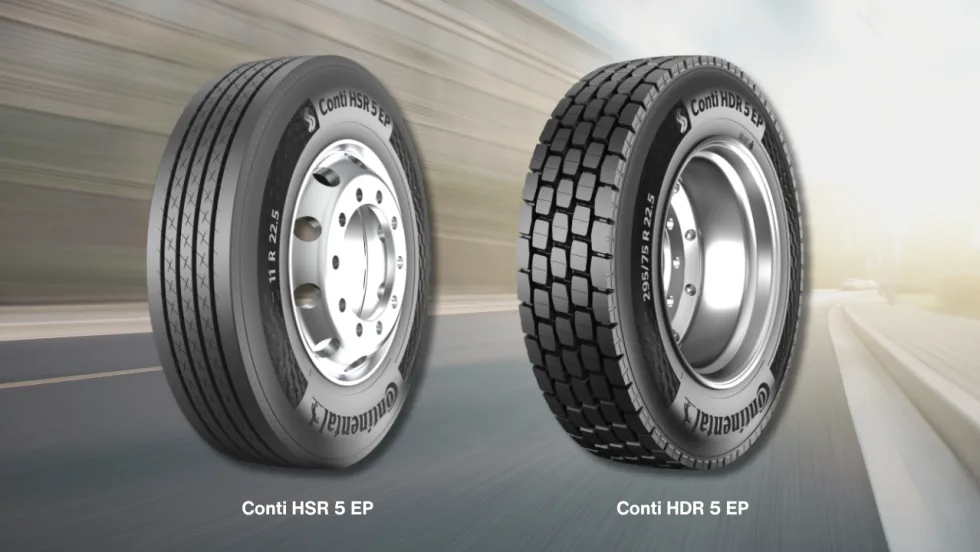
Continental Introduces New Regional Truck Tires
Continental says its new Generation 5 steer and drive tires for regional operations offer longer tread life, with estimated mileage gains of 22% and 19%, respectively.
Read More →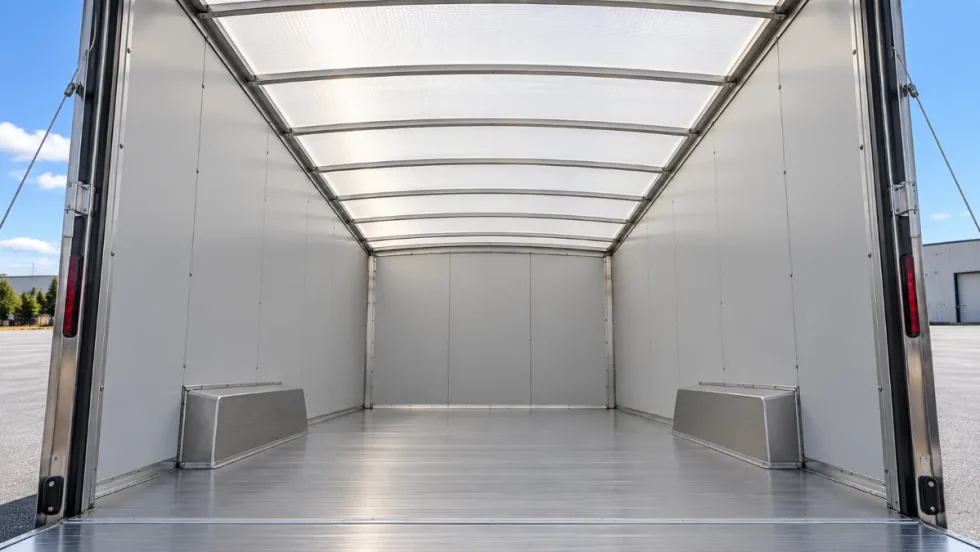
Tekmodo Introduces CargoBright Brand for Translucent Trailer Roofs
CargoBright is designed to diffuse daylight across the cargo area while performing as a working vehicle roof.
Read More →
Fleet Economics Shape Electric Truck Outlook
ACT Research expects costs, charging infrastructure, and technology improvements to drive zero-emission commercial vehicle adoption as federal regulations and incentives retreat.
Read More →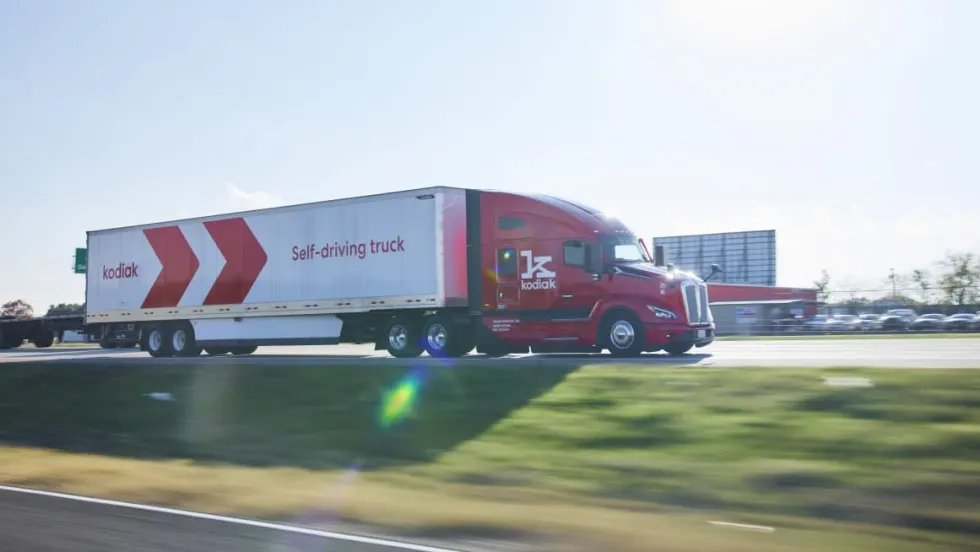
Kodiak Targets Dallas–Houston for Driverless Trucks
The company says its autonomous trucks are completing the I-45 run without a safety observer taking control. It plans to remove the observer by the end of 2026.
Read More →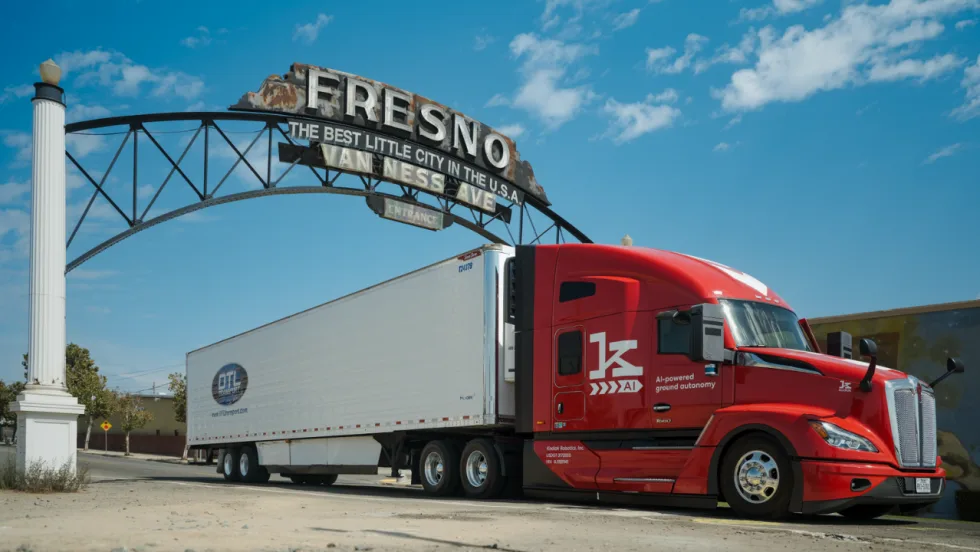
Kodiak Hauls Produce in California Autonomous Truck Pilot
Kodiak AI and DTL Transport have begun hauling produce between Fresno and Los Angeles under California’s new rules for testing heavy-duty autonomous trucks. A safety driver remains behind the wheel.
Read More →
Used-Truck Remarketing Math Is Changing
Used-truck value is no longer just a concern at trade-in. Decisions made throughout a truck’s first life can influence what it’s worth years later.
Read More →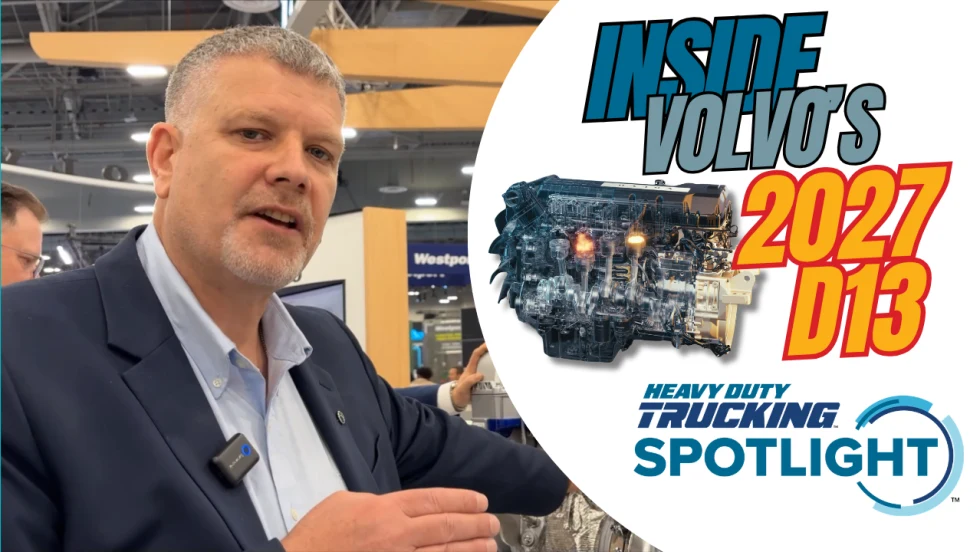
How Volvo Updated Its D13 for EPA 2027 [Watch]
Volvo’s updated D13 promises lower emissions without sacrificing performance or fuel economy. Take a closer look at what changed inside the engine in this HDT Spotlight video.
Read More →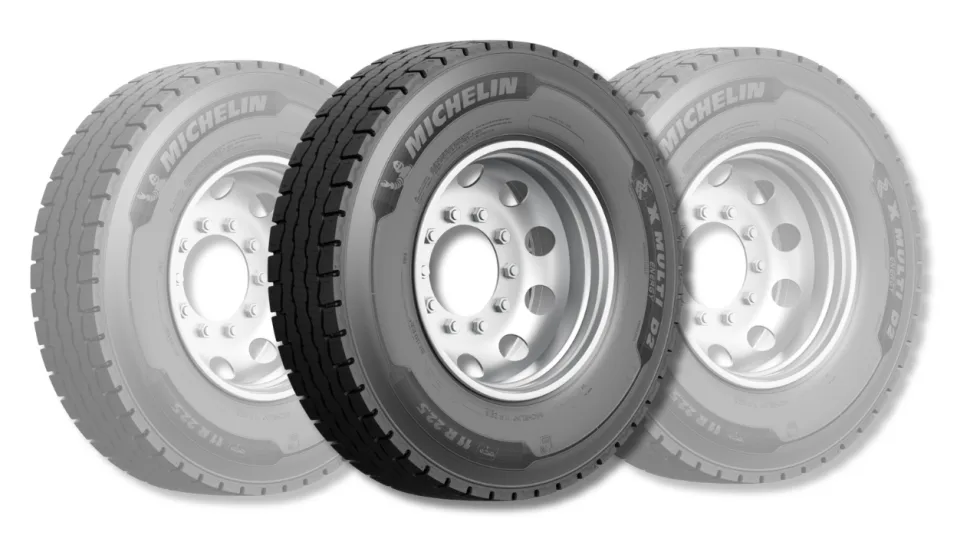
Michelin Tire Improves Efficiency and Durability for Regional Fleets
The Michelin X Multi Energy D2 is a regional haul drive tire engineered to help fleets improve fuel efficiency, durability and traction in demanding stop-and-go operations.
Read More →
ZF Expands Commercial Vehicle Push in North America
ZF is expanding its North American commercial-vehicle presence with new transmission applications, electrification, trailer technology and autonomous-driving systems.
Read More →