




Q&A: Navistar’s Tobias Glitterstam on Electric Trucks
Tobias Glitterstam, Navistar’s recently named chief strategy and transformation officer, sat down for an interview with HDT to talk about zero-emission trucking and why he thinks fleets need more help to make that transition go smoother and faster.

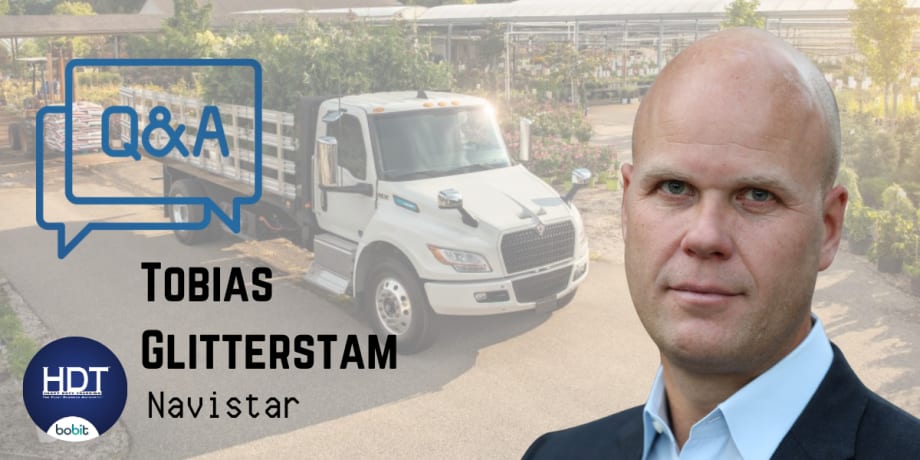
School buses and medium-duty trucks were Navistar's first forays into the electric truck market. But new, larger models are coming, according to Tobias Glitterstam, chief strategy and transformation officer.
Photos: Navistar
You don’t get to be one of the oldest truck OEMs on the planet without a tradition of technological innovation. Over a century ago, International Trucks helped define the concept of what a commercial vehicle would be, as well as the powertrain technologies that would power and propel them.
Today, Navistar is once again at the forefront of technological change, helping trucking transition away from fossil fuels to a zero-emission transportation future.
Tobias Glitterstam, Navistar’s chief of strategy and transformation since early 2023, is leading the truck-builder’s efforts on this new frontier. In an interview with HDT, he spoke about the complexities facing fleets and truck OEMs — and why more help is needed to ease and expediate this transformation.
HDT: We’re here talking primarily about electric trucks today. But you’ve made it clear Navistar looks at the technology transformation fleets are facing in more basic terms. Can you explain?
Glitterstam: Our transformation toward zero-emission vehicles started years ago. And our strategy has always made our mission clear for us: We want to accelerate the adoption and impact of sustainable mobility in trucking.
But that very much goes back to our core values at Navistar — and that is putting our customers first. One big reason we are so committed to green transportation and decarbonization is we strongly believe that electrified transportation is the best solution for our customers in the long term.
HDT: You’re talking about fleet benefits instead of something massive like combatting climate change?
Glitterstam: Yes. That’s why we are so committed. Our strategy is very much based on our own, in-house scientific research. We have our own global team of scientists dedicated to studying all of these zero-emissions technologies in detail. And as they look into the future, data shows us that electric vehicles will offer our society the best possible solutions from an environmental point — but even more so from our customers’ view.
Our research tells us that in terms of efficiency, productivity, performance, and total cost of ownership, electric trucks will be the best solution for a majority of customer applications.
HDT: And your electric vehicle rollouts have reflected these views, haven’t they?
Glitterstam: Yes. We brought out our electric school bus in 2020. That was followed by our first electric medium-duty truck shortly thereafter. The reason is we saw that as a very good starting point on the path to full electrification.
Those launches will be followed by regional haul and long-haul trucks. Given the high, intensive usage of long-haul trucks, they prove to make the best longer term business sense in transitioning to electric. So, this approach to introducing this new technology allows us to learn about it hand-in-hand with our dealer network and customers as we go.
HDT: How important has Navistar’s place in the global Traton corporation for this process?
Glitterstam: Very important. Although it’s not merely a question of Navistar using European technology here. The fact is that now, Navistar is fortunate to be vital member of a leading global truck OEM. It is true that Traton and Navistar quickly synergized and merged our zero-emission research and development activities into one, joint, global organization with a global product roadmap. And that benefits us.
HDT: And those R&D efforts go far beyond electric trucks?
Glitterstam: Yes. Electric truck development was already underway at Navistar. But now, our global research is focused in many other areas. We are working on the digitalization of fleets and connectivity, for example. And we are looking toward autonomous trucks in order to leverage that technology from a leading position in the North American market.
HDT: But none of this means Navistar is abandoning diesel engine technology any time soon, does it?
Glitterstam: No. Of course, we have a two-step approach to this transformation. We have investments in green, clean technology. And that includes bringing the completely new International S13 Integrated Powertrain to the market. When compared to the last generation of the A26, the S13 Integrated Powertrain offers up to 15% better fuel economy and 75% fewer NOx emissions.
Accelerating the introduction of the S13 makes very good economic sense for our customers, and environmental sense aligned with more stringent regulations for greenhouse gas emissions. So, we see this as a logical step toward decarbonization as we move on to electrification.
HDT: Which brings up another point: We are moving into a time when many fleets will have to manage different powertrains at once. What are your thoughts on that new reality?
Glitterstam: While we explore all major technologies, we see BEV as our clear core priority. At Navistar we believe battery-electric vehicles have a clear advantage over fuel-cell-electric vehicles.
At the same time, we recognize that fuel-cell electric vehicles can have compelling use cases in certain applications to make the best use of clean energy resources.
To manage mixed fleets, it starts with a strong foundation of connected vehicles and enables new digital technologies to help optimize the freight operations. Continued digitalization will be vital for fleets, especially in managing the new complexities of mixed fleets.
HDT: What about alternative-fuel internal combustion engines?
Glitterstam: For some time to come, our customers will have to run mixed fleets. So, we will continue to have an efficient ICE product available over the next five, 10 and 15 years.
In parallel we will see a rapid transition to electric trucks. We are strong believers that is the path forward. Our ambition at Navistar is to sell 50% new electric trucks by 2030, subject to the buildout of charging infrastructure. And that is the largest concern at this point in time — the lead time required to get sufficient electric charging infrastructure in place.
HDT: Which is why we see Navistar stepping up to offer more than just trucks? You are really moving into a business partner and consulting role, aren’t you?
Glitterstam: Yes. We have to support our dealer network and the customer, becoming a trusted partner. There is no other choice. We are not just selling the best trucks possible anymore. We are helping to set up an entirely new system and an entirely new way of managing their fleets.
HDT: What would you like to see happen to help accelerate the adoption of electric trucks in North America?
Glitterstam: I think two things are important.
One, we need to find a pathway to cost parity for electric trucks in as many applications as possible. Navistar has over 300,000 connected vehicles on the road, and we know from that data that 10% to 15% of the freight currently being moved by our customers could be moved by electric trucks efficiently today.
One way we could get more fleets to try electric trucks on these routes would be with grants and incentive to support one-off costs of upgrading electric charging infrastructure for fleets. Such incentives would help align everyone’s timeline to zero emissions – OEMs, regulatory agencies and fleets.
HDT: And your second ask?
Glitterstam: There is always resistance to new technology at first, and fleets are finding that installation of charging infrastructure is a new complexity. Navistar is here to help, of course.
But targeted incentives for fleet operators would be another big help in easing fears about adopting this new technology. I would like to see subsidies for initial vehicle deployments to help get the ball rolling. This would give both fleet managers and drivers valuable experience with these trucks.
More Fuel Smarts

How Volvo Updated Its D13 for EPA 2027 [Watch]
Volvo’s updated D13 promises lower emissions without sacrificing performance or fuel economy. Take a closer look at what changed inside the engine in this HDT Spotlight video.
Read More →
Diesel Price Spike Shortens Payback for Natural Gas Trucks, Report Says
Energy Vision estimates fleets could recover the higher purchase price of an RNG-fueled Class 8 tractor in 1.3 to 2.8 years under current fuel-price scenarios.
Read More →
Calstart Becomes Catalyst Mobility, Reflecting Broader Focus
Calstart is now Catalyst Mobility, reflecting the nonprofit’s growing national role in clean transportation, including zero-emission trucks, infrastructure and incentive programs.
Read More →

Record Diesel Prices Squeeze Trucking Fleets
Average U.S. diesel prices have climbed to nearly $6 a gallon, surpassing the 2022 record as tight refinery capacity and Middle East disruptions keep fuel costs elevated.
Read More →
How Fuel Delivery Shapes Engine Performance
Fuel delivery depends on more than what happens at the injector. For fleet, maintenance and technical professionals, looking at the full path from pump to injector can provide useful context for understanding engine performance.
Read More →
East Coast Port Launches $45M Electric Truck Push
The Port Authority of New York and New Jersey announced millions in incentives for zero-emission drayage trucks, yard tractors, and new charging hubs near the port.
Read More →
California Bill Could Shed Light on Electric Truck Prices
Why do battery-electric Class 8 trucks remain so expensive? A California bill headed to Gov. Gavin Newsom would give fleets and state agencies more visibility into what manufacturers charge.
Read More →
Detroit Opens Orders for EPA 2027 Engines
Detroit isn’t starting from scratch to meet EPA 2027 diesel emissions standards. Its Gen 6 DD13 and DD15 engines keep much of today’s platform while updating the fuel and aftertreatment systems.
Read More →
Zero-Emission Truck Corridor Planned for West Coast
California, Oregon, Washington, British Columbia and Baja California are coordinating plans for truck charging and hydrogen fueling from Canada to Mexico.
Read More →
A Closer Look at Kenworth’s Electric T880E Vocational Truck [Video]
Learn more about Kenworth's T880E battery-electric vocational truck at the Paccar Technical Center, including its range, applications, upfitting considerations, and PTO options, in this HDT Spotlight video.
Read More →