HDT Fact Book 2023: Sustainability and the Decarbonization of Trucking
As the trucking industry moves toward sustainability, fleets are exploring how to deploy alternative fuel options such as battery-electric, hydrogen fuel-cell, renewable natural gas, hydrogen internal combustion engines, and more. However, infrastructure continues to be a key challenge in rolling out widespread adoption of most of the new technologies. But, at the same time, diesel trucks are becoming more efficient than ever.
As the trucking industry seeks out more sustainable options, challenges remain.
5 min to read
Even as global heat wave records and severe weather keep climate change in the headlines, there are many unanswered questions about decarbonizing the trucking industry. Sustainability is just one of the important trendlines detailed in the HDT Fact Book 2023, HDT's annual snapshot of where the trucking industry is, where it's been, and what its current long-term trends are.
Ad Loading...
Lessons are being learned about the challenges of battery-electric truck adoption as large fleets unveil zero-emission operations in California ahead of stringent upcoming regulations. A major stumbling block here is the charging infrastructure.
Medium-duty battery-electric trucks and yard trucks are applications where electric truck adoption is less challenging.
Ad Loading...
Hydrogen has also gained a lot of interest, both for hydrogen fuel-cell electric trucks with more range than BEVs, and as an alternative fuel for use in internal combustion engines. Renewable natural gas and renewable diesel are gaining popularity. A new generation of ICEs is being developed to run on a variety of alternative fuels.
At the same time, two SuperTruck II projects unveiled this year demonstrate how internal combustion engines can become more efficient than ever. Navistar said its SuperTruck II project truck achieved a 170% improvement in freight efficiency, hitting 16 mpg. Daimler Truck North America said its truck doubled the freight efficiency of the base vehicle from the start of the SuperTruck program.
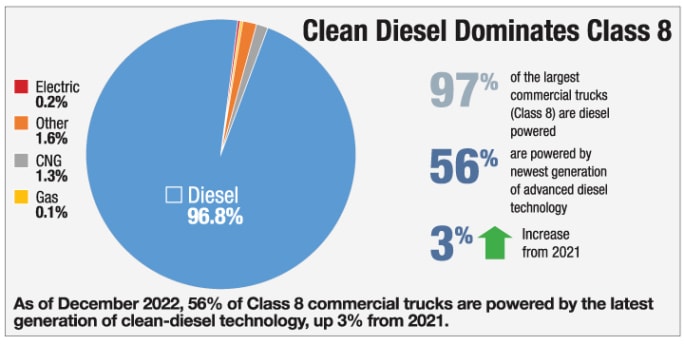
As of December 2022, 56% of Class 8 commercial trucks are powered by the latest generation of clean-diesel technology, up 3% from 2021.
Source: Diesel Technology Forum
Clean-Diesel Tech Powers More Than Half of Commercial Trucks
U.S. trucking companies are buying more new, low-emission diesel technology engines than ever before. The number of new near-zero-emission Class 3-8 diesel trucks on the road increased 10% between 2021 and 2022, according to the Diesel Technology Forum.
Fact Book 2023: HDT's annual snapshot of where the industry is, where it's been, and long-term trends.
Near-zero-emission trucks are powered by advanced diesel technology found in 2010 and later model years designed to meet EPA emissions rules, with particulate filters and selective catalytic reduction systems for near-zero levels of tailpipe emissions.
According to DTF’s analysis of S&P Global Mobility TIPNet Vehicles in Operation Data as of December 2022, 97% of Class 8 commercial trucks are powered by diesel, and 56% are powered by the latest generation of clean-diesel technology. That's up 3% from 2021.
Ad Loading...
Illinois is the state with the fastest-growing registration of new advanced diesel technology Class 8 commercial trucks, up 4.6% as of December 2022 compared to a year earlier.
Of the total Class 3-8 commercial truck population, 76% are powered by diesel. The near-zero-emission models make up 57% of all commercial diesel trucks (Class 3-8) on the roads today.
Indiana has the highest percentage of registrations of 2010 and later model year near-zero-emission Class 3-8 diesel trucks with 73%. California lags the national average, taking the 35th spot with 52%. In fact, there are 125 times more new-generation advanced diesel trucks on the road in California than electric trucks.
Nationwide, for every electric commercial truck on the road, there are nearly 1,100 powered by internal combustion engines. As the trucking industry explores new fuels, including all-electric and fuel cell technology, it is clear that diesel and other internal combustion engines are going to continue to play a dominant role for years to come.
— Contributed by the Diesel Technology Forum (Now the Engine Technology Forum)
Ad Loading...
Alt-Fuel Growth Driven by Large Fleets
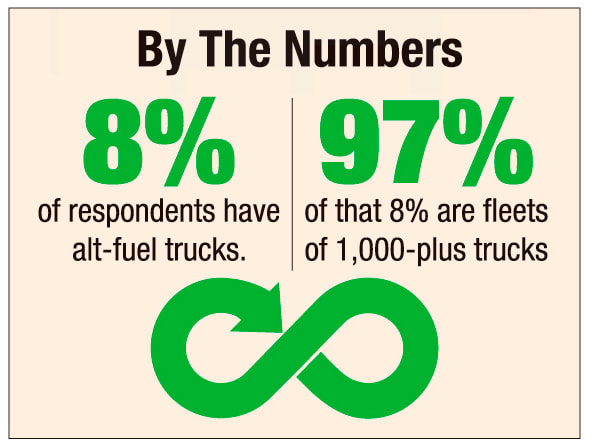
In the American Transportation Research Institute’s latest cost of operations survey, in 2022, 8% of respondents had at least one Class 8 truck-tractor in their fleet powered by an alternative fuel source, up from 7% in 2021.
But only 3.4% of all trucks in the 2022 sample used alternative fuels (although this is on the rise from 2.7% in 2021.)
The reason? 97% of all alternative-fuel trucks in the sample belong to just four carriers, all of which have more than 1,000 trucks each. With significantly higher prices and limited use cases, ATRI notes, alternative-fuel trucks are more challenging to incorporate into small carriers’ operations.
How Fast Will Commercial ZEV Adoption Take Hold?
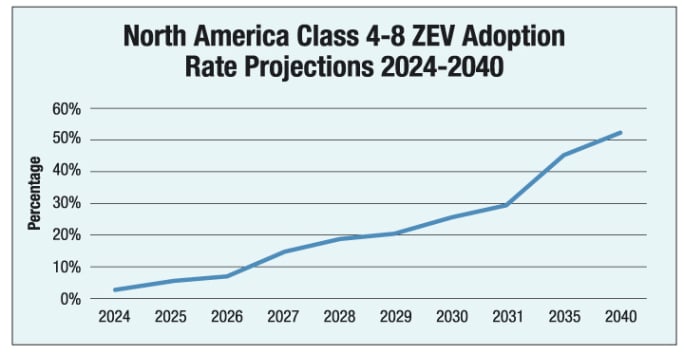
In the third edition of ACT Research’s Charging Forward report, a 2024-2040 decarbonization forecast, we predict a relatively low adoption rate of Class 4-8 zero-emission vehicles from 2024 through 2026, reflective of the fact that sales of battery-electric commercial vehicles are still in their early years.
This begins to change in 2027, in part due to cost increases for diesels as a result of the increased stringency of the EPA’s 2027 Low-NOx regulations. In addition, by 2027, seven states will have joined California in adopting its Advanced Clean Trucks regulation, resulting in moderate growth in adoption rates.
Ad Loading...
By 2030 we are forecasting 25% adoption rates. By then, the remaining nine states that signed the memorandum of understanding to adopt ACT will have enacted those regulations. This forecast also assumes improved battery technology will negate battery replacement costs, and charging infrastructure utilization will significantly increase, decreasing those costs in the total cost of ownership.
By 2040, we are forecasting that adoption of ZEVs will account for just slightly above 50% — essentially half of all commercial vehicles will be zero-emissions, primarily BEVs.
While the technologies for decarbonization can already provide better TCO for many applications, today the driving force behind increasing adoption rates for zero-emission and decarbonization vehicles is regulations. From all of our research, interviews, and meetings, it was very clear that regulations have been and will continue to drive increased adoption rates for alternative-powered commercial vehicles.
— Contributed by ACT Research
ACT Research’s base case Charging Forward forecast assumes that California's Advanced Clean Trucks and EPA 2027 Low-NOx regulations will stay in place. Not considered in the base forecast are California's Advanced Clean Fleets or the EPA proposed GHG Phase 3 regulations.
Source: ACT Research
Van, Yard Tractors Lead ZEV Adoption
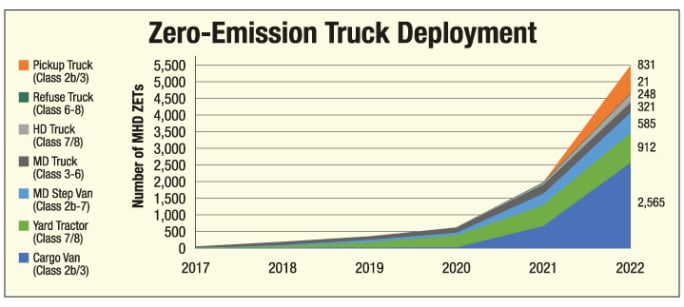
The deployment of zero-emission trucks grew by 163% in 2023, adding another 3,510 units to fleets in the U.S., according to Calstart’s “Zeroing in on ZETs: May 2023 Market Update.”
Ad Loading...
Zero-emission cargo vans and yard tractors are achieving a significant share of total medium- and heavy-duty ZET sales, said Calstart. Cargo vans account for 47% and yard tractors account for 17% of all new medium- and heavy-duty ZET registrations.
This is followed by:
Pickup trucks (which have been available for purchase since 2022) at 15%.
Medium-duty step vans at 11%.
Medium-duty trucks at 6%.
Heavy-duty trucks at 5%.
Refuse trucks at 1%.
In electric yard tractors, Calstart reports 1,541% growth in deployments from January 2017 to December 2022. The deployment of Class 8 ZETs overall experienced 7,167% growth from January 2020 to December 2022.
Three OEMs dominate zero-emission yard tractor deployments in California, according to Calstart, all of which have deployed models outside of California. Since January 2017, California has accounted for 65% of zero-emission yard tractor deployments, followed by New York (5%) and Colorado (4%).
The cumulative growth of the seven medium- and heavy-duty zero-emission truck segments over the past six years. More than 136 models are now available for purchase across more than 40 manufacturers.
Volvo’s updated D13 promises lower emissions without sacrificing performance or fuel economy. Take a closer look at what changed inside the engine in this HDT Spotlight video.
Energy Vision estimates fleets could recover the higher purchase price of an RNG-fueled Class 8 tractor in 1.3 to 2.8 years under current fuel-price scenarios.
Calstart is now Catalyst Mobility, reflecting the nonprofit’s growing national role in clean transportation, including zero-emission trucks, infrastructure and incentive programs.
Average U.S. diesel prices have climbed to nearly $6 a gallon, surpassing the 2022 record as tight refinery capacity and Middle East disruptions keep fuel costs elevated.
Fuel delivery depends on more than what happens at the injector. For fleet, maintenance and technical professionals, looking at the full path from pump to injector can provide useful context for understanding engine performance.
The Port Authority of New York and New Jersey announced millions in incentives for zero-emission drayage trucks, yard tractors, and new charging hubs near the port.
Why do battery-electric Class 8 trucks remain so expensive? A California bill headed to Gov. Gavin Newsom would give fleets and state agencies more visibility into what manufacturers charge.
Detroit isn’t starting from scratch to meet EPA 2027 diesel emissions standards. Its Gen 6 DD13 and DD15 engines keep much of today’s platform while updating the fuel and aftertreatment systems.
California, Oregon, Washington, British Columbia and Baja California are coordinating plans for truck charging and hydrogen fueling from Canada to Mexico.
Learn more about Kenworth's T880E battery-electric vocational truck at the Paccar Technical Center, including its range, applications, upfitting considerations, and PTO options, in this HDT Spotlight video.