HDT Fact Book 2023: Fatal Accidents, Driver Abilities Among Key Safety Concerns
With a 49% increase in the number of truck-crash fatalities over the past decade, DOT-recordable accidents per million miles of travel is an important metric for fleets. In addition to that concern, fleet safety managers say their biggest challenges are staying up to date with regulatory changes and improving driver knowledge and skills.
Get a snapshot of key trucking-safety issues and learn about the current safety statistics.
Source: Canva/HDT Illustration
4 min to read
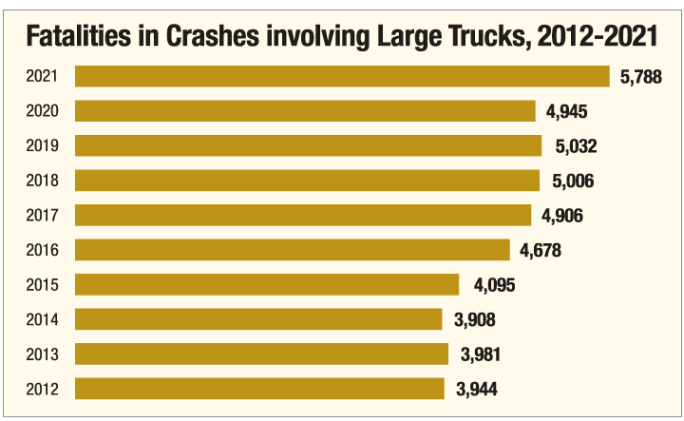
The number of fatalities in crashes involving medium- and heavy-duty trucks jumped in 2021 (the most recent numbers available) after the COVID-19 pandemic contributed to a drop in 2020. At 5,788, fatalities were up 17% from the previous year. That’s according to the Department of Transportation’s Fatality Analysis Reporting System (FARS), which defines “large trucks” as any medium- or heavy-duty truck with a gross vehicle weight rating greater than 10,000 pounds, commercial and non-commercial.
Ad Loading...
That was one of the trucking industry's primary safety concerns in 2023. Learn about this year’s top issues related to trucking safety, as detailed in the HDT Fact Book 2023, HDT's annual snapshot of where the trucking industry is, where it's been, and what its current long-term trends are.
Fact Book 2023: HDT's annual snapshot of where the industry is, where it's been, and long-term trends.
According to the National Safety Council, there has been a 49% increase in the number of truck-crash fatalities in the last 10 years. NSC reports the involvement rate per 100 million truck miles traveled is also up — 7% from 2020 and up 22% in the last 10 years.
Ad Loading...
Between 2012 and 2021, DOT numbers indicate that about one-fourth of the fatal large-truck crashes were on interstate highways. The remainder were non-interstate.
Looking at geography, between 2012 and 2021, North Dakota had the highest percentage of large trucks involved in fatal crashes, at 19.4%. Wyoming came in second at 18.8%.
Smallest percentage? Hawaii at 4%, DC at 4.2%, and Rhode Island at 4.8%.
81% of fatal crashes involving large trucks were multi-vehicle, and 72% of the fatalities were occupants of other vehicles.
Source: FARS
Metric to Watch: DOT-Recordable Accident Rates
DOT-recordable accidents per million miles of travel is an important metric for fleets, because it’s one of the things the FMCSA considers during a compliance review to decide a carrier's safety rating.
The industry average accident rate for most carriers is 0.74 accidents per million miles, according to Trucksafe.com. A carrier with an accident rate of more than 1.5 accidents per million miles (for non-urban carriers) or 1.7 accidents per million miles (for urban carriers) over the course of a 12-month period will fail that portion of the audit, which could lead to a downgraded safety rating.
Ad Loading...
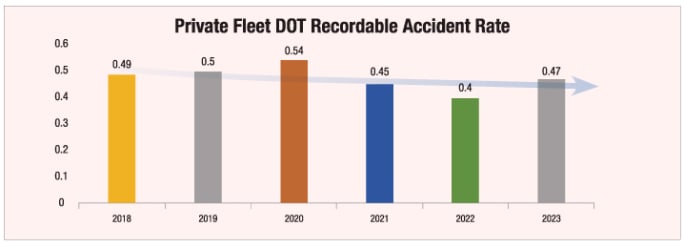
Private fleets participating in the National Private Truck Council’s annual benchmarking survey continue to report an outstanding safety record. In this year’s survey, private fleets reported 0.47 recordable accidents per million miles, up from last year’s all-time low of 0.4.
For five of the last six years, the crash rate among private carriers has come in at 0.5 accidents per million miles of travel. Source: National Private Truck Council
Source: NPTC
Fleet Safety Manager Challenges
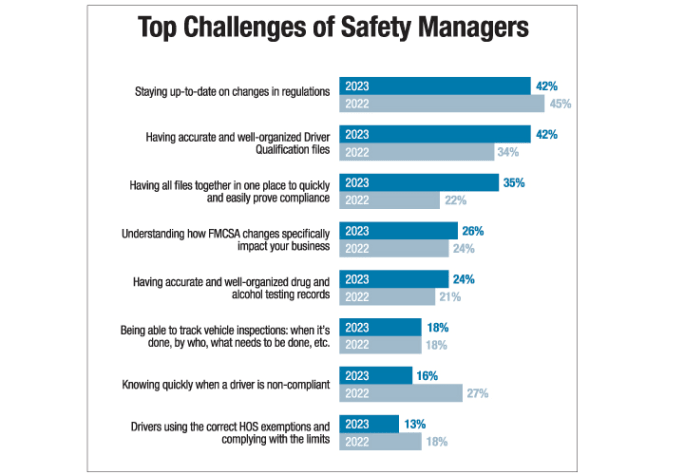
Among fleet managers' biggest challenges are staying up to date with regulatory changes and improving driver knowledge and skills, according to a recent survey.
The State of Fleet Management: Insights on Priorities for Today’s Fleet Managers is based on a survey fielded in February 2023 and is the third such study conducted by the J.J. Keller Center for Market Insights, the research arm of J.J. Keller & Associates. Survey respondents are trucking fleets, both for-hire and private. In terms of size, 67% were less than 25 trucks, 17% were 25-99 trucks, and 17% were 100+ trucks.
Two challenges rose in importance from last year:
Knowing quickly when a vehicle or trailer is damaged or non-compliant jumped 24% from 2022.
Having all driver files together in one place so fleet managers can quickly and easily prove compliance increased 13% from 2022.
Ad Loading...
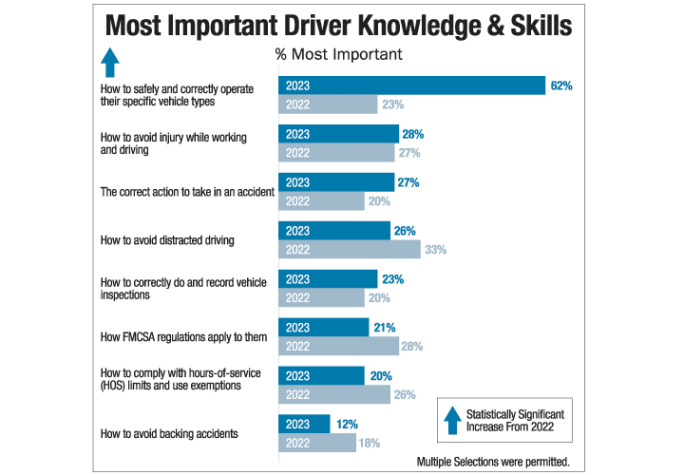
When it comes to driver knowledge, safely and correctly operating a specific vehicle type topped the list, with 62% of respondents agreeing it was the most important driver knowledge and skill. That was a 39% increase over 2022, when distracted driving was the top of the list.
This year's survey respondents were less concerned about driver distraction than last year but more concerned about drivers knowing their specific vehicle type.
Source: J.J. Keller
Fleet safety managers want to stay up to date and stay organized, but it's a challenge.
Source: J.J. Keller
Commercial Drivers and Drug Testing
The Federal Motor Carrier Safety Administration has been tracking positive drug and alcohol tests among commercial driver’s license and permit holders since 2020.
When a driver has a positive test, he or she can’t drive a commercial vehicle or other safety-sensitive functions until a prescribed return-to-duty process is completed.
In a Clearinghouse snapshot as of June 1, 2023, out of more than 191,000 drivers that had at least one violation, nearly 136,000 were in prohibited status. More than half, 102,905, had not started the return-to-duty process, likely indicating those drivers decided to get out of trucking. About 55,500 were in non-prohibited status, having had a negative return to duty test result.
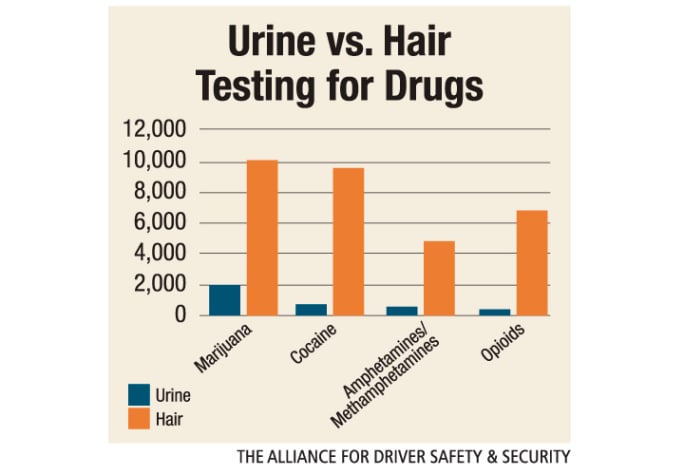
Some believe that the DOT-required urine testing far understates the real numbers. The Trucking Alliance says it’s missing 90% of the actual drug users, based on analysis of hair tests administered by its members.
Ad Loading...
When looking at hair-testing results compared to the required urine-testing, opioids moved up to the third-most-common drug found in testing.
Source: The Alliance for Driver Safety & Security
Drawing from 936,872 urine and hair drug screens administered from 2017-2022, researchers at the University of Central Arkansas found hair testing produced a 9% higher positivity rate than the DOT-required urinalysis. Hair tests uncovered:
Carriers whose updates were due on or after June 1 have more time, while FMCSA works to stabilize its new registration system and warns of phishing sites impersonating its new carrier registration system, Motus.
ZF is expanding its North American commercial-vehicle presence with new transmission applications, electrification, trailer technology and autonomous-driving systems.
Fleets have more visibility into truck health, safety events, and driver activity than ever. The next challenge is turning all that information into useful guidance for the person who has to decide what to do next.
Could Tesla’s camera-only autonomous driving technology work on an 80,000-pound Semi? In this commentary, HDT's Deborah Lockridge takes a look at Tesla, Cybercab, and how autonomous trucks see the road.
The U.S. Department of Transportation issued a new automated-vehicle strategy that outlines plans for driverless-truck regulations, cross-state freight corridors, and federal safety standards.
New York City is expanding intelligent speed assistance and pedestrian-alert systems across its municipal fleet, moving the technologies from pilot programs into vehicle procurement and retrofit requirements.
Federal regulators also are targeting more than 160 additional training providers and launching a nationwide audit of third-party CDL skills testers as part of a broader crackdown on trucking fraud.
Two pilot programs could eventually reshape hours-of-service rules, giving truck drivers options to pause their 14-hour clock or use longer split sleeper rest periods.
Hundreds of thousands of pets travel in truck cabs. A new safety guide from Volvo Trucks and the Center for Pet Safety offers practical advice for truck drivers who bring dogs and cats along for the ride.