




HDT Emerging Leader: Building a Culture That Drivers Want to Stay For
At Stokes, HDT 2024 Emerging Leader Jason Douglass is known as “The Lorax," a nickname inspired by the Dr. Seuss character who speaks for the trees. In Douglass’s case, he speaks for the drivers.
October 17, 2024

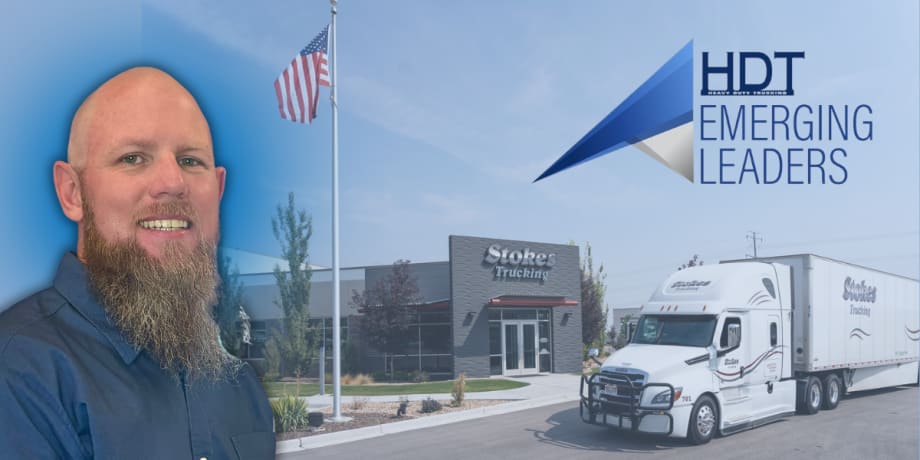
At Stokes Trucking, HDT Emerging Leader Jason Douglass focuses on driver retention over recruiting.
Image: HDT Graphic
6 min to read
Jason Douglass was working as a delivery driver for a plumbing supply company, 19 years old and straight out of high school, when he noticed something that didn’t sit right with him. The drivers were often treated as second-class citizens. For instance, free lunch Fridays for the office staff never included the drivers.
Douglass didn’t experience it much himself because he knew some of the people at the company. But when he moved from driving into load planning, he tried to do better. He saved drivers plates of food from those lunches, for example.
Today, Douglass is the director of retention and recruiting at Stokes Trucking in Tremonton, Utah, and a 2024 HDT Emerging Leader.
Earning Drivers' Respect
From the plumbing company, Douglass moved to a trucking company and started dispatching — a role that required him to gain the respect of drivers who were often twice his age.
“To get the respect of drivers, you really had to respect them and know what you were talking about,” he says.
After moving up to become a recruiter and eventually director of safety and recruiting at another company, Douglass was recruited to join Stokes Trucking. He went from a 200-truck company to a 50-truck company.
It was a pivotal moment in his career, not just because it was a new opportunity, but also because it marked a new chapter in his personal life.
“I’ve been sober now for three years, and I wake up at 3 a.m. and run every morning. I come to work with a smile on my face,” he says.
Creating A Culture of Driver Retention
When Douglass joined Stokes, the company was facing a familiar challenge: high driver turnover. But Stokes was committed to doing something about it. That’s one reason “retention” comes first in his title, before “recruiting.”
He began implementing a series of initiatives that have turned Stokes into a company where drivers want to stay.
How successful has it been? Turnover this year was in the single digits until a driver recently had to be let go for safety reasons. And Douglass has had enough time on his hands to add sales to his duties.
“One thing everybody loves is recognition,” Douglass says. So he worked to get Stokes drivers recognized through the Utah Trucking Association’s Driver of the Month program. Of the 2022-2023 drivers of the month, Stokes had eight honorees (two drivers are honored each month.)
At the UTA awards convention late last year, Stokes filled three tables with drivers of the month. “It was cool to really rock the house with that," he says.
One of those drivers took home the Driver of the Year honor — along with a $1,000 check.
It provided recognition for drivers and also camaraderie among the Stokes team. Because it’s not just about recognition; it’s about creating a community.
Speaking for Drivers
At Stokes, Douglass is known as “The Lorax,” a nickname inspired by the Dr. Seuss character who speaks for the trees. In Douglass’s case, he speaks for the drivers.
“I’ll always speak up, because I truly have their back, no matter who I’m talking to,” he says.
And while truck driver pay is important, Douglass believes that giving drivers a voice is just as crucial. For instance, he has established a pay committee that includes office staff, dispatch, and drivers.
“We meet every other Friday, getting input from drivers,” he says. “That way we get all angles of what’s in the piggy bank, what dispatch sees, and what the drivers go through.
“I’ve had people want to come work here without even asking what the pay was,” he says. “They just want to work here because they feel respected.”
Not only respected, but actually cared about.
Supporting Truck Drivers' Mental Health
Another initiative close to Douglass’s heart is the Employee Assistance Program (EAP) he brought in. It includes access to a local counselor who is also available via Zoom or phone calls for drivers on the road.
This program proved invaluable when one of Stokes’ drivers was involved in a fatal crash.
“The driver called me Friday night. He was having a hard time winding down and getting to sleep,” Douglass recalls. Stuck in a hotel room on the road, the driver had little else to do except re-run the crash in his mind and wonder what he might have done differently.
Stokes talked to the driver for a couple of hours, then contacted the counselor, who was able to spend time with the driver on Sunday.
“We got in professional help as soon as possible to help him deal with what how he was feeling,” Douglass says. “And that was really important to me, to make him feel like he wasn’t left alone.”
Innovating for Safety
Safety is non-negotiable at Stokes, and Douglass has found creative ways to keep it top of mind for drivers. From hiding $50 bills on trucks to encourage thorough pretrip inspections to offering quarterly safety bonuses, Douglass knows that incentivizing safety is key to maintaining the company’s impressive record of 13 million miles without an at-fault accident.
Technology also plays a role in the safety strategy.
Stokes trucks come with advanced safety systems such as collision mitigation and lane departure warning. When all the safety functions are enabled, the truck maker says, drivers are 60 to 70% less likely to have an accident. So drivers are incentivized to use it.
Stokes has equipped its trucks with the MirrorEye advanced camera system, which replaces traditional mirrors with LCD monitors. This enhances night vision and provides crucial post-accident footage that can exonerate drivers.
But technology is only as good as the people who use it, and Douglass is committed to ensuring that all drivers are comfortable with the new systems.
“The older generation can embrace it if you pitch it the right way,” he says. “It’s about how it’s presented and what it does for them.”
Don't Be Afraid to Get Your Hands (Or Your Pants) Dirty
Douglass believes that respect is earned through action.
“If a driver comes in, I stand up on their level and shake their hand, not for any other reason than I think it’s just a sign of respect.”
Leadership, he says, “starts with listening intently and following by example. You’ve got to be willing to get in the trenches.
“If you go out to help a driver and you’re not willing to get your hands dirty to help him pick up a tire, you’re in the wrong industry,” he says. “I'm never worried about getting my pants dirty, even if I'm dressed nice.”
He emphasizes the importance of treating drivers as equals.
“There should only be two types of people at a company: drivers and those who support drivers,” Douglass says, which he attributes to Tracy Rushing, executive director of safety and HR at R.E. Garrison Trucking
This philosophy is evident in the culture Douglass has helped build at Stokes — a culture where drivers are co-workers, not just employees.
As for the future, Douglass is far from done. He’s currently participating in the Truckload Carriers Association’s Elevate program, which aims to develop the next generation of trucking leaders.
Douglass’s ultimate goal? To keep growing, both personally and professionally, while continuing to advocate for the drivers who are the backbone of the industry.
“I've really found my passion for the industry and for drivers,” Douglass says. “I think I'm married now to the industry, and whatever I do, I'll be an advocate for drivers first.”
Subscribe to Our Newsletter
More Fleet Management

Sponsored•September 16, 2026
Color Match Smarter: Tools That Restore & Perform
For fleet managers and collision repair professionals keeping heavy-duty trucks on the road, getting the color right the first time isn't just about appearance — it's about efficiency, turnaround time, and bottom-line results. Discover how today's digital color tools are transforming the repair process from guesswork to precision.
Read More →
FMCSA Pauses Biennial-Update Enforcement Amid Motus Transition
Carriers whose updates were due on or after June 1 have more time, while FMCSA works to stabilize its new registration system and warns of phishing sites impersonating its new carrier registration system, Motus.
Read More →
Sponsored•September 14, 2026
2026 Blueprint for Countering Smarter Supply Chain Theft
Cargo theft is no longer just the cost of doing business. It's a multi-billion-dollar criminal enterprise exploiting vulnerabilities across your fleet, drivers, and supply chain.
Read More →


Sponsored•September 1, 2026
How Telematics Improves Visibility, Control, and Performance in Refrigerated Fleets
Explore how telematics help refrigerated fleets improve visibility, uptime, efficiency, compliance, and cargo protection across connected cold chain operations.
Read More →
What the U.S.-Canada Trade War Means for Trucking
Escalating U.S.-Canada tariffs could disrupt cross-border freight, reduce truck volumes, raise costs, and create new uncertainty for carriers on both sides of the border.
Read More →
What Are Trucking’s Top Concerns for 2026?
The American Transportation Research Institute wants to know what's worrying trucking fleet managers, drivers, and other stakeholders in its annual Industry Issues survey.
Read More →
American Trucking Associations Looks for a New Leader
ATA President and CEO Chris Spear abruptly left his job at the association on August 21, at a pivotal time for the trucking industry.
Read More →
Public Wi-Fi Cybersecurity Risks: How Truck Drivers and Fleets Can Protect Their Data
Public Wi-Fi can expose truck drivers and fleets to credential theft, malware, and other cyber threats. Here’s how to reduce the risk on the road.
Read More →
For Nicky Cupp, Fleet Innovation Starts With Frustration
HDT Truck Fleet Innovator Nicky Cupp turns everyday pain points at Fraley & Schilling into opportunities for better technology and smarter processes.
Read More →
Adam Buttgenbach’s Approach to Electric Trucks: Start With Where They Fit
HDT Truck Fleet Innovator Adam Buttgenbach helped PepsiCo build one of North America’s largest EV fleets by focusing on where electric trucks make operational sense.
Read More →