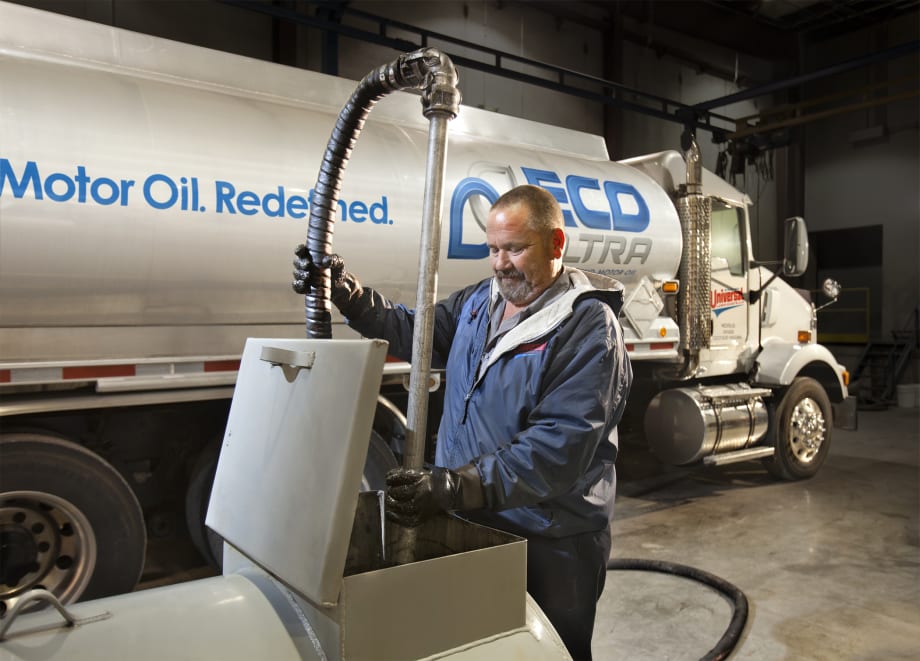
Universal Lubricants picks up drain oil at automotive dealers, repair shops and truck terminals.
5 min to read
Universal Lubricants picks up drain oil at automotive dealers, repair shops and truck terminals.
What are you doing with the spent oil from your engines? Most fleets are reusing it somehow, perhaps by burning it in special furnaces to heat the shops or selling it to a recycler who'll put it to other uses. Drain oil was once dumped or given away, but since the rise of petroleum prices on world markets, it now brings as much as 95 cents a gallon.
Ad Loading...
About 1.1 billion gallons of drain oil comes out of automotive crankcases every year, and a large amount is collected for reuse, one study says. Much of it is burned to make asphalt, to fuel steamships, and for space heating.
That use is lamented by people at oil re-refining companies, who preach that once burned the oil is gone forever. However, if the drain oil is turned into fresh motor oil, grease and other lubes, they say, it goes through another life cycle and can continue to do so almost indefinitely.
Ad Loading...
How Safety-Kleen Re-Refines Used Oil
The largest re-refiner in the U.S. and Canada is Safety-Kleen, which collects about 200 million gallons of drain oil from 115,000 service locations across the country. From that it produces 160 million gallons of motor oil and other lubricants.
The reclaimed oil undergoes analytical testing to make sure it's high enough quality to enter the re-refining process. Safety-Kleen, now a unit of Clean Harbors, has been in operation since 1923. Since 1988 the company has processed more than 2.5 billion gallons.
“In ‘88 we started producing a lot of lubricants — motor oil, but also hydraulic oil and greases,” explains Barry McCabe, director of marketing in the company's oil re-refining division.
Safety-Kleen's re-refining process uses vacuum distillation and hy-drotreating to remove contaminants such as fuel, water, sulfur and dirt from used oil. This produces new base oil. Additives are blended into the base oil. It takes 42 gallons of crude oil to make the same amount of engine oil produced from recycling 1 gallon of drain oil, the company says.
Safety-Kleen also collects spent engine coolant, McCabe says, but in the same tank trucks that gather oil and grease. The refining process de-hydrates the mixture and strips out the glycol, which is captured for reuse. This is processed and remarketed separately.
Ad Loading...
Safety-Kleen's Eco-Power motor oils have been sold since the late 1980s. Its 15W-40 CJ-4/SM heavy-duty oil recently passed a 1-million-mile engine teardown test. Last month, Detroit Diesel certified the oil for use in its DD series engines.
Every year Safety-Kleen collects about 200 million gallons of drain oil, which is hauled to refineries in Indiana and Ontario.
How Re-Refiners Maintain Oil Quality
Re-refined motor oil “can be used over and over and over and over and over again,” in the words of John Wesley, chief executive officer at Universal Lubricants, which was a formulator for many years and got into re-refining in 2010.
Its product is called Eco Ultra. Universal's refinery in Wichita, Kan., processes drain oil into motor oil and other products. Its closed-loop method controls quality, from the pickup of spent oil to the sale of packaged products that are ready for re-use.
“We collect about 40 million gallons of feedstock per year at car dealers, repair shops and truck terminals, and move 15 million gallons to Wichita, where we produce 9 million gallons of base oil,” Wesley says.
From that the company makes 12 million gallons of products by blending in additives, viscosity improvers and other ingredients. Additives and development of formulations are the expensive part of motor oil, which is why re-refined products cost as much as those made from petroleum.
Ad Loading...
Base oil from re-refining is the same as that obtained from newly extracted petroleum because oil itself doesn't wear out, Wesley and others in this business point out. But it takes far less energy to turn drain oil into base oil and emits far fewer greenhouse gasses, which means it's “green.” Companies seeking sustainability appreciate this.
How D&D Sexton Benefits from Re-Refined Engine Oil
One of those is D&D Sexton Inc., a refrigerated carrier whose 125 tractors and 300 trailer-mounted reefer units have been using Universal's Eco Ultra 15W-40 motor oil since late 2010.
Ed Boes, manager of Sexton's main terminal outside of Joplin, Mo., tested Eco Ultra for about a year before adopting it. Oil analysis showed engines were being protected as well as with regular motor oils. “There's no cost advantage, but doesn't cost any more, either.”
Boes is a fervent believer in the process. “It's re-refined, not recycled. There's a big difference.”
Look for the API ‘Donut'
Is re-refining of motor oil a sound concept?
Ad Loading...
John Martin, now a consulting engineer who retired seven years ago from Lubrizol, the maker of additives, isn't sure about the process because there are no industry standards for it. But he acknowledges the truth of the axiom, “Oil doesn't wear out, it just gets dirty, and the additives wear out.”
Put the oil through a cleaning and refining process, which suppliers say they do, reblend it with a good additive package, and test it to be sure it meets American Petroleum Institute's performance standards, and the product can be trusted, Martin says.
“The API donut is good assurance because it is a licensing process. If they've got that donut, they're good to go.”
“They're real strict about that,” Martin says of API officials and their donut label, which is earned through prescribed testing. “They've caught some suppliers cheating in the past, and they really go after them.”
Most major oil companies are not into re-refining, but any that are must be very careful with products they sell, he adds.
Ad Loading...
“You're trusting the people you're dealing with. If the company is a name-brand supplier, they don't want to do anything that would tarnish that name.”
An example is Valvoline, which recently introduced its NextGen motor oil that is a 50-50 blend of virgin and re-refined base oils, along with a proper additive package. It uses only 50% recycled oil because availability of high quality re-refined base oils is limited, the company says. Martin agrees and thinks it will become more scarce.
For fleet managers and collision repair professionals keeping heavy-duty trucks on the road, getting the color right the first time isn't just about appearance — it's about efficiency, turnaround time, and bottom-line results. Discover how today's digital color tools are transforming the repair process from guesswork to precision.
DTNA is recalling more than 2,400 trucks that received an incompatible software fix instead of the hardware repair required to address brake valve corrosion.
Fleets have more visibility into truck health, safety events, and driver activity than ever. The next challenge is turning all that information into useful guidance for the person who has to decide what to do next.
Making it through August isn’t the same as being ready for the next several months of operation. Find out what systems may have suffered from summer heat and need to be checked out before fall.
With freight improving but costs still climbing, fleet maintenance executives explain how they're balancing price, quality, and supplier relationships.
The new API PC-12 heavy-duty engine oil category reflects the changing demands of modern diesel engines. But fleets like Foodliner are looking to getting their own data before making decisions on adopting the new oils and questions such as extending oil drain intervals.
The joint venture will operate MCT's network of Carrier Transicold dealerships and mobile service locations, with the companies promising greater service capacity and uptime for refrigerated fleets.