




Friction In Focus: Trends in Brake Friction Manufacturing
Brake manufacturers are continually working with their friction material suppliers on new materials that satisfy the market's demand for noise, cost and wear with no compromise in performance. But there are also external pressures for change
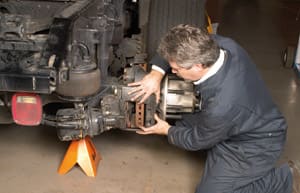
There's always activity in developing new brake friction material. But new legislation and new players are forcing the pace. (Photo by Bendix Spicer Foundation Brake)
Brake manufacturers are continually working with their friction material suppliers on new materials that satisfy the market's demand for noise, cost and wear with no compromise in performance. But there are also external pressures for change.
One is the upcoming stopping distance regulation due next year, says Gary Ganaway, Bendix Spicer Foundation Brake director of marketing and global development. That is pushing the development of different lining materials as well as the configuration of front axle brakes.
Another is new regulation, already enacted in Washington State with companion legislation pending in California and other states, that would limit the amount of copper used in brake linings.
Dissolved copper has been identified as a poison that affects Atlantic salmon, Chinook and Coho salmon and steelhead trout among other fish. Obviously any copper in brake friction material will be in the dust from automotive braking systems, so starting in 2014, these states are regulating the total amount that can be in friction materials.
Exactly how this will be enforced remains to be seen, but suppliers and retailers of friction materials are going to have to ensure that whatever they sell is compliant. It's not an issue for BSFB, says Ganaway. The company is already ahead of the phase-in of the copper limits.
New brake sizes
There's a lot of work going into brake friction, say the engineers and marketing staff at BSFB. One of the main drivers is the desire of trucking fleets to avoid additional weight on vehicles, especially on the front axle, which is already seeing increasing weight from new exhaust aftertreatment equipment. The new federal stopping distance requirements that go into effect in August of next year will mean trucks will need bigger brakes on the front axle. And bigger usually means heavier.
It is unlikely that the 15x4 brake will be able to do enough work, whatever friction materials are developed. It simply is not big enough, said Tom Runels, BSFB foundation drum brake engineering manager, in a recent conference call.
The National Highway Traffic Safety Administration stopping requirements have been in the works for nearly a decade. At first, the industry expected the air disc brake would have to be the answer. But the 16.5x5 drum has shown that a switch to discs is not necessarily the only way to go. Undoubtedly, though, those bigger brakes are heavier. So behind the scenes there has been work on a 15x5 S-cam brake with a friction material that can generate the torque to stop a truck in as little as 250 feet in the NHTSA test - or in reality 225 feet for a margin of safety.
Ken Kelley, vice president of Webb Wheel, in a press conference talking of the weight savings of his company's Vortex technology, said there was also in the works a possibility of a new standard for the rear brake. We could see 16.5x8 or even a 16.5x8.62, up from today's 16.5x7, for some additional torque at the drive axles.
There would be a minor penalty at the rear of maybe only 12 pounds per corner. Up front, though, the 69-pound 15x4 would rise to 97 pounds for a 16.5x5. Obviously a 15x5 would be somewhere in the middle.
The good news is that while the 15x5 brake is 25 percent wider, it also has 25 percent more wearable friction material, so should give a better service life.
Developing new friction materials is part of an ongoing process, said BSFB's Ganaway. So the research into a material that would offer the customer the best compromise in performance, wear, noise and cost on a new sized brake simply is part of the ongoing development activity and likely would not be borne by the customer in increased cost.
While the development of new drum brakes for the front axle goes on apace, the adoption of the air disc brake on the steer axle is also seeing an increase in activity. At the Mid-America Trucking Show, BSFB President Walt Frankiewicz said that despite the terrible truck market over the last several years, the production of the ADB22X has increased 50 percent. Not only are the truck OEMs offering the air disc brake option, but customers are stepping up to try them. In fact, at the same show, Peterbilt announced that its new Model 587 wide-cab aero model would have steer-axle disc brakes standard.
Wider availability and higher production should see efforts to contain costs. Frankiewicz said this would be the case with the adoption of a new rotor material for the rotors.
The new rotor formulation is currently available as BSFB Splined Disc rotors and will soon be available in conventional U-shaped configurations. These rotors are compatible with lightweight aluminum hubs for trucks, tractors, and trailers. Combining the ADB with an aluminum hub offers additional weight savings on the front axle.
Development of new materials for rotors, and designs that maintain the geometry of the disc as it heats up, lead to longer brake pad life, already a plus feature of the disc brake.
And pad replacement is much faster with the ADB, commented Frankiewicz, adding to the lifetime value proposition of the alternative brake.
Extreme Brake
A long-life alternative drum brake system is available from Express Brake International. The core of the technology is a no-core brake relining process that allows for new blocks to be attached to the shoes without removing the drums from the vehicle. It sounds improbable, but there is much to see at www.expressbrake.com/express-brake.asp, where the stainless-steel-tabled shoe and lining combination shows the bolted brake blocks. According to the company, the construction of the shoes ensures they retain original dimensions and don't need the reconditioning of a conventional shoe when it is relined.
The greater stability of the shoe and the fact that the lining has no fasteners through it means the friction material offers better contact and more surface area, says EBI. Accordingly, the lining has up to a 50 percent longer life than conventional riveted brake blocks. An additional benefit claimed for these linings is up to 9 percent better stopping.
The Extreme Brake, as the combination is called when used in combination with other EBI components, can reduce brake costs between 30 percent and 50 percent, says the company. The stainless steel of the shoe table also eliminates any possibility of rustjacking.
Rustjacking
While rustjacking - the corrosion at the interface between brake block and shoe table that lifts and separates the blocks - is still an industry problem, the original manufacturers and quality remanufacturers of heavy duty brake shoes have coatings that prevent this problem, says Carl Swanson, product manager, aftermarket heavy duty brakes development for BSFB. BSFB uses a proprietary e-coating system that prevents corrosion.
Early in 2010, ArvinMeritor introduced remanufactured brake shoes with its PlatinumShield coating, which it says provides superior protection against corrosion and rustjacking. According to the company this is a breakthrough technology that allows for a three-year, 300,000-mile warranty against rustjacking for the remanufactured Meritor shoes with the PlatinumShield coating. These shoes also are supplied to truck OEMs as well as being available in the aftermarket on ArvinMeritor and Fras-Le shoes. (Fras-Le is one of the world's biggest producers of brake components, particularly linings, shoes and pads, with its main production facility in Caxias do Sul, Brazil. The products are available through ArvinMeritor dealers through a joint marketing agreement.)
Will-fits, knock-offs and counterfeits
There is no regulation of brake linings in the aftermarket. To many fleets they are simply a commodity, so there are ample opportunities for offshore manufacturers to sell less-than-satisfactory products in the American aftermarket.
BSFB has been quite outspoken on the topic. It cautions that
More Maintenance

Color Match Smarter: Tools That Restore & Perform
For fleet managers and collision repair professionals keeping heavy-duty trucks on the road, getting the color right the first time isn't just about appearance — it's about efficiency, turnaround time, and bottom-line results. Discover how today's digital color tools are transforming the repair process from guesswork to precision.
Read More →
Wrong Repair Prompts Recall of Freightliner, Western Star 4x2 Trucks
DTNA is recalling more than 2,400 trucks that received an incompatible software fix instead of the hardware repair required to address brake valve corrosion.
Read More →
Truck Drivers Need More Than Another Alert
Fleets have more visibility into truck health, safety events, and driver activity than ever. The next challenge is turning all that information into useful guidance for the person who has to decide what to do next.
Read More →
The Maintenance Checks Trucking Fleets Should Prioritize Before Fall Freight Picks Up
Making it through August isn’t the same as being ready for the next several months of operation. Find out what systems may have suffered from summer heat and need to be checked out before fall.
Read More →
What Three Fleets Are Doing Differently When Buying Truck Parts in 2026
With freight improving but costs still climbing, fleet maintenance executives explain how they're balancing price, quality, and supplier relationships.
Read More →
Paccar Recalls 2027 Trucks Built This Summer for Possible Electrical Problem
The nearly 6,000 Kenworth and Peterbilt trucks in the recall could potentially lose engine power, among other things.
Read More →
Will API PC-12 Oil Change Trucking Fleet Maintenance?
The new API PC-12 heavy-duty engine oil category reflects the changing demands of modern diesel engines. But fleets like Foodliner are looking to getting their own data before making decisions on adopting the new oils and questions such as extending oil drain intervals.
Read More →
Brake Safety Week to Focus on Drums and Rotors
Commercial vehicle inspectors are focusing on truck brakes during CVSA's Brake Safety Week, August 23-29.
Read More →Possible Battery-Cable Fires Prompt Recall of 15,000+ International MV and HV Trucks
On the recalled vehicles, manufacturing variations can cause the battery interconnect cable to contact the auxiliary stud and hold down the bracket.
Read More →
Rush, MCT Team Up to Grow Refrigeration Service Network
The joint venture will operate MCT's network of Carrier Transicold dealerships and mobile service locations, with the companies promising greater service capacity and uptime for refrigerated fleets.
Read More →