




Frequent Inspections Save Tires
It seems the best you can expect from many drivers is a quick visual check that the tire is where it should be. Whether or not it's capable of holding air is another matter.

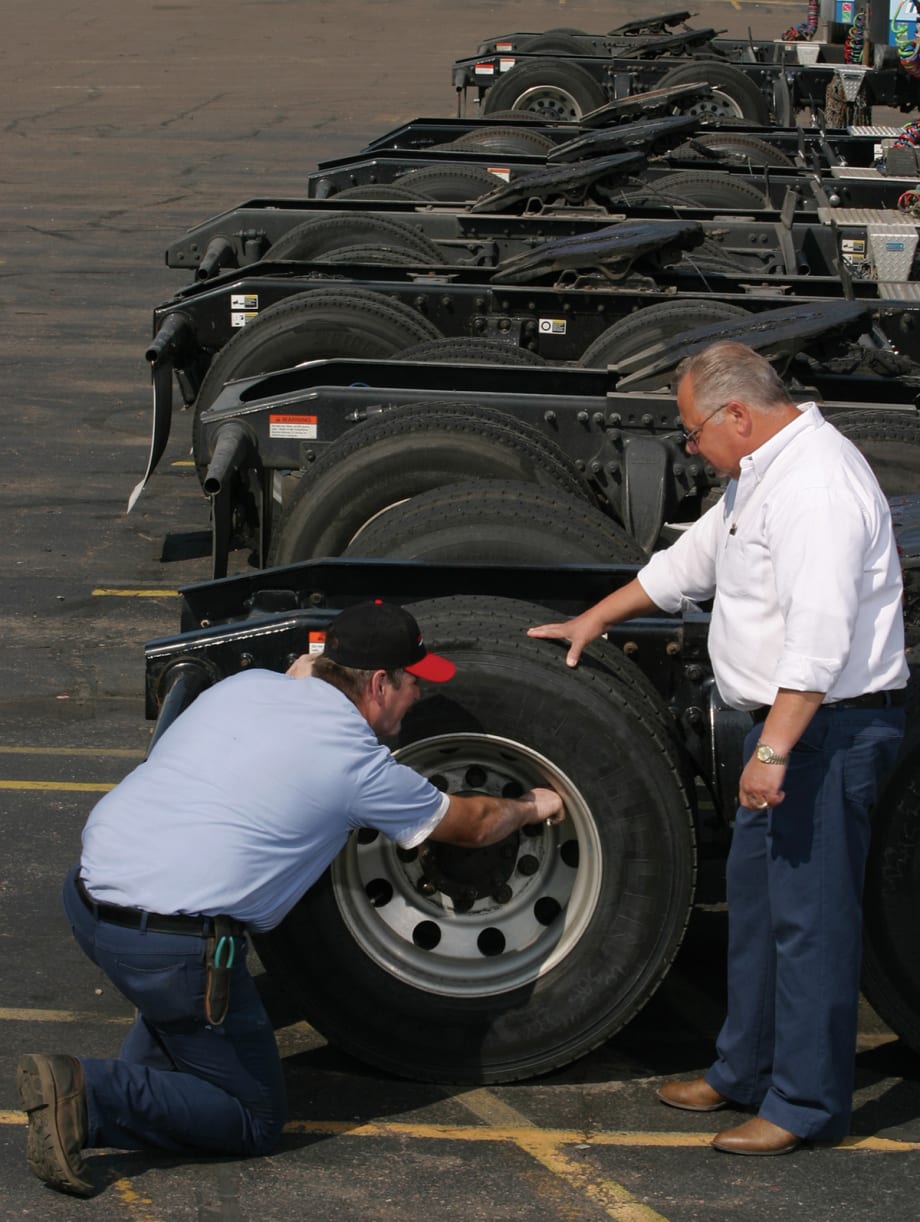
Frequent and thorough yard checks will catch problems your drivers miss.

You can't tell much about a tire simply by kicking it. Drivers would disagree, but you can't even tell with any degree of certainty how much air is in the tire. It seems the best you can expect from many drivers is a quick visual check that the tire is where it should be. Whether or not it's capable of holding air is another matter.
A lot of fleets depend on drivers for daily oversight of their tires, and that may be asking too much. Since thorough daily inspections are likely not being done, the task falls on the tire team or the outside contractor, and they have to be extra vigilant because they may not see a tire for months at a time.
"There's too much at stake to assume the tire is in good condition," says Jeff Lecklider, president of Gem City Tire of Dayton, Ohio. "We approach tire inspection both from a safety perspective and a tire management perspective. We want to minimize tire failures, obviously, but we don't want anyone getting hurt either by a tire that has been damaged internally by running underinflated."
Inflation pressure is the obvious first inspection point. If any serious time has elapsed since it was last checked, chances are it will be low. Is it sufficient to simply air it up again?
"When we come across an underinflated tire, we'll first inspect it for damage or signs that it has been run under-inflated," Lecklider says. A plug in a tire means they dismount the tire and inspect it more closely.
Lecklider looks for signs of the tire being run hot or flat sometime in its life.
"You can see discoloration when it has been run hot or overloaded while low on pressure," he says. "In severe cases you'll see some bulges caused by separation between the tread and the casing, or you might feel irregularities in the surface of the sidewall, or soft spots and bulges."

The Technology and Maintenance Council of the American Trucking Associations' Recommended Practice for tire repairs, RP 206B, advises that any tire that has been run at less than 80% of its normal operating pressure (not its maximum inflation pressure) could have permanent structural damage. It should be carefully inspected before it is repaired or placed back in service.
Assuming the tire is in good physical condition and has not been run flat, the next check is for damage and irregular wear.
Doug Jones, customer engineering support manager at Michelin Americas Truck Tires, says irregular tread wear can shorten life tire dramatically, but spotted early, it can often be slowed or stopped by repositioning or remounting the tire.
"Depending on the type of wear, detecting it early and removing the tire from that wheel position can usually save the tire," he says. "Then you have to correct the source of the problem before installing another tire. Otherwise, that new tire is likely to suffer the same fate."
Mechanically induced irregular wear will usually start to show up on a tire within a couple of weeks of mounting, so don't simply send a new tire back into the wild; make a point of getting the tire back to the shop for another inspection within a short time.
Lecklider says the final step is measuring the tread depth and recording it for later comparison.
"When we're doing a maintenance inspection, we'll measure the tread at two or three spots around the tire to get a better picture of the overall condition of the tire," says Lecklider. "We're obviously concerned with maintaining the tires in safe condition, but we're also looking to establish wear rates so we can predict service life, and for irregularities in wear that could indicate other mechanical problems with the truck."
Tread depth should be measured at two or three spots around the circumference of the tread to get an average number. The DOT will usually measure tread depth at the lowest spot on a tire because they are looking for violations of the federal minimums.
Patches and Repairs
It's not uncommon to repair tire punctures, but Lecklider pays special attention to a repaired tire -- especially tires that have been plugged rather than properly repaired.
"When we see a plug in a tire, we know it's been run soft or run flat. The problem for us is we don't know for how long, and what kind of internal damage running it underinflated may have caused to the tire," he says.
Guy Walenga, director of engineering for commercial products and technologies at Bridgestone, says the prescribed procedures for repairing punctures do more than just keep the air from leaking out.
"When something has gone through the tread surface, it has damaged the rubber as well as the steel cords in the tire. You have to remove the damaged material and then fill the void with a properly prepared insert to protect the internal structure of the tire," he says. "Once you allow moisture to penetrate the casing, you risk further damage to the cords through wicking. You have to remove enough material from around the wound so that you remove any trace of moisture around the steel, and then apply a proper patch to the inside of the casing to seal the wound."
TMC's RP 206B outlines proper puncture repair procedures. They are too complex to be described here.

With the cost of a tire today, a $50 nail-hole repair is a very cost effective alternative to scrapping a damaged tire. But Lecklider cautions that scrimping on a tire repair -- like simply just jamming a plug into the hole -- can hasten the demise of the tire due to rust incursion through the steel cords.
"We recommend any tire with a puncture be removed and inspected as soon as possible, and not repaired even temporarily with a plug," he says. "A small puncture is a cheap and easy fix, but you can ruin an expensive tire in no time by ignoring what happens after a puncture occurs."
Retreaders do very thorough casing inspections before retreading a tire, and they find improperly repaired tires all the time. They often scrap the casing because the internal damage has progressed beyond the point where it can be repaired.
If you're not inspecting your tires on a weekly basis, how are you going to know what condition the tires are really in? If you come across a tire that is under-inflated, don't just re-inflate it. Inspect it first for damage and improper repairs.
A low tire, or a tire that won't hold pressure, is a time bomb. An inexpensive -- and proper -- repair can save a lot of money and grief in the long run.
More Drivers

Trump Administration Looks to Put More Veterans Behind the Wheel
The Freedom Haulers program pulls together existing and expanded programs at several federal agencies to recruit veterans to drive commercial heavy-duty trucks and cut the red tape for them to get a CDL, training, and employment.
Read More →
Putting Mack’s Command Steer to the Test
A test drive of Mack’s Command Steer active steering system evaluates how it can make truck driving easier and less tiring.
Read More →
Competition Heating Up for Truck Drivers
New report reveals rising driver hiring costs, the return of sign-on bonuses, growing AI advantages, and the operational factors shaping driver retention.
Read More →
How Fraley & Schilling Improved Logbook Compliance by Over 50%
Fraley & Schilling needed a way to close a compliance workflow gap in its ELD system without adding more work from driver training, reminders, and back-office follow-ups. It found the answer in a custom driver app.
Read More →
Volvo Goes Gaming
Volvo has roared into American Truck Simulator with two new flagship trucks.
Read More →
What the Best Fleets to Drive For Teach About Driver Retention
Survey fatigue, AI-powered routing, owner-operator expectations, and the decline of social media all emerged as themes from this year's Best Fleets to Drive For program.
Read More →
Driver Retention Lessons From the Best Fleets to Drive For
What separates trucking's best workplaces from the rest? Jane Jazrawy shares the biggest lessons from this year's Best Fleets to Drive For program on driver retention, communication, AI, and workforce trends on the HDT Talks Trucking podcast.
Read More →
Farewell, CDL: Why I'm Giving Up My Commercial Driver's License
After more than 20 years as a CDL holder, HDT Executive Editor Jack Roberts is letting his commercial license expire. Not because he wants to — but because trucking's nuclear verdict crisis has made the risks of public-road test drives too great for editors, manufacturers, and everyone involved.
Read More →
How Top Trucking Fleets Improve Driver Retention [Video]
What do healthy snacks, optimized routing, and just picking up the phone have in common? They're all strategies the Best Fleets to Drive For are using to retain truck drivers.
Read More →
Trucker Path Adds Verisk CargoNet Theft Data to Navigation Platform
Trucker Path’s new cargo theft risk overlays give drivers and fleets visibility into high-risk areas, stolen commodity trends, and theft hotspots.
Read More →